


Thrills Remembered
Shrieks and thrills are all part of the exhilarating experience of an amusement park. Getting away for a brief diversion from daily life is what these spine-tingling destinations are all about. Louisvillians have been enjoying these delightful escapes for more than 100 years. While Kentucky Kingdom’s ‘Lightning Run’ and ‘Wind Chaser’ are some of today’s exciting rides, ‘Shoot the Chutes’ and the ‘Comet’ were just as much fun in the early 1900s.
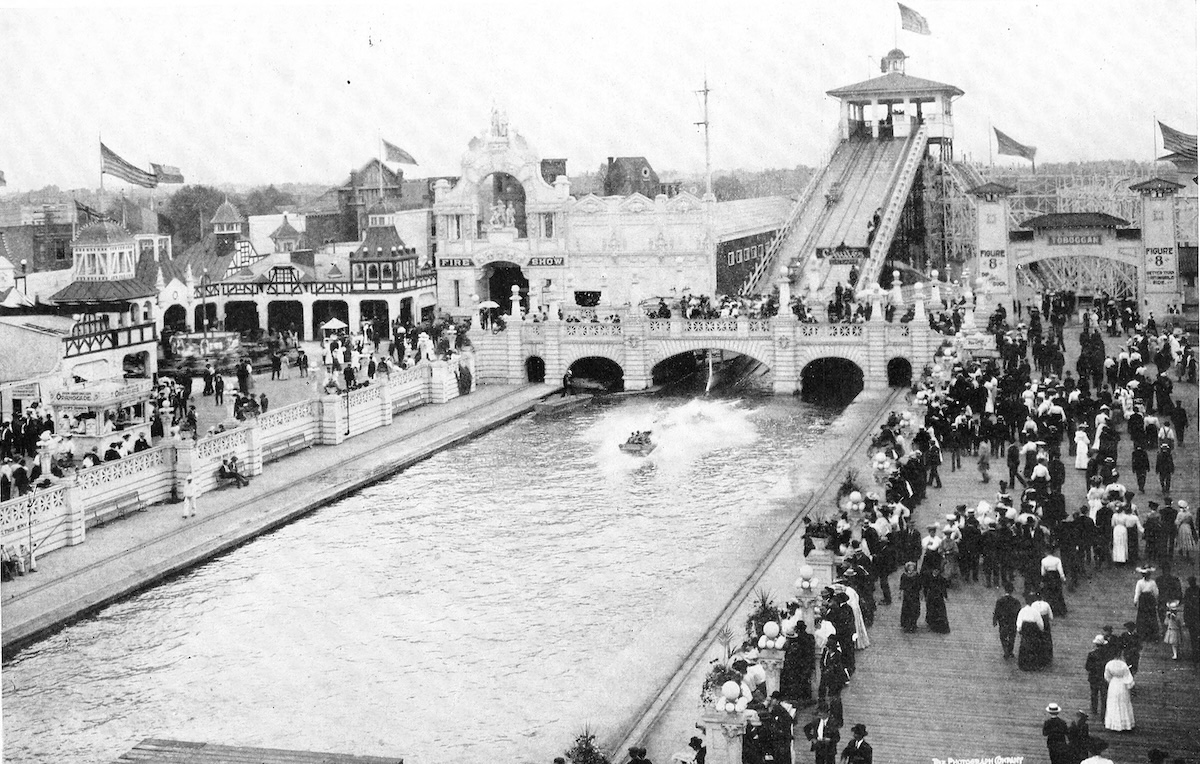
On April 27, 1907, the “White City” amusement park opened on 14 acres at the western end of Greenwood Avenue, adjacent to the Ohio River. Promoted as the “Coney Island of the South,” its attractions included the ‘Canal of Venice’ boats, a scenic railroad, a vaudeville stage and a bathing beach. The highlight was the ‘Shoot the Chutes,’ which had thrill-seekers sitting in a boat. This boat was then pulled up a steep ramp by a cable and released, plunging the screaming passengers into the lagoon below. It is not known if there were any restraining devices for the riders or how drenched they were afterward, but it definitely was a white-knuckle E-ticket trip.
Louisville’s ‘White City’ was based on Chicago’s 1893 World’s Fair Exposition, which was nicknamed the ‘White City.’ Like Chicago, Louisville’s White City had whitewashed structures that were lit by 250,000 lights. Throughout the nation, there were at least 27 additional White City amusement parks.
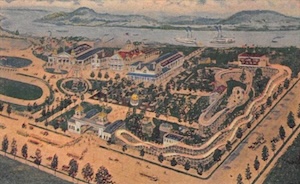
Just north of White City was an even grander and more famous amusement park: Fontaine Ferry. Named for Aaron Fontaine, who operated a ferry at the western terminus of Fontaine Ferry Road (now known as Market Street), Louisvillians have mispronounced the family name ever since as FOUNtian Ferry. It opened in 1905 by Hopkins Amusements of St. Louis. John Miller, who was responsible for planning the acclaimed Palisades Park in New Jersey, designed it.
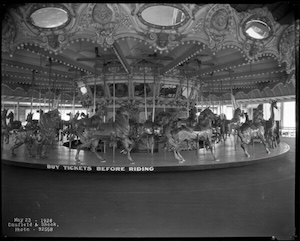
Fontaine Ferry had more than 50 rides and attractions on 64 acres. A wooden roller coaster, roller-skating rink, an extremely large swimming pool, a Ferris wheel, a carousel and, in later years, a go-kart turnpike were some of the enticing attendance-getters. Besides these features, the park also had live entertainment by national celebrities such as trumpeter Louis Armstrong, the Tommy Dorsey Orchestra, the John Philip Sousa Band, dancer Fred Astaire, vaudeville humorist Will Rogers, actress Mary Pickford and singer Frank Sinatra, among many others.
No visit was complete without a trip to ‘Hilarity Hall,’ an enclosed pavilion containing several feat-defying challenges like tumbling inside the rotating ‘Barrel of Fun,’ zooming down a steep slide on a burlap sack or spinning uncontrollably within a wooden bowl. Sam and Sue, two oversized jovial mannequins, greeted the daring guests.
Located next to the Ohio River, the 1937 flood inundated the grounds, causing the park to miss that season, but it reopened in 1938. However, during this racially segregated Jim Crow period, Fontaine Ferry prohibited minorities from admittance until after the Civil Rights Act of 1964 was enacted.
Across the Ohio River in New Albany was a similar festive location that was more of a sports park than amusement. Glenwood Park, started in 1903, was located near the intersection of Spring and Beharrell streets. While it did have a carousel and miniature railroad, there were more athletic activities like baseball and football fields, tennis courts, fishing and swimming in nearby Silver Creek, as well as a theater and dance hall. A large Chautauqua tent offered educational displays and presentations.
For a more extended leisure pursuit, Rose Island upriver in Southern Indiana near Charlestown was the place to relax. David Rose, a Louisville printing company executive, purchased 118 acres of the former Fern Grove recreational camp in 1923. It wasn’t actually an “island” but a peninsula of land along Fourteen Mile Creek and the Ohio River. Rose built a hotel, swimming pool, golf course, zoo (with wolves, monkeys and a bear), restaurant and dance hall. He also had 22 summer cottages constructed. Rose Island did have a carousel, pony rides and canoeing, but it was more of a resort than an amusement park. It was an extremely popular getaway with 132,000 visitors in 1932.
Traveling to Rose Island was an adventure in itself. A steamboat trip from the downtown wharf up past Six Mile Island and Twelve Mile Island on the Ohio River provided heightened anticipation for the soon-to-be-enjoyed amenities.
And, in the early 1900s, when automobiles were not as prevalent, public transportation in the form of streetcars provided another fascinating ride as part of the amusement park experience. The streetcar lines ran westward along Market Street to arrive at Fontaine Ferry and along Broadway to access White City. For Glenwood Park, an even more enthralling trip was had on the interurban rail line that went over the Ohio River via the Big Four Bridge and then around to New Albany. The Louisville and Southern Indiana Traction Company owned Glenwood Park and thus benefitted in several ways from this unique logistical arrangement.
All four of these amusement parks were exceedingly popular, with crowds enjoying the summertime festivities. But within 50 years, they were mostly memories of a bygone era. So, what happened to these fun-filled retreats of yesteryear?
Rose Island succumbed to the devastation inflicted by the flood of 1937. Attendance had already been negatively impacted by the Great Depression. The property was acquired during World War II for the ammunition plant. Today, the property is a city park for Charlestown. There are a few reminders still visible such as the swimming pool, which has been infilled with gravel, display plaques illustrating its past glory and namesake Rose Island Road near Prospect.
Glenwood Park closed in 1935, prior to the flood. Its land was developed into a residential district with streets named Glenwood Court and Glenwood Park.
White City only lasted two years, from 1907 to 1909. Due to its much smaller size compared to its neighbor Fontaine Ferry (14 acres versus 64 acres), it couldn’t compete and struggled financially. It was sold in 1910 and renamed ‘Riverview Park.’ This successor met the same fate, closing prior to the 1913 season. A residential development was built there, with one of the streets named ‘Riverview Avenue.’
Fontaine Ferry had the longest run, 64 years, from 1905 to 1969. On opening day, May 4, 1969, vandals ransacked the park and robbed some of the staff and patrons. Fearing further damage, along with guests’ safety being compromised, management decided to immediately close it permanently. The park was sold and reopened as ‘Ghost Town on the River’ in 1972, but eventually closed after the 1975 season. The City of Louisville purchased the property in 1981. The Fontaine Estates neighborhood was built in the late 1990s along with the Shawnee Sports Complex. Only the concrete foundations for the Comet roller coaster may still be visible as remnants of this fondly remembered vibrant location.
Louisvillians today can get their excitement locally at Kentucky Kingdom, located at the Fairgrounds, or drive two hours north on I-71 to Kings Island, or travel to Holiday World, which is just over an hour west on I-64. But ‘Shoot the Chutes’ and the wooden roller coasters of 100 years ago elicited just as many shrieks and thrills.
Steve Wiser is a local historian, author and architect.














At last, I finally understood the confusion of Fontaine Ferry & Fountain Ferry & never, ever knew about “White City”. A grand article because of the history of all of the nearby amusements & Fontaine would be the only remembrance for me (b. 1946). However, my grandmother was born in the 1880’s & have heard her mention the interurban stop places for areas in the southwest part of the county, along Dixie Highway. She was totally dependent on those stops for shopping purposes after her divorce from my grandfather (until then, they both lived in/around today’s West end & shopping was easier). She found a place to live near the current Mike Linnig’s Restaurant, but facing Johnsontown Road. But she mentioned that the interurban she caught was at Dixie & Johnsontown Rd. & that had a given name for that stop & other stops made on Dixie Hwy., (other than the street names of the stops). Was there a spelling error in your piece regarding Foun-tain & not tian? Couldn’t make it to the Filson to find out, so thought it may be interesting to see if stops made by the interurban had grandeur names.
I would like to see a follow up of Fontaine Ferry Park area. Not only as grade schools and high schools have field trips to Fontaine Ferry, as young adults they also visited Gypsy Village. There are many memories of first dates at Gypsy Village. Love to see an article on Gypsy.
It was always Fontaines Ferry and the Fontaines Ferry Park, but people must have just started calling it Fountain Ferry out of habit and easier to pronounce.
Fun times at Hilarity Hall and as an adult fun times at Gypsy Village. One of my first dates with my husband was there.