

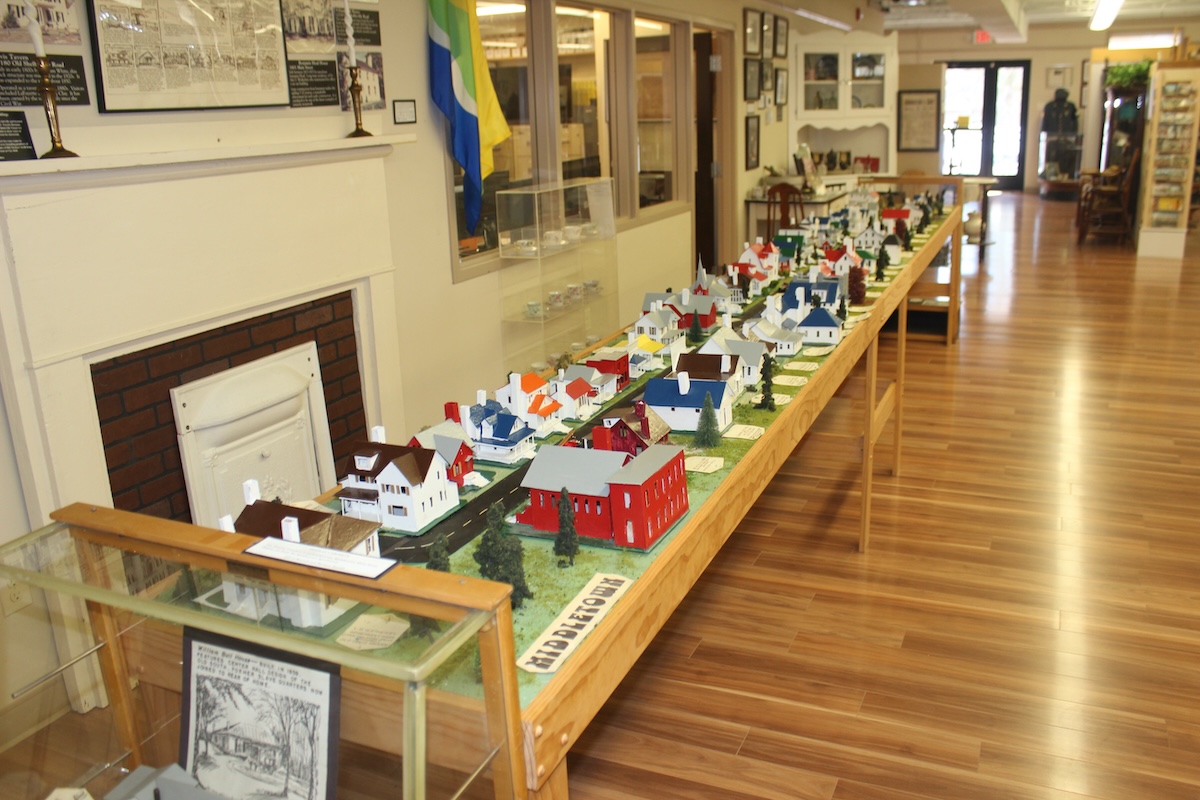
History Preserved
“Indian attack!” was an alarming scream in the late 1700s in what is now the Middletown community. While pioneers and Native Americans had brutal conflicts to protect their territory here in Jefferson County, the Revolutionary War was underway as the colonists fought the British. With America celebrating her 250th birthday this year, these life-and-death battles are relegated to the pages of history. However, if you want to time travel and really touch what it was like to live in this 1776 era, there is no better place to experience the past today than at the Middletown Museum.
Located at 11700 Main St. in Middletown, the museum is best accessed from the rear off Madison Avenue, where there is a convenient parking lot near the entrance vestibule. The museum is actually part of the former United Methodist Church. This quaint repository of local artifacts and memorabilia has a dedicated staff of volunteers who are extremely knowledgeable of the facts and events that have occurred here over the last 250-plus years.
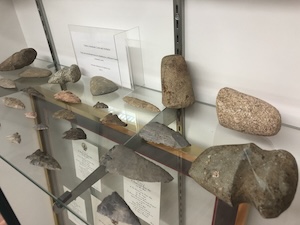
Arrowheads crafted by the Native Americans who inhabited this once-rural landscape are in an exhibit and are a tangible reminder of their presence here. A recent acquisition to this collection is a “smoothing stone” that was donated by the Letita Knoeller estate. It was possibly used for cleaning animal skins.
Nearby, in another arrowhead display case, is a graphic map that illustrates the infamous “Chenoweth Massacre.” This terrifying incident took place on July 17, 1789, at the Chenoweth family homestead. As the map pinpoints, a sturdy stone springhouse still exists at this conflict location, which is now part of a stone quarry complex on Avoca Road, off Old Henry Road.
Shawnee warriors killed two adults as well as two of the three Chenoweth children. Their mother, Margaret “Peggy” Chenoweth, was wounded by an arrow in the shoulder and “played dead” while she was scalped. Her husband, Richard, was able to repel the attackers from inside this fortified springhouse. Peggy did survive and wore a skullcap to conceal her bald head.
After viewing these arrowheads and map, look up! Sitting on top of this display case is a large-scale model of Thomas Jefferson. This figurine is from the legendary “Louisville Clock” sculpture by acclaimed local sculptor Barney Bright. This model was a preliminary mock-up that Barney used in creating his famous artwork in 1976, which was the 200th-year celebration of America. The “Clock” was originally located downtown on Fourth Street but was relocated several times and is now in storage.
Smaller “Clock” figurines are also at the museum. Donated by a Middletown resident, they are in the previously noted arrowhead display case with the smoothing stone. Besides Jefferson, other models include Daniel Boone, King Louis XVI and several others.
Thomas Jefferson was not only an integral part of the American Revolution 250 years ago, but he is also the namesake of our county. He was governor of Virginia when Revolutionary Gen. George Rogers Clark founded the town of Louisville in 1780. As most know, our city’s French namesake funded the Revolution.
Another recent acquisition is a bell, but not just any bell. While this bell is not as large or as famous as the patriotic symbol Liberty Bell in Philadelphia, it has a very historic relationship to Middletown. This bell originally hung in the tower of the former United Methodist Church, which houses the museum. Over time, it was removed and, through various transactions, transported to Tennessee, near Knoxville, where volunteers from the museum were able to retrieve it and bring it back home. The bell is now on display at the front entranceway.
On the bell is listed its manufacturer: “Kaye & Bro; Louisville, Ky.” The William Kaye Bell Company was a very prominent brass foundry and bell maker. Products included bells for churches, such as the Cathedral of the Assumption where they still toll today, schools, courthouses, steamboats and even fire alarms. The city firehouses also had Kaye bells that rang out during fires.
William Kaye, who started this company in 1841, has a very fascinating history himself. Born in Yorkshire, England, in 1813, his family immigrated to America, finally residing in Pittsburgh, where he was trained as a machinist.
Kaye most likely traveled by steamboat down the Ohio River to find his permanent home here in Louisville. Besides operating a successful business, Kaye found time to serve as mayor of Louisville from 1863 to 1865 during the Civil War period. He issued an official proclamation for a day of observance after Confederate Gen. Lee’s surrender. Kaye (pronounced “Coy”) was also elected to City Council several times, with one term being president of the council. To further add to his busy schedule, he was appointed chief of police for one year.
Kaye passed away in 1890 and is buried in Cave Hill Cemetery. His company lasted until 1895 when it closed. His obituary noted that Kaye bells are found in many cities throughout the United States. Thus, when you visit the Middletown Museum, be sure to rub your hand across this artifact of American history.
In the back of the museum, a beautiful handmade quilt is laid out that contains symbols memorializing the heroes of the 9/11 terrorist attacks. It was crafted by Ms. Dora Waggoner of Campbellsville, Kentucky, in 2021 on the 20th anniversary of that solemn national tragedy.
Besides exhibits, on March 19, 2025, the museum became an officially designated affiliate of the “FamilySearch” library system. With this digital connection, anyone can use the computer at the museum to conduct genealogy research, including Ancestry.com (World version). This is an invaluable resource, along with the museum’s extensive collection of archival material. If you are seeking ancestral records, this would be a great place to start your search. Another important resource is free access to Newspapers.com (U.S. version).
The museum is managed by the Historic Middletown Inc. organization and is a 501(c)(3) nonprofit. Volunteers are always welcome, and admission is free. Hours of operation are Wednesday, Thursday and Friday from 10 a.m. to 2 p.m.; Saturday from 1-4 p.m.; and closed Sunday and Monday.
Steve Wiser, FAIA, is a Louisville historian, author and architect.