

Honoring Heroes
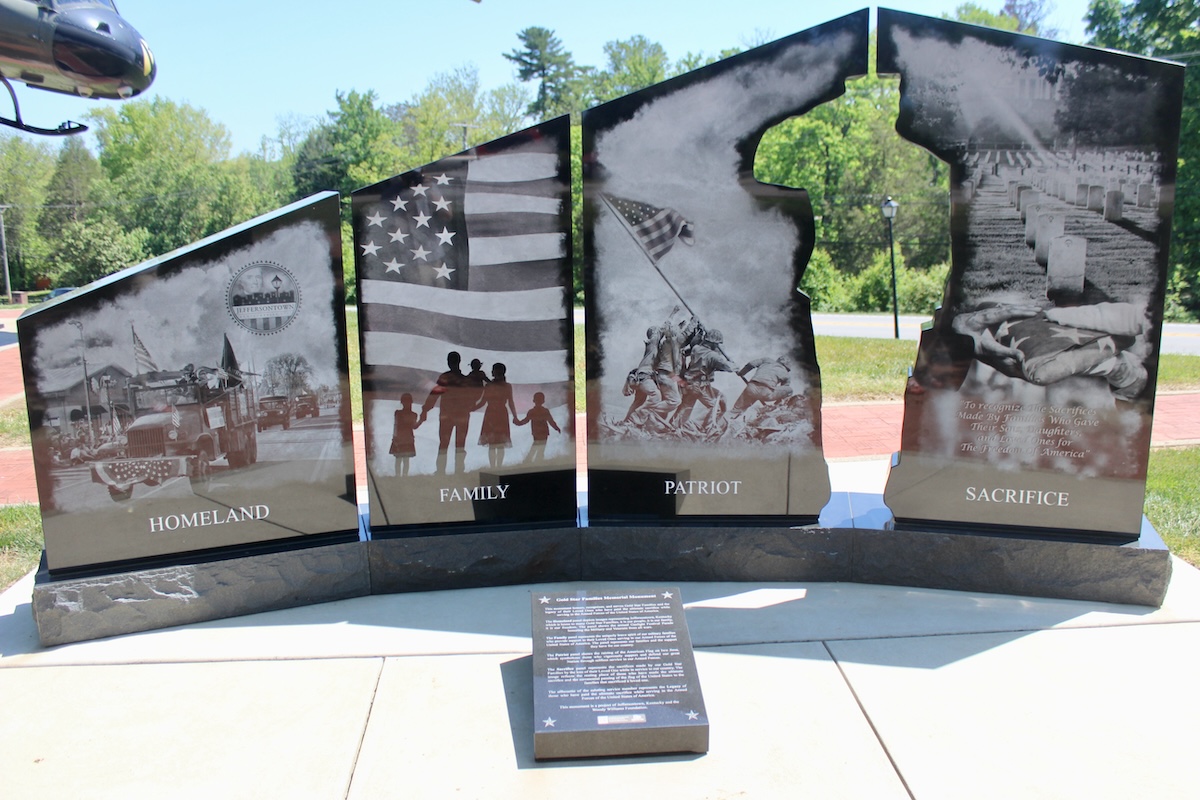
To celebrate the 250 years of freedom that United States military veterans have provided us, the Jeffersontown Historical Museum has created an exhibit to pay tribute to our local veterans and the immense sacrifices they have made to ensure that freedom. The display, created with help from Jeffersontown’s American Legion G.I. Post #244 and Greg Bunnell, includes artifacts from the Revolutionary War era through more modern times, highlighting some interesting facts you may not have known about our hometown heroes.
For example — were you aware that Maj. Robert Anderson, the commander of Fort Sumter, was the son of Col. Richard Clough Anderson, whose rebuilt home, Soldier’s Retreat, stands just off Hurstbourne Parkway? At the time Richard Anderson came to the area, Indian attacks were still occurring, and it was to his home that Peggy Chenoweth and other survivors of the Chenoweth Run massacre in Middletown were taken for safety while recovering from their very serious wounds.
Many of Jeffersontown’s earliest settlers were Revolutionary War veterans and/or served in various militias up through the War of 1812. The Jeffersontown Museum currently has on display the Kentucky Long Rifle of Windle Miller, who lived in the Billtown Road area in the early 1800s. Philip Winand, buried in the old German Reformed Presbyterian Cemetery, was a member of Gen. George Washington’s mobile reserve troops, established in 1776 and known as the “Flying Camp.”
Although — thankfully — nothing major happened in Jeffersontown during the Civil War, there was an incident brought about by a visit from Confederate guerilla Sue Mundy and his cohorts to a tavern on the town square that ultimately led to the execution in Jeffersontown of four Confederate prisoners, two of whom are buried in the Jeffersontown Cemetery. On display with Ashley Davis’ Union cap and some small cannonballs is a genuine hardtack biscuit carried by McDonald Walters during the war.
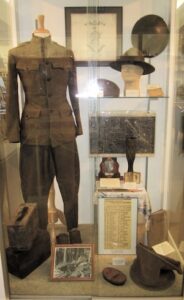
Our World War I exhibit includes a list from The Jeffersonian newspaper of the first draftees from Jefferson County, along with the uniform of William Henry Ohlmann. Uniforms of other local veterans from World War II to more modern times are on display throughout the museum, along with countless other items, from helmets to hygiene kits.
Some interesting artifacts include the coffin tag that accompanied the body of Earl Tarrence, a young seaman who was the first known casualty from Jeffersontown when the U.S.S. Houston was sunk in 1942, as well as the diving helmet of Senior Chief Bill Neal, who served in the U.S. Navy from 1958-1978. Also on display are uniforms of ordnance officer Franklin Chambers, who became mayor of Jeffersontown in the 1960s — we even have a charming photo of Chambers in uniform, taken at Tucker’s Lake.
One very special artifact on display is the Eisenhower jacket worn by Charles William Peers, who was judged to be “The Typical G.I. Joe” in a national contest held in 1944 by radio-show host Eddie Cantor. Out of more than 25,000 entries, Iris Peers’ letter about her husband won the couple $5,000, with which they bought a farm and later moved to S. Watterson Trail in our neighboring town of Fern Creek.
We have not forgotten our female veterans, either. World War II uniforms of Dr. Kathleen Drummond, a second lieutenant in the U.S. Marine Corps, are on display. She looked amazingly similar to recruitment posters of the same era.
Speaking of women — the museum also has a “Sweethearts” exhibit to honor the women who stood behind the men who fought so valiantly for our freedoms. Many a couple met at the various dances held in town — especially at Bowman Field, which, incidentally, once shared the same ZIP code as Jeffersontown. On exhibit is a gown made by Joanne Tanselle Taylor just for such dances.
And speaking of dancing — did you know that in 1942, Jeffersontown residents Ernie and Ada Grawemeyer founded the Union Barrack-ades, an all-volunteer entertainment troupe that put on shows for soldiers, both at home and overseas?
Troop morale was important, and the museum also has on display a field organ, which was used for worship services, and an accordion that belonged to Xavier “Bud” Singler. Singler and his friends hid his accordion and other musical instruments for fear of having them taken away, but when their commanding officer found out how they were entertaining themselves, he insisted on keeping the instruments in his jeep so they would always be available at a moment’s notice.
Of course, medical care was a must for soldiers. Dr. J.R. Shacklette, whose home/office still stands on the town square, and Aileen Lacy Bryan, a Red Cross nurse who was the granddaughter of one of Jeffersontown’s earliest doctors, both served overseas during World War I. Throughout World War II, Jeffersontown’s much-beloved Dr. John Bishop was asked to remain at home and serve county residents from Eastwood to Okolona.
Joseph Campbell stated, “A hero is someone who has given his or her life to something bigger than oneself.” Our freedom is perhaps the biggest gift we could ask for, and too many take it for granted. We hope the Jeffersontown Museum’s current exhibit conveys our gratitude for the selflessness and sacrifices of those who have served and continue to serve our country. Thank you.
The Jeffersontown Museum is located at 10635 Watterson Trail (in the back of the library) and is open Monday through Friday from 10 a.m. to 4 p.m. Admission is free.