

Revolutionary Roots
It’s not in any of the places you would think it would be — Philadelphia, Boston or Washington, D.C. One of the most “truly American” museums centering on the Revolutionary War era is in Louisville, Kentucky.
The National Society Sons of the American Revolution Education Center & Museum is located at 809 W. Main St. and has been undergoing a major renovation. It is a place where you can learn about our nation’s past, see artifacts used in daily life 250 years ago, and research your Patriot ancestor.
The National Society of the Sons of the American Revolution (NSSAR or SAR) was founded in 1889 and has since been headquartered in Louisville. A $30 million project, the expanded 10,000-square-foot SAR Education Center & Museum will highlight the ideals of our patriot ancestors and tell the story of the American Revolution on the world stage.
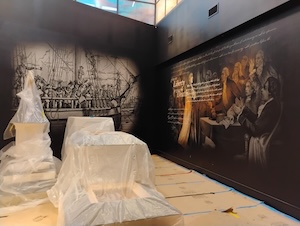
Planned in preparation for America’s 250th birthday, visitors will be able to tour two floors consisting of three galleries, 17 high-tech interactive exhibits and a theater that will bring the past to life. The SAR’s national Genealogical Research Library, located next to the museum, houses one of the nation’s premier genealogical libraries, containing more than 50,000 books featuring historical lineage from floor to ceiling.
“The project is being completed in phases,” says Rae Ann Sauer, director for education and outreach at NSSAR. “By late fall, the museum will be open to select groups and the grand opening will be in early 2027.”
She says the museum is set to be “an immersive experience, where visitors are taken back in time to the sights, sounds and smells of the American Revolution.” She pointed out that there will be many digital interactive elements, which will also be available online for members and the public around the country to use.
Sauer says that to date, more than $28 million has been raised for this project over several years, including funding for the SAR Genealogical Research Library. “$5 million of that money was a grant from the Commonwealth of Kentucky, while most of the rest was from private donors, most from out of state.”
Phil Bloyd, executive director for SAR, says the new museum and education center “represents a defining moment for the Sons of the American Revolution. We are incredibly fortunate to call Louisville home to this landmark institution, where the story of our nation’s founding will come to life for generations. This facility will significantly expand our capacity to deliver high-quality educational programming, engage broader audiences, and elevate the visibility of our mission across the country — ensuring that the ideals of the American Revolution continue to inform and inspire for years to come.”
The focus of the nonprofit SAR is to honor Revolutionary War patriot ancestors by promoting patriotism, serving communities, educating and inspiring future generations about the founding principles of our country, and constantly seeking ways to preserve this American history. SAR members are very active, volunteering countless hours a year in their local communities to carry out this mission.
NSSAR is a congressionally chartered organization and one of the largest male societies in the country. Any male 18 years or older — regardless of race, religion or ethnic background — who can prove blood lineal descent from a patriot of the American Revolution is eligible for membership in the SAR.
The SAR Genealogical Research Library is free for SAR members and $5 for the public. It is filled with resources for tracing family history, early American records and Revolutionary War connections. You’ll find family histories, state records and archives, along with online databases.
A plus to having the library and museum in Louisville is that “many Revolutionary War museums are on the East Coast in cities such as Philadelphia or Boston. Many families in the U.S. may not be able to make it to those locations. However, Louisville is within a day’s driving distance of over half the country’s population, making it much more accessible to the average family,” Sauer says.
The crowning glory is that select premier 18th-century artifacts from the SAR collection will be on display to help tell the broader story of what life was like in 18th-century colonial America, she says. The basement has a climate-controlled room filled with artifacts from the American Revolution, including a signed document from 1776 by George Washington.
Zac Distel, SAR curator and director of collections, says approximately “10-20% of the collection will be on display at any given time. This is typical for museums, as a top priority is to preserve the collection for current and future generations. Artifacts will routinely be rotated to allow them to ‘rest,’ and so visitors will see something new each time they visit.”
Thanks to the generosity of SAR members from across the country, the vast majority of artifacts in the SAR’s collection have been donated, he says. “Such artifacts are evidence of the American Revolution and inform our understanding of those historical events.”
Close examination of each artifact leads us to “learn more about the people and events of the Revolution. What is this made of? How was it made? Who made it? When was it made? Where was it made?
Answering these questions about each artifact helps it tell the story of the American Revolution.”
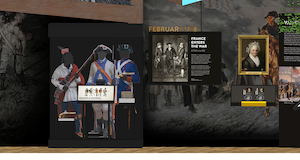
Even though it seems a daunting task to select a portion of the museum’s collection to be displayed, Distel says a curator’s most difficult task is perhaps to “decide what will not appear in an exhibit. Each artifact that will appear in the new museum will have been meticulously selected and considered for its condition, the story it tells, and its ability to engage visitors and spark their interest in the American Revolution. So, yes, this is a difficult task but one that the SAR is very glad to grapple with.”
Kentucky played an important role in the Revolutionary War. While the SAR collection is not specific to Kentucky, Distel says the society has a deep appreciation for the location of its museum and has worked hard to ensure it will tell the story of the Revolution in the West. For example, he says the SAR recently acquired a 1782 document signed by Daniel Boone that highlights the tumultuous months following the Battle of Blue Licks.
The location of the museum is equally important. The SAR National Headquarters is on the outskirts of Fort Nelson. This was a fort built in 1781 by troops under Gen. George Rogers Clark. It was the second onshore fort erected on the Ohio River in the area that is now downtown Louisville.
“Artifacts related to Fort Nelson are very scarce, but the SAR was able to acquire a voucher written and signed by George Rogers Clark at Fort Nelson. It is remarkable to look at a document that is nearly 250 years old and written less than 500 feet from headquarters!”
To add to the spirit of the era, a replica Liberty Bell will be featured in the museum, Sauer says. It is an exact replica of the original, made by Whitechapel Bell Foundry in England, the same company that made the original in Philadelphia. “The SAR wanted to take on this project to share its extensive collection of 18th-century documents and artifacts with the public.”
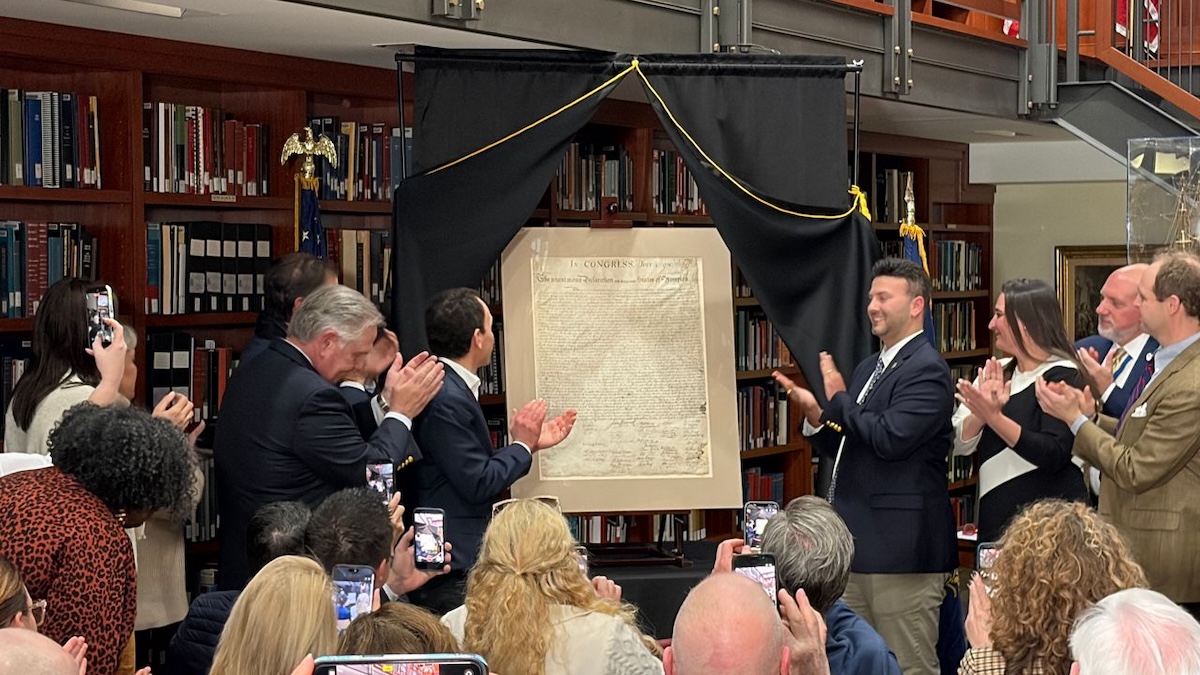
Through Labor Day weekend, visitors will be able to see a rare 1823 William Stone copy of the Declaration of Independence on display in the Craik Room of the SAR Genealogical Research Library. It is free to view in celebration of America’s 250th birthday.
For more information, call 502-589-1776 or visit sar.org/headquarters.