

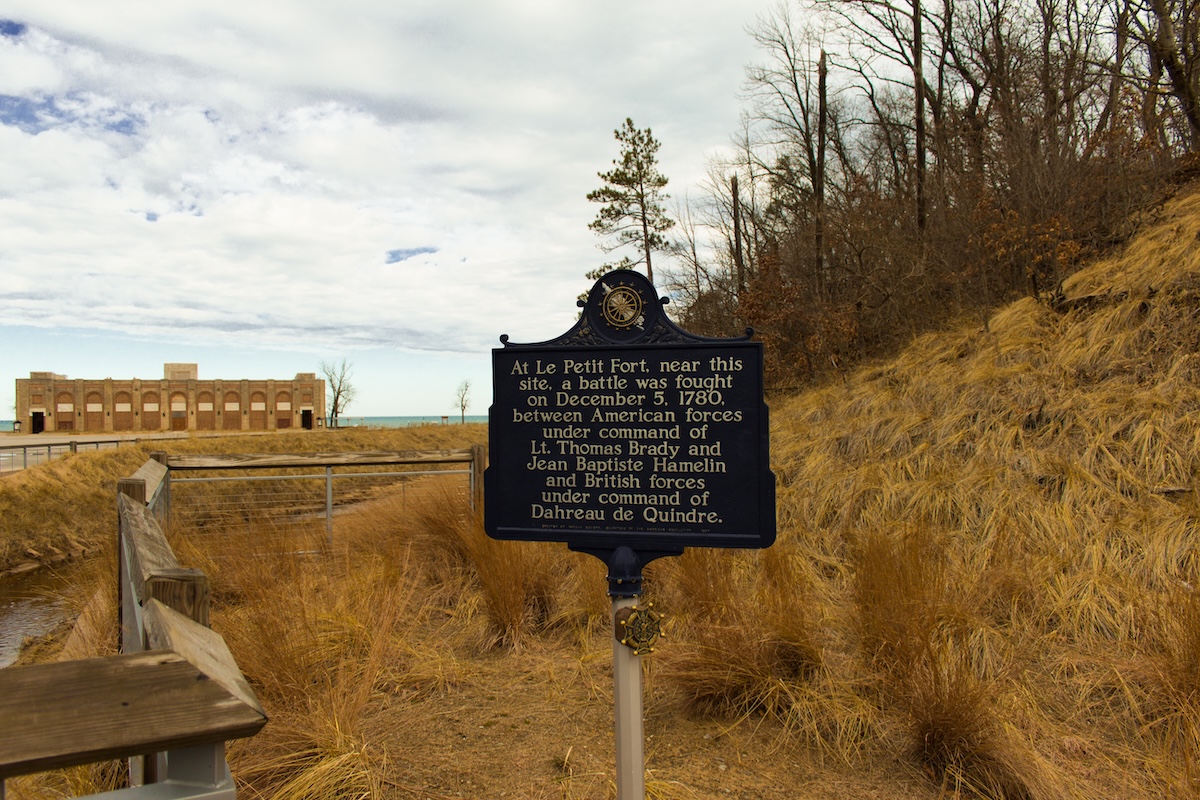
Hidden Revolution
It seems fitting, during this celebratory year of the 250th birthday of the United States of America — and in the month of July, no less — to take a brief look at what many in the Lakes readership area may be surprised to learn: Northwest Indiana was home to a Revolutionary War battle, albeit a small one.
The Battle of Petit Fort, sometimes also called the Battle of Trail Creek, was one of a handful of Revolutionary War battles fought in the Hoosier State between 1779 and 1786 (more on that later).
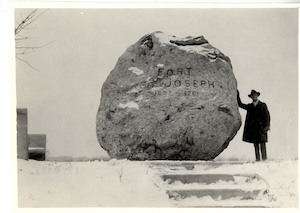
The story begins in the fall of 1780, when around 14 creoles — racially mixed men of French descent — departed the area of Cahokia, Illinois, toward Fort St. Joseph in present-day Niles, Michigan.
Indiana University Northwest professor Ken Schoon, in a 2024 presentation described in The Chicago Tribune, suggests that part of the impetus for the group’s enthusiasm had been the capture of the British fort at Vincennes, Indiana, by George Rogers Clark and a group of Virginians in February 1779.
“People in the Calumet region decided if they could do that, we can do the same thing,” Schoon told the audience.
Leading the party were Capt. Jean Baptiste Hamelin and Lt. Thomas Brady, acting under the order of French-born Revolutionary War patriot Augustin de La Balme.
Hamelin was a descendant of French fur traders and a French-Canadian member of the Ojibwa Tribe who supported America’s Revolutionary cause. He had served in Congress’s Own Regiment for some time, later joining Lt. Col. George Rogers Clark in Cahokia. Brady, meanwhile, was a Cahokia resident who first enlisted on the American side in 1777.
The group made their way up the Illinois and Kankakee rivers, recruiting additional members from frontier settlements until their band consisted of some 30 people. They stopped near today’s South Bend before continuing down the St. Joseph River to Fort St. Joseph.
That fort had played an important role in supporting pro-British Native American groups of the area, including the Potawatomi and Miami, and Brady’s group of Patriots carefully planned their raid of the fort to take place when the Native Americans would be away on a hunting trip.
The raid on Fort St. Joseph included plundering various supplies — especially trade furs — which they loaded onto pack horses for the return journey by way of the Sauk Trail, which ran through today’s Valparaiso and La Porte.
The raid ostensibly served more than one purpose. Besides its impact on Fort St. Joseph and the symbolic victory it may have demonstrated, small though it might be, it also was conceived by Augustin de La Balme as a distraction for British forces as La Balme made his way up the Wabash River for his ill-fated attack on Fort Detroit, which took place on Nov. 6, 1780.
The Detroit attack, which became known as “La Balme’s Defeat,” was put down by a Miami band led by Little Turtle, who would earn widespread fame for his command during the event and later play a key role in the Northwest Indian War.
Meanwhile, the Fort St. Joseph raid had attracted the attention of British Lt. Dagreaux Du Quindre, who quickly gathered a group of British loyalist traders and Potawatomi under Chief Anaquiba and his son, Topeneble. Their pursuit of Brady’s raiders ended at the sand dunes near Lake Michigan in the area of today’s Indiana Dunes State Park in Porter County.
The pursuit lasted for miles through the dunes before the raiders sought refuge at Petit Fort. The fort itself was located near the mouth of today’s Dunes Creek, then known as Fort Creek. Little is known today about it, but it has been speculated that it was more likely a private residence or trading post, or perhaps a support station for larger forts of the region. In fact, its name is likely not a proper one but a descriptive one.
“Petit” in French means “small.”
Petit Fort was actually under British dominion following the French and Indian War, though it’s unknown if the British ever used it, and it had been abandoned in 1779, the year before the Patriot raiders took up defensive positions within its walls on that fateful day, Dec. 5, 1780.
In a letter to Gen. Henry Watson Powell on Jan. 8, 1781, British Maj. Arent Schuyler De Peyster wrote of the incident:
“A Detachment from the Cahokias, consisting of sixteen men only, commanded by a half Indian named Jean Baptiste Hammelain, timed it so as to arrive at St. Joseph’s with Pack Horses, when the Indians were out on their first Hunt, an old Chief and his family excepted. They took the Traders Prisoners, and carried off all the goods, consisting of at least Fifty Bales, and took the Route of Chicagou.
“Lieut. Dagreaux Du Quindre, who I had stationed near St. Josephs, upon being informed of it, immediately assembled the Indians, and pursued them as far as the petite Fort, a days Journey beyond the Riviere Du Chemin where on the 5th December, he summoned them to surrender, on their refusing to do it he ordered the Indians to attack them. Without a loss of a man on his side, killed four, wounded two, and took seven Prisoners, the other Three escaped in the thick Wood. Three of the Prisoners were brought in here amongst whom is Brady a Superintendent of Indian affairs. The rest he suffered the Indians to take to M. Makina. I look upon these Gentry as Robbers and not Prisoners of war, having no commission, that I can learn, other than a verbal order from Mons. Trottier an Inhabitant of the Cahoes…”
It’s interesting to note that De Peyster considered the prisoners “robbers and not prisoners of war” since the raiders had no military commissions, though historians do consider the exercise and ensuing battle to be Revolutionary War events due to their attempted role in support of the Patriot military cause.
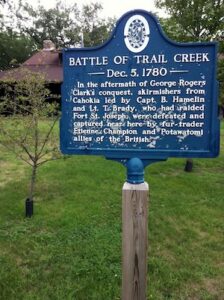
The exact site of the fort and battle remain a mystery, and in fact two historical markers tell the story of the event and its background: one at Indiana Dunes State Park and one at Krueger Memorial Park in Michigan City. Both locations claim to be the site of the battle. Some have speculated that the highest dune in the region, Mount Tom, was named after the raid’s leader, Thomas Brady, though conflicting accounts say it was named for a sailor named Tom who was buried at its peak.
As mentioned earlier, Petit Fort was not the only — and certainly not the most significant — Revolutionary War battle fought on what is today Hoosier soil.
Others include:
The Battle of the White River Forks in 1779, in which George Rogers Clark’s militia and Native Americans loyal to Britain clashed at the forks of the White River near Petersburg, Indiana.
La Balme’s Massacre in 1780, following the aforementioned La Balme attempt to capture Fort Detroit. He was killed by the Miami along the Eel River in northeast Indiana.
Lochry’s Defeat in 1781 involved members of a Pennsylvania militia under the command of Col. Archibald Lochry, who were defeated by British and Native American forces near the Ohio River’s junction with Laughery Creek.
Piankeshaw Village Skirmish in 1786 was a battle between Patriots and pro-British Native Americans near today’s Vincennes.
Of course, the 1779 victory of George Rogers Clark at Vincennes was quite significant and impactful enough that, during the peace talks that took place in France, Benjamin Franklin pressed for this region to become part of the United States because of Clark’s successful retaking of the British-held Fort Sackville, right here in Indiana.