

The Little-Known Hoosier Home of a Cultural Icon
 Lakes-area readers of an age to remember the earlier days of legendary public television art instructor Bob Ross might have been somewhat surprised at the stature he’s attained nowadays as a nearly ubiquitous, international celebrity, defining an era and a style.
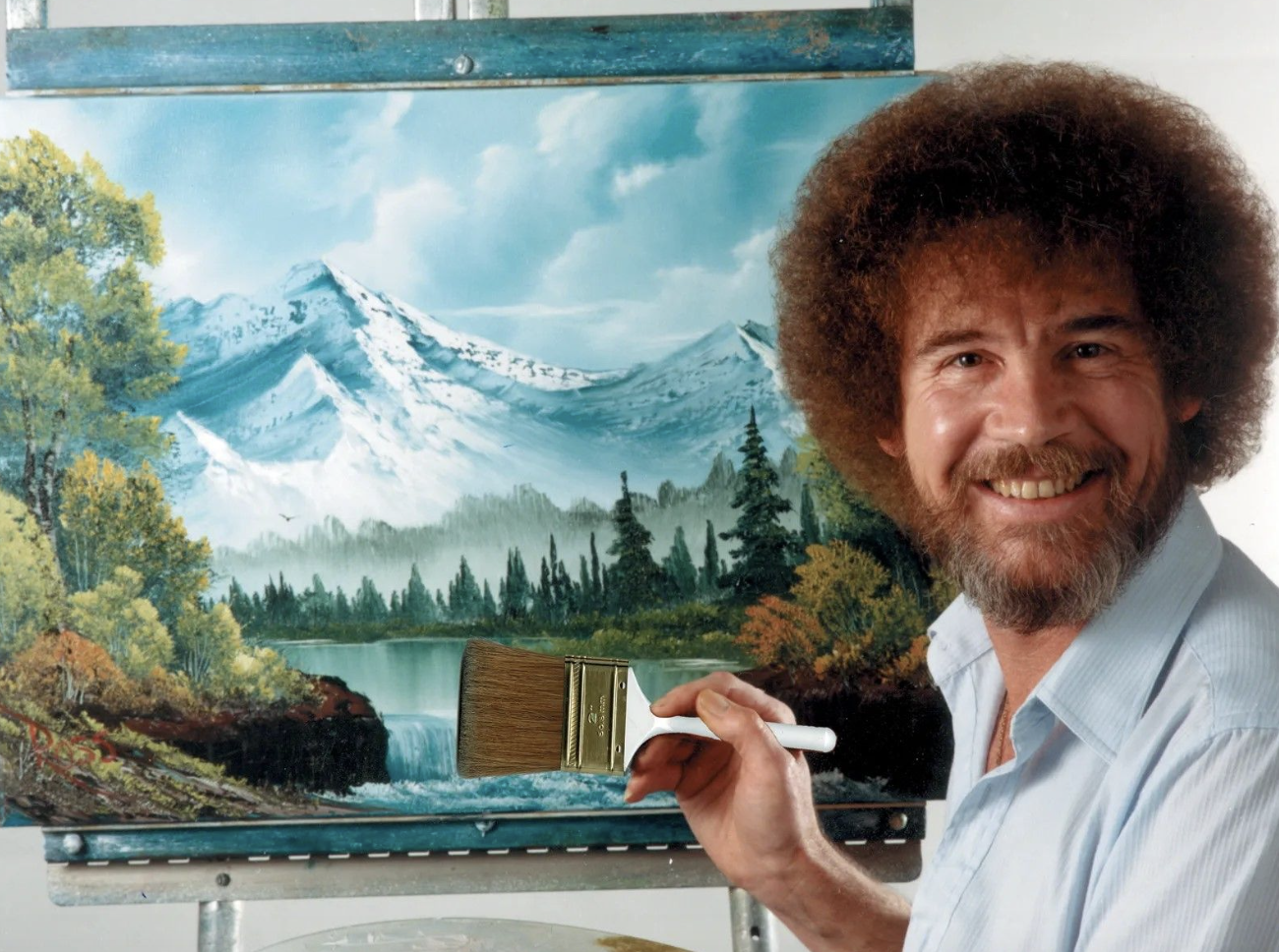
After all, his earlier television programs might be described as quaint: simple of production value, certainly not “high art,” — perhaps even kitsch — right down to his trademark perm-style hair; quiet, unassuming demeanor. His consistent themes of natural landscapes (dotted with “happy little trees,” as he famously dubbed them) and his speedy production of a painting from blank canvas to complete in less than his 30-minute time slot allotted, all of it punctuated by words of encouragement and affirmation for his viewers. A sort of Mr. Rogers of art as everyman therapy.
But it might surprise many to learn of his strong ties to Indiana — specifically just down the road in nearby Muncie, which most of us in these parts associate almost exclusively with Ball State University.
Even there, there’s a tie to Bob Ross, as the house that became ground zero for Ross’ early TV endeavors once belonged to Lucius L. Ball, one of the Ball brothers best known for making their fortunes in the canning jar industry, though their philanthropy, of course, also generated the university which bears their name.
So how did a worldwide cultural icon like Bob Ross wind up in the Hoosier State, which was not his home state (he hailed originally from the area of Daytona Beach, Florida)? The route was perhaps an unlikely one.
Born in 1942, Bob Ross had a love of nature from his youth, inspired partly by the love his mother, Ollie, had for animals. Ross completed only the 9th grade in school before dropping out to apprentice with his carpenter father, Jack, which is how part of one of Bob’s fingers was cut off.
At 18, young Bob Ross joined the Air Force, taking art lessons at a USO club on the base in Alaska at which he was stationed. He made money on the side painting landscapes on souvenir gold pans while his service continued. He retired as a master sergeant some 20 years later (it might further surprise readers to learn that Ross’s stint in the military involved his needing to yell and intimidate those under him in order to get jobs done, something he vowed not to do once he retired).
 Back in Florida, Ross was exposed to a painting technique which would prove critical to his future television project: the “wet-on-wet” approach involved applying wet paint to an already wet surface, creating soft edges and transitions, especially helpful in rendering natural landscapes like skies. It also helped facilitate a faster painting process, which would prove advantageous later for Ross.
Already having taught painting while in the Air Force, Ross worked as a tutor and traveling salesman once back in Florida, where one of his students pooled her and her husband’s money with that of Ross and his wife to start Ross’ company (his trademark permanent hairstyle — which Ross later admitted he’d never liked — was actually the result of cost-cutting efforts, though it would become permanent as part of the company’s logo).
A Virginia TV station recorded one of Ross’ painting lessons and aired it, prompting some 60 PBS affiliate stations to sign on to carry the show. That was 1982, and as fate would have it, in 1983 co-investor Annette Kowalski booked Ross on a national tour of painting workshops which included the Indiana town of Muncie. Ross and company’s purchase of advertisements on Muncie’s PBS station, WIPB, paid off: his workshop was sold out by the time Ross’ camper arrived in Muncie.
Ross felt a surge of kindred spirits alive in the Muncie community and he and Kowalski made arrangements for his show, The Joy of Painting, to be filmed at local PBS affiliate WIPB, which was situated in the aforementioned Lucius Ball house, made of yellow brick and located at what would become Muncie’s museum and cultural center, Minnetrista, which was founded by descendants of the Ball Brothers.
As described on its website at minnetrista.net, the facilities encompass a “spacious forty-acre campus and beautiful gardens, a nature area, a museum facility, a permanent museum collection and archive, historic homes, children’s play areas, and a portion of the White River Greenway.”
The facility hosts a “year-round roster of educational programs, engaging workshops, community events, and interactive exhibitions (and welcomes) tens of thousands of visitors each year and offer something new to experience on every visit,” according to the site.
From his first-floor studio, Ross quietly and gently took his TV audience through the process of creating a landscape painting marked by encouraging his viewers in (to quote the Minnetrista website again) “fearless creativity and life-affirming compassion.”
Ross, who did the show free of charge (making money instead from the sale of books, videos, and art supplies), taped each episode in Muncie even through his return move to Florida in 1989, the year after filming of The Joy of Painting had moved to a more modern filming space on the Ball State campus than the former farmhouse that became Minnetrista had been, though Ross admitted he missed the original space). Even after moving, he still made the trek to Muncie every three months to tape new episodes, an arrangement which continued until the show’s original run ended on May 17, 1994.
Ross, who painted an estimated 30,000 paintings during his lifetime, did not live long beyond the final episode of The Joy of Painting. He died on July 4, 1994, at just 52 years of age of lymphoma, which he kept a secret to most people outside his family and close circle of friends (he had, in fact, prepared paintings for a planned 32nd season of the show).
Somehow, his persona, technique, and memory, though, are timeless. In the decade that the show aired, a generation grew up watching the unlikely legend that was Ross, and an array of digital services have offered it in the years since, generating legions of fans.
According to an article on beltmag.com, “Bob Ross Was Here,” by Ashley Stimpson, the famous blue “X” on the floor of Ross’ art studio — marking where he should stand when creating paintings — somehow was left untouched long after his passing.
Writes Stimpson: “Every so often, George Buss, Minnetrista’s Vice President of Visitor Experience, would point it out to a guest. Their reactions always surprised him. ‘People would cry,’ he told me. ‘Lots of people would ask if they could stand on it.’ Betty Brewer, President and CEO of Minnetrista, experienced something similar when she mentioned the house in passing to some visitors from the Indiana Arts Commission on an abbreviated, after-hours tour. ‘Everyone freaked out,’ she recalled. ‘They couldn’t believe it.'”
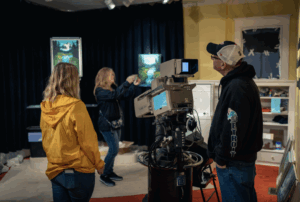
Such experiences led the staff to create a permanent museum experience including a “recreated WIPB-TV studio, a 1980s living room similar to those where so many welcomed Bob Ross into their homes, a gallery space designed for specially curated shows, and a workshop space designed to host Bob Ross Painting Workshops.
The exhibition is also home to many original artifacts from Bob’s career, including his easel, palette, and brushes,” writes the the Minnetrista website. Opened in the fall of 2020, “The Bob Ross Experience” in Muncie is the only museum in the world dedicated to Ross.
As Stimpson notes, the museum will not only serve fans of Ross worldwide, but Hoosiers in the Muncie area who remember him having a home there, volunteering with Habitat for Humanity, and assisting local fundraisers by donating his paintings (which are surprisingly rare on the art market, as he tended to keep them out of the commercial market, meaning many today are highly monetarily valued).
Bob Ross’ final television appearance was on the 1995 premiere episode of the children’s show, “The Adventures of Elmo and Friends.”
As the show closes, Ross’ final words for his audience, after offering them “just thanks,” were fittingly similar to the end of many of the episodes of his own show: “One day soon our paths may cross again. Until then, God bless, my friend.”