

Historic Samuel Culbertson Mansion B&B Tells the Story of Louisville’s Racing Era
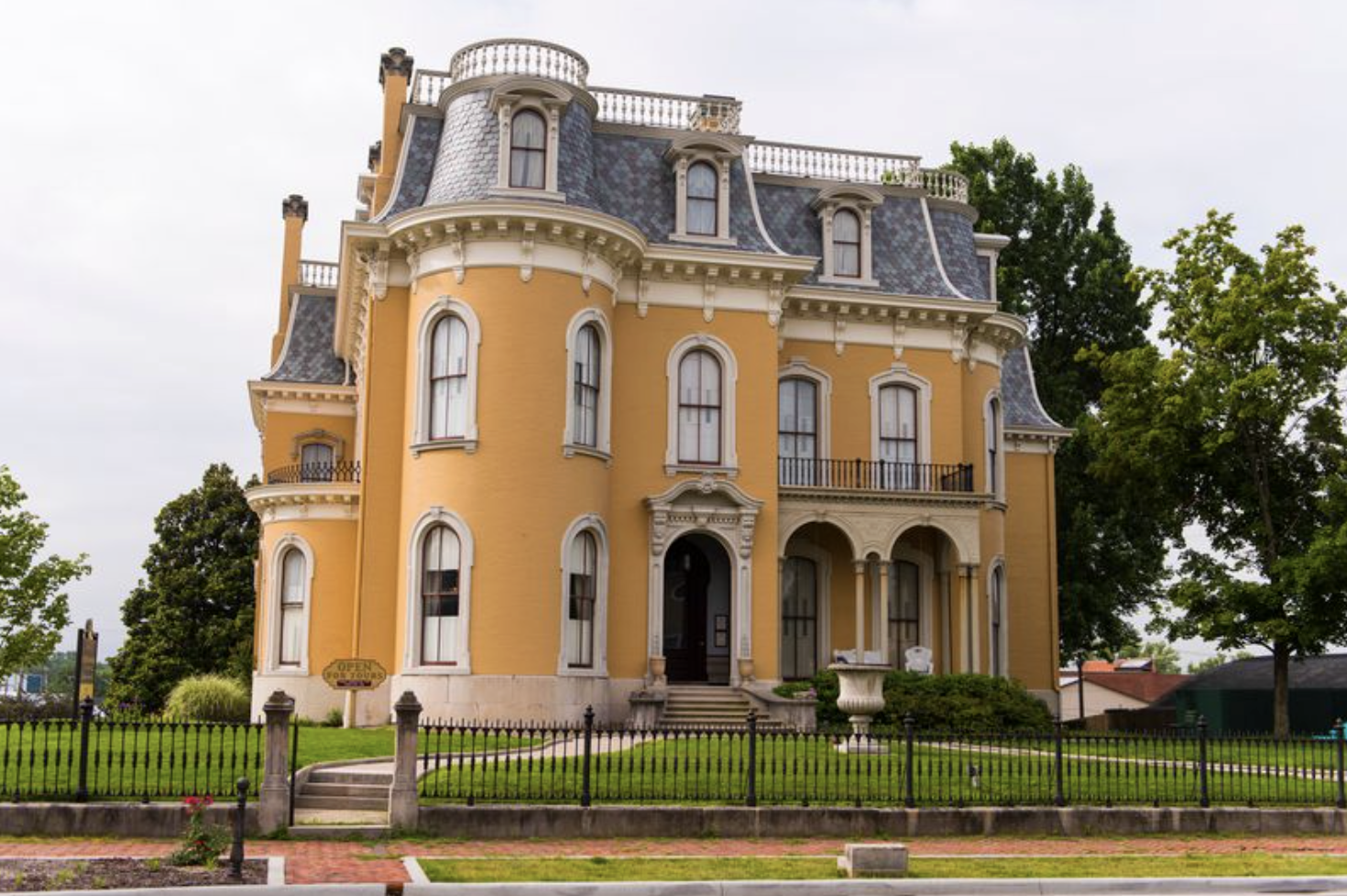
 Known as Louisville’s most historic bed-and-breakfast, the Samuel Culbertson Mansion B&B sits in the heart of Old Louisville’s National Historic District. Behind its doors, you’ll find splendor and opulence combined with casual Southern charm — a testament to the Culbertson family and their influence in the area.
Located at 1432 S. Third St. in Louisville, this impressive mansion was built in 1897 for Samuel Alexander Culbertson. The previous year, Samuel had purchased the land on Third Avenue, one of the most sought-after locations in Louisville.
Money was no object for William Stewart Culbertson (1814–1892), who built the home for his son, Samuel. William was Indiana’s wealthiest man and made his fortune through dry goods and the railroad before becoming a banking tycoon. Born in New Market, Pennsylvania, he went west in search of his fortune at age 21. William settled along the Ohio River in New Albany, Indiana. When he died in 1892, his estate was worth $3.5 million.
William’s home in New Albany still stands and is now a museum. Known as the Culbertson Mansion State Historic Site, “we tell the story of the Culbertson family and their philanthropy,” says Devin Payne, Southeast Regional Director of State Historic Sites. The French Empire-style mansion was built in 1867 and is where Samuel was raised.
The site interprets “the story of William and his family and the story of growth in Indiana in the mid-1880s,” Payne says.
The mansion is one of 12 historic sites in the state, which assumed ownership in 1976. The family was heavily involved in “great community works,” Payne adds.
Samuel’s family moved into the Indiana home when he was young. In 1886, Samuel and his wife, Louise, were gifted a wedding present by his father in the form of a mansion next door to his boyhood home. But Samuel was drawn to Old Louisville, across the river, because it was “popular and where the wealthy people went.”
 Samuel eventually settled in Kentucky with Louise, their two sons, and several servants. His mansion was built at a cost of $25,000 and designed by renowned Minneapolis architect William Channing Whitney. Other notable buildings he designed include the Minnesota Building at the Columbia Exposition World’s Fair of 1893.
The Louisville mansion was “one of two built by the architect outside of Minnesota,” says Jason Bam, current owner of the Louisville mansion and B&B. It is similar to the Minnesota Governor’s Residence, also built by Whitney. That home was originally constructed as a 20-room English Tudor for lumber businessman Horace Hills Irvine and his family.
Samuel’s home in Louisville was completed just in time to receive guests for the 23rd Kentucky Derby. For the next half-century, the iconic race became the focus of Samuel’s life, and his home on Third Avenue was the jewel of Millionaire’s Row.
Samuel loved horse racing, though his father was staunchly opposed to gambling.
“His father was very anti-horseracing,” Bam says. When William disowned another son for betting on the ponies, Samuel knew he must keep his passion hidden “until his father passed away.”
He went on to make a career out of it. After a brief stint in the U.S. Army, enlisting at nearly 60 years old as a private near the end of World War I, he served from 1919 to 1928 as a member of the board of directors for Churchill Downs. He became president of Churchill Downs and the American Turf Association in 1928 and chairman of the board from 1937 to 1948.
Samuel entertained dignitaries and international guests who came to witness “the fastest two minutes in sports.” Many thoroughbred champions graced Churchill Downs during this time, cementing its legacy — with Samuel’s hand in shaping its history, especially during the 1930s.
 It was Culbertson who conceived the idea and commissioned the symbolic Garland of Roses for the 1932 Kentucky Derby champion, Burgoo King. He and Louise, along with their home, became known for formal dinner parties and elegant dances in their ornate third-floor ballroom.
The Courier-Journal noted the Culbertsons in its Dec. 12, 1948 edition: “In former days, (the Culbertsons’) tallyho carriage, drawn by four high-stepping horses bound for the race track, provided a spectacle for pedestrians.”
Samuel’s sons, Craig and William, also found a bit of fame in the 1890s and 1900s. They and the mansion were immortalized in the popular “Little Colonel” book series, penned by Annie Fellows Johnston. Her novels were loosely based on real-life characters and events in Pewee Valley, Kentucky, then a fashionable summer retreat for Louisville’s elite.
The boys became known as Keith and Malcolm, “The Two Little Knights of Kentucky,” and were recurring characters in the 13-volume series. Today, the B&B features an elegant Knights of Kentucky Suite, once the brothers’ original room. It contains two large rooms — a parlor and bedroom — where guests can relax and connect with their story.
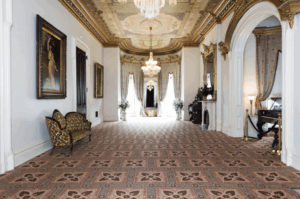
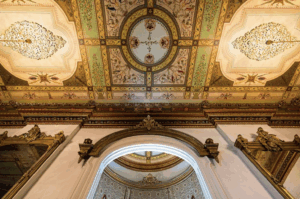
Overall, the mansion carries a Renaissance theme throughout, rich in woodwork detail with massive beamed or coved ceilings. The “ladies parlor,” or morning room, is in the style of Louis XVI, while the drawing room is reminiscent of an English manor. The B&B contains more than 50 rooms across 20,000 square feet of floor space.
Few original Culbertson furnishings remain, except for a dining table built specifically for the mansion out of Honduran mahogany, and a matching sideboard. A few wingback chairs also belonged to the family.
An additional 3,500 square feet is housed in the twin-spired, two-story carriage house at the rear of the property. The mansion and carriage house enclose a formal courtyard with a fountain and a rose garden containing more than 100 varieties — as elegant as in the Culbertsons’ day.
Samuel lived in the mansion for 51 years before passing away at age 86. He walked the 15 blocks to his downtown office until his death in 1948. Two years later, Benton Roberson purchased the mansion and converted much of it into 26 apartments during the 1950s and 1960s. Restoration efforts were completed between 1975 and 1985 by Rudy Van Meter, Tony Monks and Lois Lacefield, then-owners. Bam is the fourth owner, with a partner, since the Culbertsons sold it.
Guests from across the world now visit, Bam says, including travelers from Thailand and Australia. “In the U.S., there are not many historic buildings you can stay in of this caliber,” he adds.
Samuel’s boyhood home in New Albany is open for tours and hosts a Haunted House every Friday and Saturday in October at 7 p.m., as well as Haunted Happenings Tours. A Holiday Open House is held the first Saturday in December.
Samuel Culbertson will be remembered as a paragon of his era. He also contributed to the group that established the Louisville Park System and supported numerous philanthropic causes.
Col. Matt J. Winn — “Mr. Kentucky Derby,” who promoted the Derby worldwide — referred to Samuel in his 1944 autobiography “Down the Stretch” as “the Beau Brummell of Louisville.”