

Rooted Art
Most have heard of the bonsai plant, but more likely than not, they have a skewed version of its history and the practice that comes with it. Perhaps you think the plant is just decorative or you’ve only seen it in movies, but enthusiasts believe it’s so much more.
Russ Stevens, president of the Greater Louisville Bonsai Society, can explain.
“Nomads from the Arabian Peninsula would travel with spices and began growing these plants in containers. China adopted the practice of ‘training trees’ or penjing, but it wasn’t until after World War II in the 1950s that the Japanese really took what China was doing and have since redefined the practices that we use today,” Stevens says.
Today, bonsai plants are associated with mindfulness and meditation, artistic expression, environmental awareness, community and connection.
Even though the Louisville Bonsai Society was founded more than 50 years ago, Stevens says the U.S. is still behind when it comes to bonsai, with interest only spreading over the past 75 years or so.
“Our primary goal in the society is to increase awareness for bonsai and to educate any individual interested in how to be successful in growing and developing their plants,” Stevens says.
The word bonsai simply means “grown in a container,” and while the stereotype might put one image in our minds, there are actually hundreds of variations.
Some are outdoor only; others are outdoor in the summer and need to come inside during the winter. Some grow in the ground; others are considered tropical and can’t tolerate frost.
In the beginning, plant enthusiasts are simply learning how to keep their bonsai alive.
“We are able to accelerate their growth by using specialty soil and other things, but the design and styling of a bonsai come many years down the road, when the tree or plant is around five to eight years old,” Stevens says. “There has to be enough branches to use some and remove some to create the art.”
Stevens teaches classes at a local nursery in Louisville and says it’s all according to what you’re looking for. Some customers want to start at the very beginning; others want to start with a mature tree, ready for design.
To purchase a tree that “looks good” can be costly, considering the time and money that went into it. Stevens says there’s a list of guidelines one uses to create and design and that they determine the artistic value of the plant.
“One of the guidelines talks about tapering; leaving a larger bottom and skinnier as it gets taller. Foliage placement is very important as well,” Stevens says.
Those interested in learning more can attend a monthly meeting of the Greater Louisville Bonsai Society at the Waterfront Botanical Gardens. There is an overview with general information, a directed discussion or workshop based on the season and a ‘beginner’s corner’ for those looking for first steps.
“We cater to all interest and knowledge levels. Bonsai is a regional thing. If it’s within three hours of you, that’s considered close, so we have around 80 members in 2026, but some of them live in neighboring states, so each meeting has around 25 people in attendance,” Stevens says.
For bonsai enthusiasts, becoming a member for $35 per year can be worth the distance. A monthly newsletter is published. That specialty soil needed for bonsai growth is for sale at the beginning of the year through the society. In addition, special events are promoted through the membership.
One of those special events is the upcoming Bonsai Festival, May 29-31, at the Waterfront Botanical Gardens.
In its fourth year, Stevens says the event continues to grow.
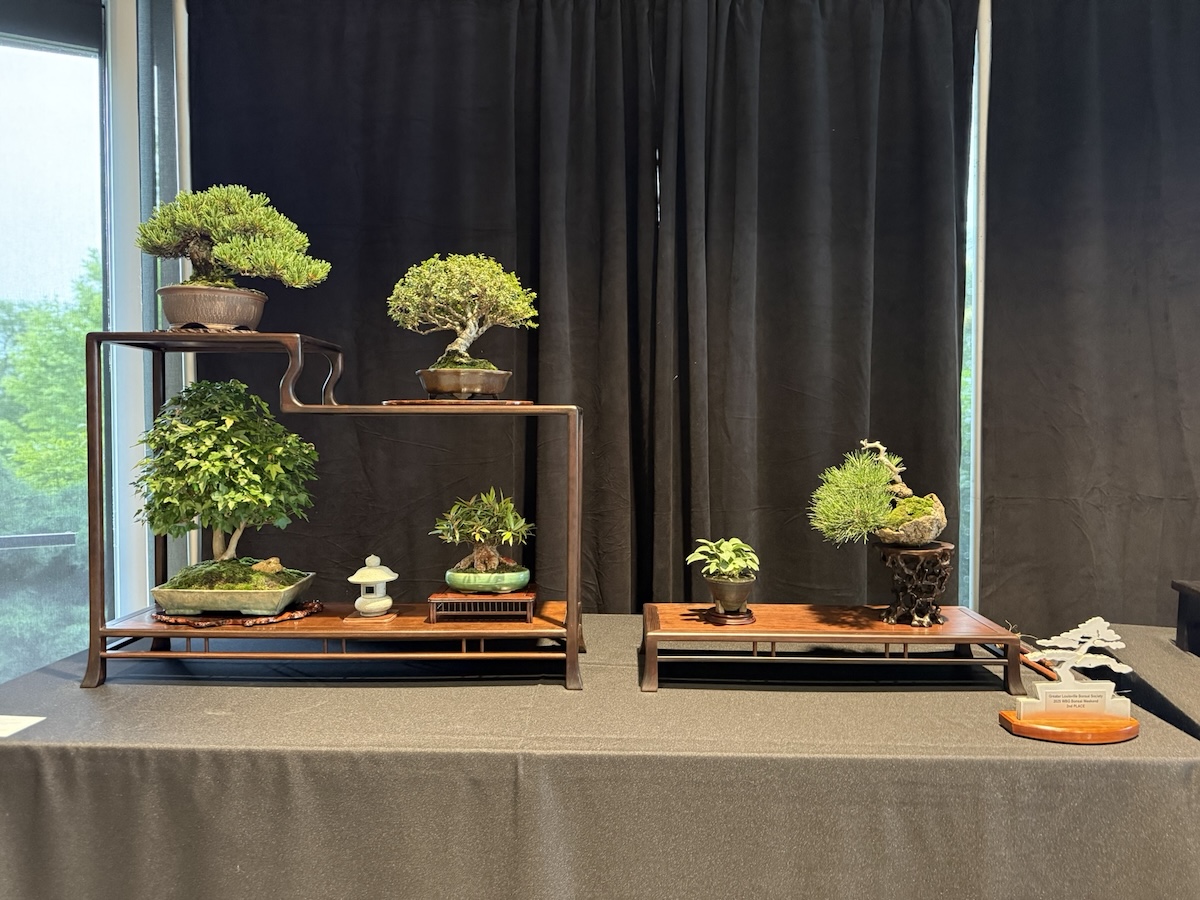
A committee is currently approving or declining trees submitted by members of the society to exhibit in the show, and Jennifer Price, professional guest artist, will be on hand to judge the 45 to 50 regional bonsai on display.
“We’ll have demonstrations and workshops throughout the weekend. We’re working with the Japanese-American Society of Kentucky, and we’ll have a tea ceremony and performances by Southern Indiana Taiko Drummers. We want to have some cultural events going on concurrently with the show,” Stevens says.
Food trucks will be on-site, a vendor marketplace will feature all things bonsai and, new this year, the Kentucky Koi and Goldfish Society will be on hand.
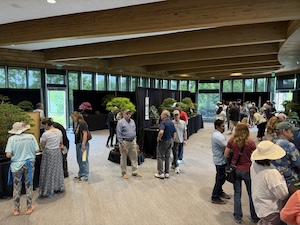
“We will continue to add something new each year,” Stevens says. “We hope to have a bonsai festival but also to honor the culture that brings us bonsai.”
Outside the annual festival, the bonsai society will continue educating and spreading the word about the joy and camaraderie they find surrounding the practice.
In 2027, the Waterfront Botanical Gardens is slated to open a bonsai garden — a project led by the bonsai society.
It’s part of the garden’s $22 million project, a Japanese garden including a Japanese tea house, a waterfall, lake, stream and bonsai garden designed by Shiro Nakane, designer.
“Construction will start in the spring, and we hope to have it finished and open by the spring of 2027,” Stevens says. “This will be a world-class bonsai garden with at least 50 trees on display year-round. We’ve got that number in our collection now, and we’ve hired a curator to begin taking on more trees. We’d like to have around 150 trees total to switch out based on the season throughout the year.”
Bonsai Weekend will be 11 a.m. to 5 p.m. May 29 and 30 and 11 a.m. to 4 p.m. May 31. Tickets are $10 for Bonsai Society members, $12 if purchased in advance or $15 at the door. Youth 16 and under are free. For more information, visit waterfrontgardens.org/bonsai/.