

Urban Revival
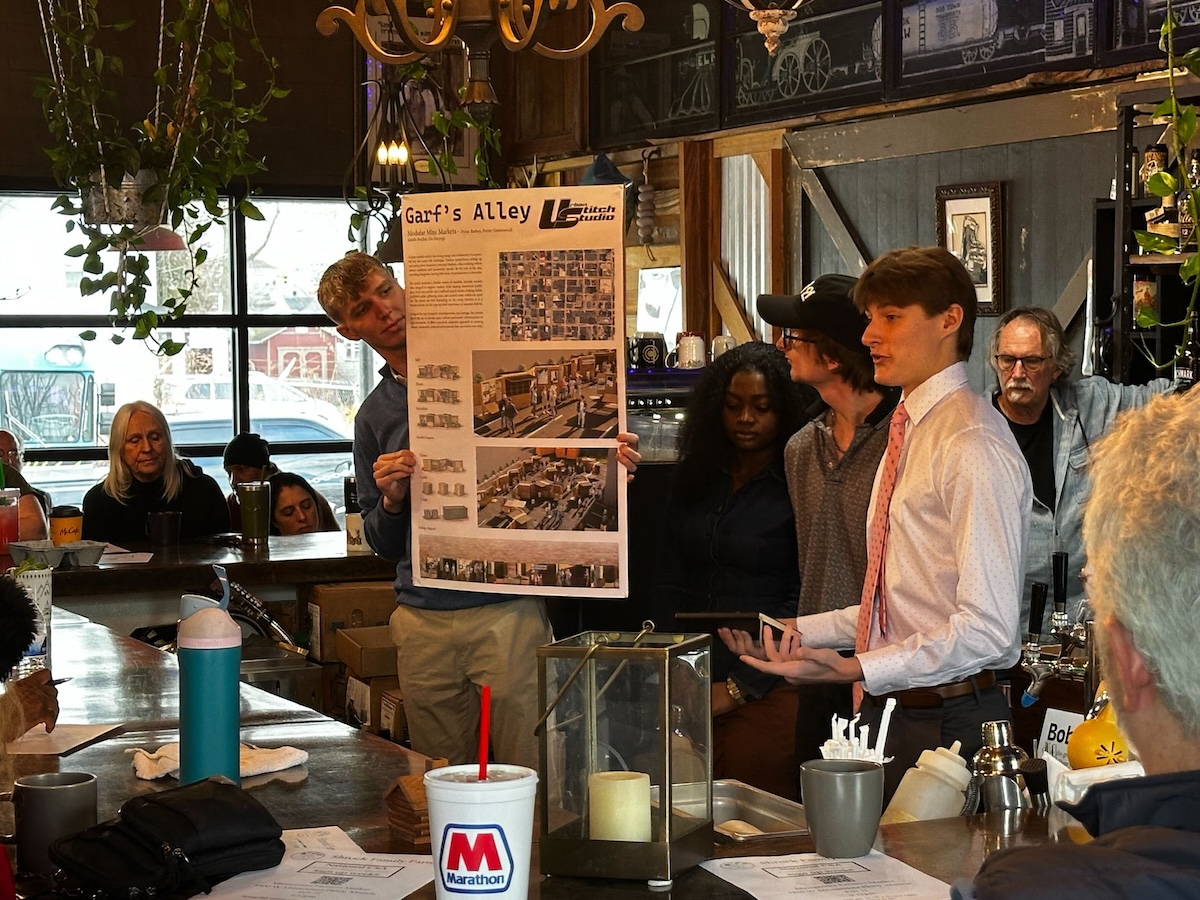
Inspired by the success of Dave’s Alley, third-year Ball State architecture students are designing ways to revitalize downtown Muncie. The student-led initiative focuses on alleyway activations, banner reuse, platforms, public art and pedestrian access corridors.
The Ball State University Estopinal College of Architecture and Planning, located on Walnut Street in downtown Muncie, is Ball State’s extension and hub for urban design and planning. The students utilize downtown as a living laboratory for immersive learning, design exploration and collaborative projects.

The informal names of each alley activation pay homage to Muncie legends. The students focused on boosting tourism, connecting the community through art and attracting Ball State students to downtown Muncie.
“We’re actively stitching the urban fabric of downtown Muncie with Ball State University,” Ball State architecture student Dylan Barkey says.
Bob’s Alley, named after painting legend Bob Ross, is located near Roho’s Martini Bar and features a view of the Canan Commons stage. Bob’s Alley includes an elevated alleyway platform and revolving local art exhibit.
Emily’s Alley pays homage to Emily Kimbrough, a New York Times bestselling author, and is located between Carnegie Library and the AT&T building. The project will include new benches in Dave’s Alley and a revamped mural on Walnut Street.
Garf’s Alley, named after the beloved lasagna-loving cat Garfield and the world’s most widely syndicated cartoon, is located between the Delaware County Historical Society and Washington Square. The project will include a real rose mural and steel installation.
The students are also creating a mobile stage and mobile vendor market. The mobile stage repurposes the platform formerly used for Muncie Gras and other downtown events.
“This year with Urban Stitch Studio reminded me why design matters,” Ball State architecture student Peyton Griffith says. “Through our elevated art gallery project in downtown Muncie, I saw firsthand how a single idea can transform a forgotten alleyway into a space that inspires, connects and energizes a community. Design has the power to shape the world around us, and Muncie showed me that people are ready for it.”
Kevin Klinger, Ball State associate professor of architecture, said the students have shown tremendous leadership by being active as students and citizens in downtown Muncie.
“We recognized early that Muncie is not a laboratory, but rather a vibrant and engaged community. Our studio projects aim to work and learn together to craft and create projects that better advance the community’s goals for quality places and spaces in the heart of downtown,” Klinger says.
Ball State architecture student Keaton Lewellen said the studio class has been his most influential college experience.
“I think it’s so important to get students out into the real world and working with real people who make a direct impact on their cities,” Lewellen says. “The opportunity to do that alongside real individuals in their fields gave me a confidence I have not found before.”
The students collaborated with local business owners and city officials, including Dan Ridenour, Bill Lett, owner of Elm Street Brewing Company, Derrick McNelly, owner of Record Parlor of Muncie, and Cheryl Crowder, events director of the Muncie Downtown Development Partnership.
Crowder said she has been excited to see the projects materialize downtown.
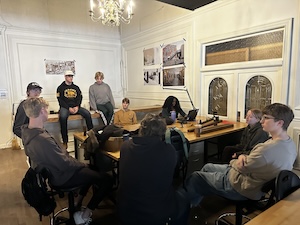
“It has been so energizing to see the students dig deep into what are the missing pieces or opportunities for downtown,” Crowder says. “It has been awesome watching them search for answers. Each of the projects is thoughtful and creative and offers a new perspective on third space downtown.”
Crowder said the students are living up to their Urban Stitch Studio name by stitching together repurposed downtown banners. The students will update the murals on Walnut Street near Canan Commons with vintage signage.
“The DWNTWN banners have been sitting in our storage unit for a minute collecting dust — dozens of them,” Crowder says. “I could never bring myself to get rid of them because I always felt that they deserved another life after their season.”
The Ball State students involved in the Urban Stitch Studio class include Donna Momoh, Wilma Vergavist, Ian Fairbairn, Evelyn Fielbrandt, Jesus Rodriguez Ortiz, Ashley Rogers, Devon Wilson, Keaton Lewellen, Peyton Griffith, Gio Mayorga, Cody Adkins, Dylan Barkey, Isabelle Bradley and Porter Greenwood.
For more information, including a release date for the students’ upcoming documentary, follow @urbanstitchBSU on Instagram.
For more information on the Ball State University Estopinal College of Architecture and Planning, visit bsu.edu.