

Local Organization Turns Surplus Food Into Community Support
Feed Louisville is an organization with a twofold mission. While alleviating hunger in the community, the nonprofit fights food waste. Working with community partners such as restaurants, caterers, bakeries, farms, grocery stores and food distributors, it transforms surplus food into hundreds of healthy meals. The meals, made in the Feed Louisville commissary kitchen, plus rescued pantry staples, are picked up or delivered to agencies and programs such as women’s shelters, temporary housing facilities, street outreaches and smaller pantries.
 According to Rhona Bowles Kamar, executive director and founder, up to 40% of food produced goes to waste in the United States, yet 16% of Kentuckians don’t know where their next meal is coming from. Since it began, Feed Louisville has prepared more than 700,000 meals for the community and has prevented more than 1 million pounds of food from being dumped in landfills. In addition, it has distributed more than 400,000 pounds of foodstuffs and snacks to at least 24 human service partner agencies.
The organization began in March 2020 when the COVID-19 pandemic forced soup kitchens and other resources to shut down. After a conversation Kamar had with street outreach volunteer Donny Green, the two co-founded an initiative with the goal of supplying meals to the food-insecure and unhoused population in the Louisville area.
“At the time I was renting out kitchen space in Douglas Boulevard Christian Church and running my own catering company,” Kamar says. “Donny and I talked about how people living on the streets were hurting. Everyone has the human need for food and the right to have access to it. I asked what would be helpful, and he said 500 hot meals.”
Initially, a few hundred meals a week were provided and delivered by Green. Then, as the former co-owner of Ramsi’s Café on the World, Kamar was able to reach out to several contacts in the hospitality industry. Within two months, 16 restaurants were on board supplying meals for the organization to distribute. Money was raised, and the participating restaurants were paid $2 a meal, although some did it for free.
Eventually, excess food from farmers, bakers and others began to be donated, and the initiative shifted to a food rescue model. In 2023, the operation moved to an 8,000-square-foot space in the Butchertown neighborhood. Around the same time, Green moved on to work in a separate street outreach program, which continues to grow.
“We are an intersection between food rescue and hunger relief,” Kamar says. “On one side is the hospitality industry with an incredible amount of surplus food that is still viable. We have a crazy array that gets donated to us. Our partners are health department-certified, and our chefs are safe food handling experts. The meals produced are 70% from scratch and 30% sourced from catering donations. On the other side are community feeding partners, which include domestic violence shelters, human service agencies and street outreach.”
A typical day at Feed Louisville starts about 8 a.m. Chefs arrive and start planning for the day; they already have a rough idea of what is in the freezer and what produce is on hand from farmers markets. At the same time, drivers and volunteers start picking up food from roughly 100 restaurants, caterers, farmers and bakers. Throughout the day, they continue their scheduled runs plus a few random stops at caterers who have surplus, traveling all over town.
 “After the trucks come in, the dock manager unloads and weighs the load,” Kamar adds. “It is assessed and triaged. There might be two pans of brisket, a couple pans of mashed potatoes or a beautiful casserole from a catering company. Groceries could include laundry detergent, broccoli and frozen chicken. First, it is determined what is there that chefs can make a meal from. Second, what partner needs a particular item the most. For instance, baby formula would go to a women’s shelter.”
During the day, meals are delivered, and others are picked up by community feeding partners. Later in the afternoon, chefs assess what is available for the next day. They may remove hamburger from the freezer and place it in a refrigerated space to thaw. Vegetables are prepped and chopped. It all concludes between 4 to 5 p.m.
“We are committed to not wasting food,” Kamar says. “We get creative with it. We look at what we have and what we can do with it. For instance, we can freeze the zest of limes and use the juice to make sauces. We recently moved from composting to feeding pigs; it was more cost-effective and a huge benefit to the pig farmer.
“Zest, a line of grab-and-go meals, is our revenue initiative,” Kamar adds. “Nonprofits need to find ways to raise and earn their own money to create sustainability. The food is fun, globally inspired and has no dairy, gluten or soy. It is sold in Rainbow Blossom Natural Food Markets, Nori inside Story Louisville and Shawnee Public Library, 721 Mint It Herb & Juice Bar inside Logan Street Market and ValuMarket Highlands–Mid City Mall. Zest also produces two varieties of Bro-itos, which are sold by Heine Brothers Coffee.”
In the future, Feed Louisville would like to provide workforce training for the people they are serving by sourcing candidates through their partner agencies. Funding is being sought, and planning is slowly moving forward. A three-month, hands-on curriculum will be developed and tested carefully on a small scale. Kamar stresses that the program would be more than just training; it would ensure students are taught other skills, such as resume building, to be successful.
The Louisville community can assist Feed Louisville in several ways. Besides donations, volunteers are always needed, and typically 60 to 70 individuals give their time each week. To sign up, visit feedlouisville.org. Supporting the organization’s food rescue partners by frequenting their establishments is another way to help. Each has made the commitment to supply Feed Louisville with its surplus of viable foodstuffs when it would be easier to throw it in a dumpster. Partners are listed on the organization’s website.
“Feed Louisville started as a response to a crisis,” Kamar says. “I never imagined we would be where we are today. Unless the obstacle of hunger is removed, people can’t think or focus. By removing hunger, relationships can be built and people can move to the next level of life. Our niche is needed and unique.
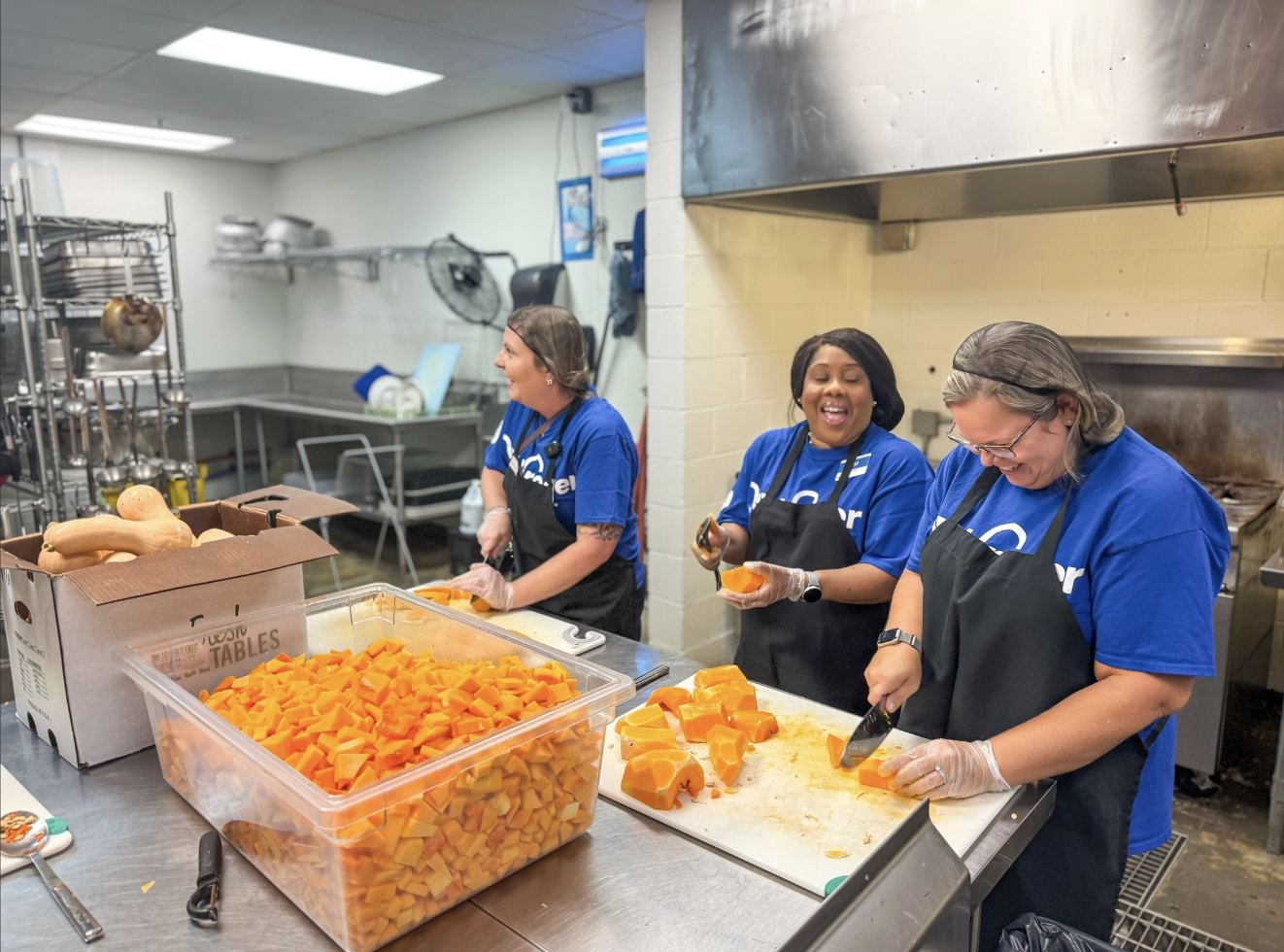
“This work belongs to the community. We can’t do it without our many volunteers who are in the kitchen chopping, peeling, packaging, taking in donations and organizing the walk-in, and our drivers. We have incredible community partners, committed local food producers who help keep perfectly edible food out of landfills, donors and supporters.”
For more information, visit feedlouisville.org. Feed Louisville is located at 1334 Story Ave. in Louisville.