

Layer by Layer
As a child, Licia Priest spent a lot of time at the Speed Art Museum in Louisville while she and her mother waited for her father, Sam Neal, to finish his day teaching at the University of Louisville. Exposed to many different art mediums at a young age, Priest took sewing in her home economics classes, along with acting and art classes in the community, which continued to expand her creativity and passion for art.
She loved designing clothes, sitting up by the light of the sewing machine many nights while in high school, preparing a new outfit to wear the next day. Then, people who noticed her unique designs began commissioning their own fashion requests for pieces they could not find anywhere else. She made hand-beaded wedding gowns, hand-painted garments, and loved mixing textures and patterns.
Her college days in the art department jumped from fiber to painting and sculpture, and she had plans to transfer to Parsons School of Design in New York City. But like many young brides and mothers, art took a back seat to raising a family.
“You imagine your life unfolding one way, with very minimal change, but the time you pour into raising your children is a sacrifice you never regret, and life unfolds in a very different manner,” Priest says. “I decided to homeschool them, and we’d do projects together. I even taught art projects through the Louisville Visual Arts, one of which was completed in 1995 and is a three-panel mosaic mural that still hangs on the side facade of Kenwood Elementary School.”
During homeschooling, Priest taught her son and niece African American history, focusing on the Underground Railroad. While their son gave an oral report on Harriet Tubman, her husband, Mark Priest, a narrative figurative painter and professor at the University of Louisville, was inspired to make that history the center of his artistic practice. For many years afterward, Licia supported his work through archival research, conversations with historians, and walking routes believed to have been used by those escaping on the Underground Railroad.
Priest traveled to West Africa in 1998 through Parsons School of Design, where she studied weaving and fabric dyeing in Mali and Cote d’Ivoire. In 2012, after finishing homeschooling her son, she returned to the University of Louisville and completed her degree, concentrating on painting, fiber art and sculpture, with a minor in art history. By 2014, the family’s first trip to Zimbabwe opened a new chapter in her artistic practice.
“I’ve been to Zimbabwe two times since then, and prior to going to Africa, you mostly hear stories about people starving, war, and the lack of modern technology. If you just watch the news, you’d think there was constant gunfire,” Priest says. “Don’t get me wrong, there are challenges across the 54 countries that make up Africa, just as there are everywhere in the world, but there’s a lot of beauty and positivity, too.”
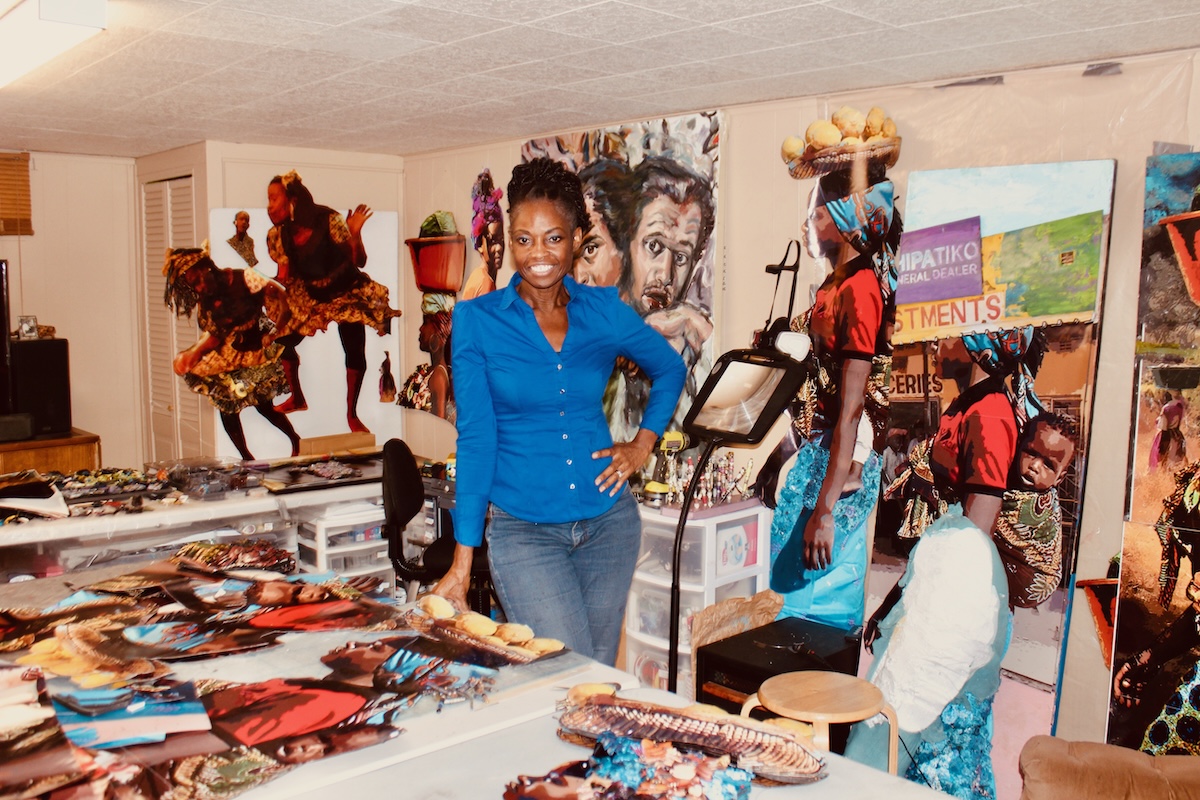
She began taking photographs that celebrate what makes Africa unique: a bicycle vendor selling his produce as he cycles down the street, the beauty of the Ivory Coast, rolling hills and landscapes, and the intricate patterns on a woman’s skirt. Returning to her Louisville home and using paper tole, a three-dimensional decoupage art form created by cutting, shaping and layering pieces together, Priest set out to bring others on her journey through her art.
Early this summer, she received the 2025 Bill Fischer Award for Visual Artists through the Community Foundation of Louisville and Louisville Visual Art, which includes a $10,000 award she is using to further develop and expand her artistic practice.
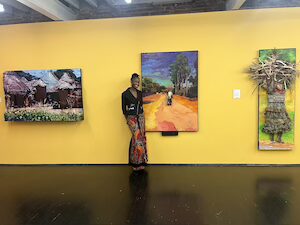
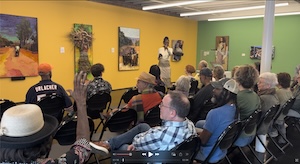
Her recent solo exhibition, “I Am We,” at the Kentucky Museum of Arts and Crafts came with a six-month residency supported by a South Arts grant, allowing Priest to meet visitors, discuss her practice and art form, and share the stories behind the work.
“I loved the residency,” Priest says. “People came to my studio almost daily, and I’d teach them how to do paper tole and paper beadmaking during their visit. I worked on projects that would be exhibited in the museum and would go out and talk to every person who came in, from school groups to adult visitors.”
How Long Does Each Piece Take?
Priest is not sure because she gets so absorbed in a project and does not keep track of time. But when calculating the many hours it takes to create up to 40 to 50 layers of a subject and then paint it, each piece could take months to complete.
More important to Priest is that visitors are able to have a collective experience that affects each person individually.
One piece in the “I Am We” exhibition depicts Priest wearing a dress with one-eighth images of individuals who have shaped her life.
“The concept behind it is that all the people who cross our paths become a part of who we are and how we process experiences, whether negative or positive, can make us a better person,” Priest says. “There are images of people in my life as well as images of everyone who came into my studio. They look like a pattern in the skirt, but look closer.”
Priest will not stop there. The artist, with a background in fashion, painting, photography, glasswork, sculpture and other mediums, has more planned for the future, and the sky is the limit.
In May 2026, Priest’s paper tole work will be displayed at the Art Center of the Bluegrass.
“They saw the glasswork I’ve done, and they want to show the paper tole work to share the variations and changes an artist can take with their work,” Priest says.
In October 2026, she will have an exhibit at the Moremen Gallery that is in the planning stages of a new, thought-provoking idea.
“I am going to develop portraits and incorporate mirrors,” she says. “People love to see themselves, and I’m going to use mirrors as the back layer of the works so the viewer becomes a part of the scene. I want people to enjoy my work and to be a part of it.”
Looking forward, Priest hopes to get involved in public art space projects, commissioned work and more.
“I’d love to do projects in public art spaces I want the public to interact with the work and for people to be moved and impacted by what they see,” she adds.
To learn more about artist Licia Priest, visit layeredimages.com.