

The First 500
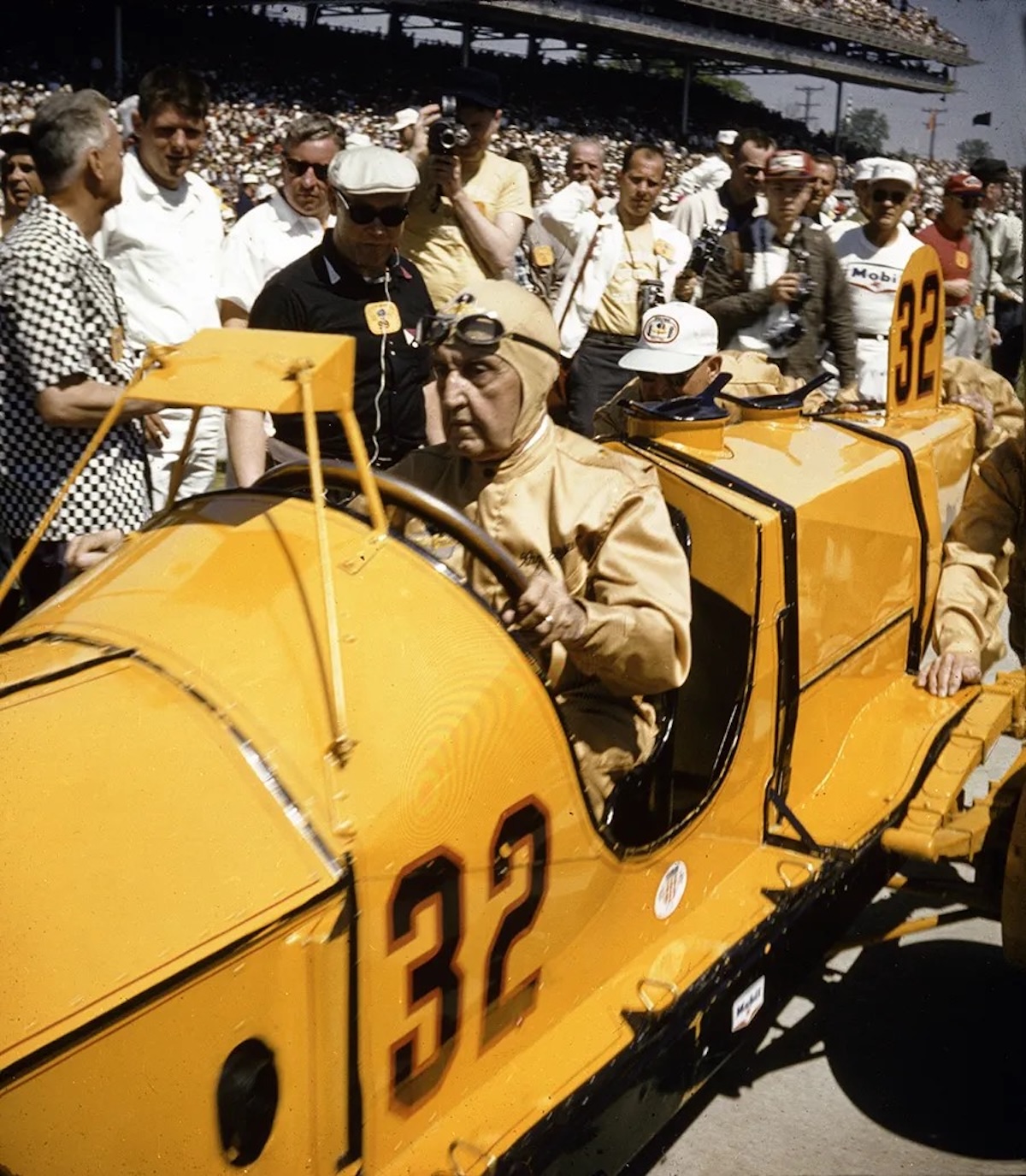
One hundred and fifteen years ago this month, on May 30, 1911, Ray Harroun drove the famous Marmon “Wasp” (owned by Howard Marmon) over the finish line to complete the first Indianapolis 500 automobile race, marking a milestone for the Hoosier State as the destination for the greatest auto race in the nation, if not the world, for the next century-plus.
The moment had particular significance for some in the Lakes readership area at the time, since members of the Marmon family had already spent summers in the Lake Maxinkuckee area for more than 25 years by 1911 and made an indelible mark on the community.
Not many months after his victory, in August 1911, winning driver Ray Harroun, accompanied by his mechanic, flew his “hydro aeroplane” on Lake Maxinkuckee, which would become a go-to destination for him and his wife (who rented a cottage on the west side of the lake for a time).
As the Culver Citizen newspaper noted in its Aug. 24, 1911, edition, “(Harroun) … will do some experimental work, both in the morning and afternoon. Mr. Harroun has had experience in air flying, but this is his first attempt to make flights from the surface of the water. His machine is a monoplane of the Beriot type, fitted with pontoons for resting on the surface of the water. Observers at any point around the lake can see all the work of the aviator.”
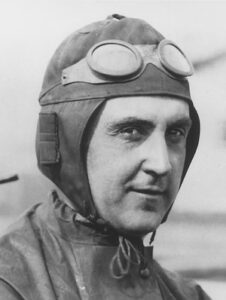
Besides being a race car driver and the aviator mentioned above, Harroun was actually an engineer with the Marmon company that manufactured his car — a vehicle that was a household name in the early part of the 20th century, exemplifying speed, dynamic performance and beauty beginning in an age when the state of Indiana was more a center of automobile manufacturing than Detroit, producing one of America’s first gasoline-powered cars out of Kokomo (the Haynes-Apperson) as well as an array of now-legendary luxury cars such as Auburns, Cords, Duesenbergs and Studebakers.
MARMON ROOTS
For its part, the Marmon company began with Daniel Marmon, who met his future wife, Elizabeth, after his family moved to Richmond, Indiana. Daniel would become head of the well-known Earlham College, and shortly after the Civil War, his aptitude for engineering and mechanics impressed the Nordyke family, who had operated a flour mill in that city since 1851. Daniel Marmon was asked to join the company as a full partner.
Company leadership at Nordyke included a roster of names also familiar in years past in the Lake Maxinkuckee area, including S.S. Griffith, A.K. Hollowell and H.H. Rice.
By 1877, Nordyke and Marmon had moved to Indianapolis, where the future Indianapolis Power and Light Company, which Nordyke eventually sold, would launch.
Daniel’s son Howard Marmon was enthralled by engines of all sorts and purchased his first automobile during the relative infancy of the invention, in 1900, taking it to the Nordyke-Marmon plant for rigorous testing. He would soon produce the first touring car in America, which included several never-before-seen features, test-driving it on a trip from Indianapolis to Kokomo.
Starting in 1903 and over the next handful of years, the company introduced a car with a four-cylinder engine and the new Marmon four-speed oiling system; released the Marmon Model C in 1906; released an eight-cylinder, air-cooled Nordyke-Marmon auto and, the following year, the company’s first water-cooled motor. The racing car, the Marmon 32, went into production in 1909, the same year the Indianapolis Motor Speedway opened.
The Model C’s prowess was demonstrated via a perfect score on the 1,200-mile Glidden Tour of the Northeast U.S. and eastern Canada. Such long-distance tests were common for automobiles of the day, giving their makers bragging rights if the results were good. Future Indy 500 driver Ray Harroun was at the wheel at that first race in 1909 as well.
Marmon cars actually raced all over the U.S., racking up 10 first-place race results (out of 20 races), six seconds and seven thirds out of 22 races that year. Typical Marmon racing car colors were yellow and black, earning the car its moniker of “The Marmon Wasp.”
It was no surprise, then, to see Marmon cars hit the Indianapolis Speedway at the debut of its 500-mile race.
BIRTH OF THE SPEEDWAY AND THE 500
The speedway itself was the brainchild of entrepreneur Carl Fisher, and its first event was a hot-air balloon launch.
In fact, the 1909 debut of the track was something of a disaster, which led to a turn of fortune for Fisher. When drivers and spectators were killed during the 1909 race weekend and AAA refused to sanction the Speedway as a result, Fisher paved the track with 3.2 million bricks that fall, leading to the track’s nickname, the “Brickyard” (contrary to some confusion, the bricks in question, though stamped “Culver,” have no connection to the town of Culver in this area and were in fact made in Crawfordsville, Indiana).
Ray Harroun, who would become the second-most-winning driver in Speedway history, with eight wins under his belt, geared up for his last Speedway race at the first Indy 500.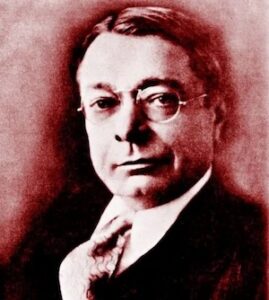
During that historic event, Harroun’s driving averaged 74.61 miles per hour, which the Saturday Evening Post would describe as a “savage, record-breaking pace.” Such hyperbole wasn’t as excessive as might be assumed, given the relative crudeness of safety and protective measures available to drivers in those early years of auto racing. A serious crash was much more likely to result in death than today.
Harroun’s relief driver, Cyrus Patschke, drove about 35 laps in the first Indy 500 for Harroun. It was Patschke, in fact, who first put the Wasp in the lead.
Another Marmon car would have been second if not for an accident on the track. It was driven by Joe Dawson, who would go on to win the second Indy 500 in 1912, though not in a Marmon car.
A rumor persists that the Marmon Wasp featured the first rearview mirror used on a car. In fact, cars manufactured for non-racing use had begun to utilize such mirrors a few years earlier, though the Wasp was likely the first racing car to do so. Its mirror was designed by Harroun himself.
Another historical sidebar relates to a famous photo of the Wasp in motion at the first Indy 500, which makes the wheels look more oblong than round. The appearance was the result of the use of a large-format camera, rather than an optical illusion created by speed, though use of oblong wheels in motion has persisted to this day in animation and other graphical representations intended to convey high-speed motion.
In yet another Lakes-area connection, a graduate of Culver Academies’ famed Woodcraft Camp, Roger Penske, purchased the Indianapolis Motor Speedway, the NTT IndyCar Series and IMS Productions in 2000, making him the fourth owner in the track’s century-plus history.
Penske, whose name adorns a building he donated at the Woodcraft Camp in Culver, has seen more wins via Team Penske than any other Indianapolis 500 team.
MARMON CARS — FROM GOLDEN AGE TO A FOND FAREWELL
In the years following that first Indianapolis 500, Marmon cars continued to grow in quality and notoriety, with dealerships opening in London and Paris, among many other locales.
Meantime, Howard Marmon also served in the Army Air Corps during World War I, making significant contributions in the development of Liberty aircraft engines.
By 1920, the Marmon plant in Indianapolis employed more than 5,000 people, occupying 67 acres and 1.5 million square feet. During the ’20s, legendary The Great Gatsby author F. Scott Fitzgerald and his wife, Zelda, purchased a Marmon car and wrote about it — and their frequent use of it in their travels — often. The Marmon epitomized the large, speedy cars favored during the Roaring ’20s.
In 1926, the company name officially changed to the Marmon Motor Car Company, and five years later its V16 model was released, with one test driver remarking driving it was “like driving jewelry” (less than 60 of those cars, produced between 1931 and 1933, survive today, and they’re valued in the millions).

More regionally, Elizabeth Marmon in particular, following the 1909 death of her husband Daniel, contributed significantly to philanthropic endeavors in Marshall County, including a lead role in launching the Culver Public Library and support of other literary, cultural and ecological efforts in the region.
As impactful as the Marmon company and its cars were, similar to many of the high-end cars Indiana had produced up to then, it could not survive financially the ravages of the Great Depression. In 1933, the Marmon Company went into receivership, though Walter Marmon soon partnered with Arthur Harrington to launch the Marmon-Harrington company, which manufactured military vehicles.
For his part, Harroun, after retiring as a driver, led the Maxwell racing team as chief engineer, with Eddie Rickenbacker as lead driver, in 1915. He also launched the Harroun Motor Company in Wayne, Michigan, but the company — forced to fill government contracts at a loss during World War I — eventually failed.
Harroun was on hand in 1961 for the 50th anniversary of the first Indy 500 at the Speedway, seven years before his death in 1968.
Similarly, descendants of the Marmon family were on hand 15 years ago in 2011 to celebrate the race’s centennial in style, with a number of Marmon cars on hand to celebrate the remarkable legacy of one of the Hoosier State’s great contributions — both its legendary race and the car whose victory started it all.
Note: Portions of this article were derived from coverage by the author of a talk given by a Marmon family member.
Jeff Kenney serves as Museum and Archives Manager for Culver Academies as well as on the board of the Culver Historical Society. He speaks frequently on topics of local and regional interest in the area.