

Managing Sedimentation, Invasive Plants & Algae
As 2025 comes to a close, it’s time to review our annual Geist Reservoir Treatment Summary. We’re pleased to present another season of successful voluntary lake treatments, all of which are permitted by the Indiana Department of Natural Resources (IDNR), the Indiana Department of Environmental Management(IDEM), and Citizens Energy Group.
 We couldn’t do it alone. Our treatments are fully funded through donations, and because of that, donor areas do take priority. Thank you for all the contributions toward our 2025 Lake Treatment, and for helping us try to keep up. Let’s review Geist’s 2025 treatment updates by beginning with the reservoir’s aquatic plant ecology.
Identifying Invasive Aquatic Plants and Algae
Vegetation in Geist Reservoir can get out of control. Invasive species, such as Eurasian Watermilfoil, threaten native plant and animal life and can degrade entire ecosystems if not properly managed. Every year, we help manage vegetation to support healthy conditions in Geist’s ecosystem.
Here are common plants and algae that call Geist home:
Eurasian Watermilfoil: This long, lush green plant is an invasive one. It competes with native species, creating dense surface mats that impair navigation, swimming, and fishing. It spreads through fragmentation and can harm our ecosystem at Geist.
Common Coontail: In appearance, Coontail is very similar to Watermilfoil; however, a huge distinction is that it’s native to Geist Reservoir. Common Coontail forms dense mats from late spring through early fall, providing good cover for our fish.
Water Stargrass: This native plant looks pretty much just like it sounds—submerged grass-like stems with yellow flowers that look similar to stars. Water Stargrass has always been at Geist, but at low levels. It’s difficult to control and has been slowly expanding above the Fall Creek bridge for the last few years.
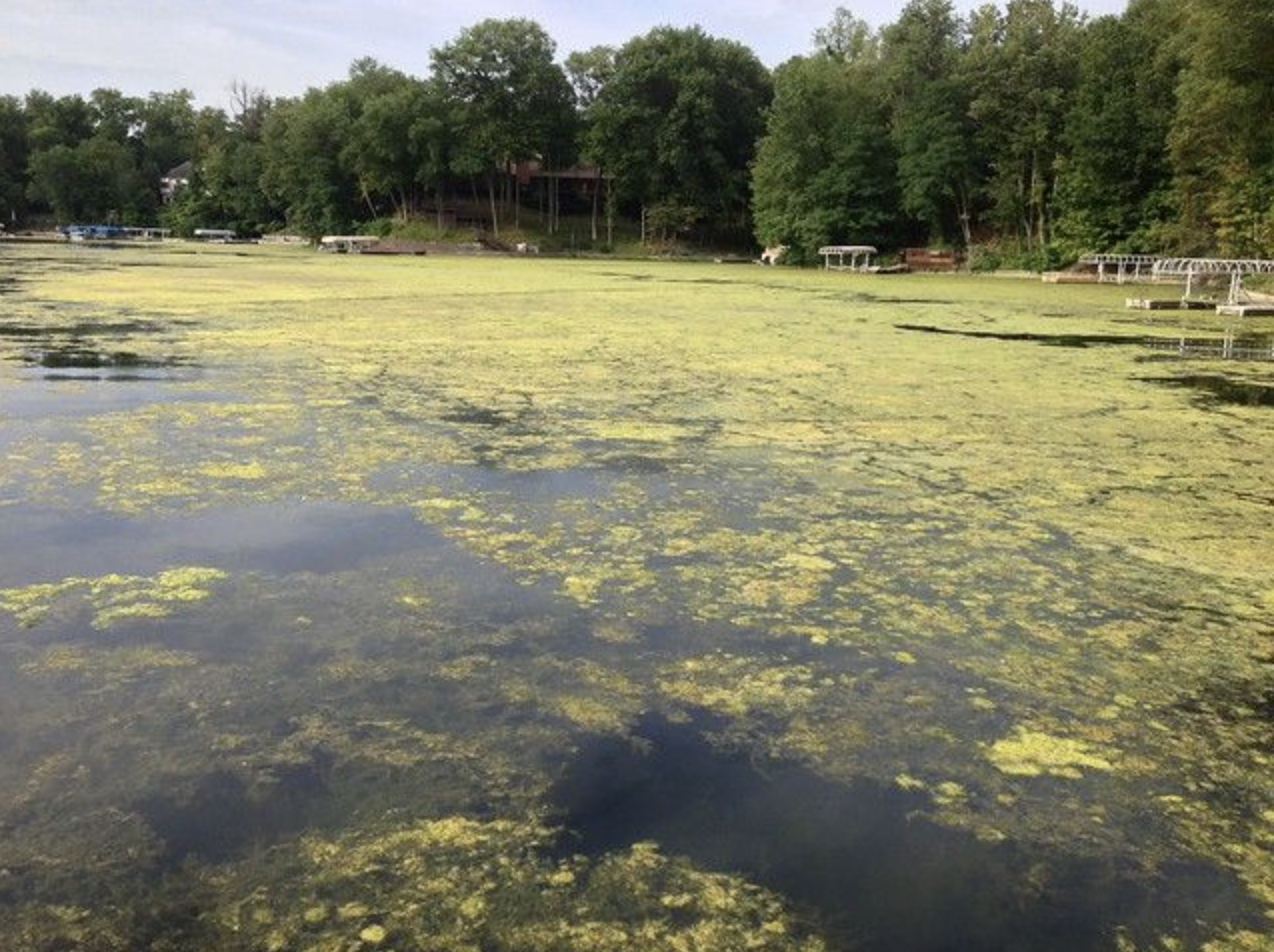
Filamentous algae: Also known as moss, this invasive algae grows best in shallow, calm waters or dense plant beds and can quickly spread when conditions are right. Different types of Filamentous algae grow at different times of year, and Rhizoclonium causes most of our issues at Geist.
Blue-green algae: This bright green algae encompasses thousands of species, which vary throughout the season. It, too, can quickly reproduce in the right conditions and is invasive. However, it’s less common in Geist since the expansion of zebra mussels in 2010. Blue-green algae can produce toxins, taste-and-odor compounds, and films on the surface of our lake
Timeline of Treatments
Treatments at Geist are designed to control submerged plants and algae, most of which occur naturally. We treat the lake with EPA-registered aquatic herbicides, completed by state-licensed and trained applicators. We can’t control or prevent floating plants. Our treatment plan only covers native plants in approved areas of Geist.
The first treatment of 2025 took place on May 29. After a very wet spring, weather conditions led to murkier water in early summer.
We treated weekly from late May through late September using four application boats, starting at daylight and finishing by noon. The application boats were guided via GPS to locate specific homes and treatment areas. Reduced water quality led to less aquatic plant growth than in previous years. Filamentous algae growth increased in late summer.
Lessons Learned from Treatment Management
Here’s our key takeaways:
Effectively manage expectations. It’s a lake, not a swimming pool. Certain areas will need more work than others — that’s inevitable.
Open communication is key. Plant and algae growth vary from year to year and are hard to predict.
Vegetation can be actively managed without negatively affecting fish, wildlife, or water clarity, provided that funding is available.
Dedicated, consistent treatment management helps preserve the reservoir.
Help Us Keep Geist Reservoir Healthy
None of this would be possible without our surrounding Geist community. Yearly treatments, funded by your donations, help keep us on a path to preserving Geist. If you have any further questions about lake treatments, please reach out to treatment@geistconservancy.com.