
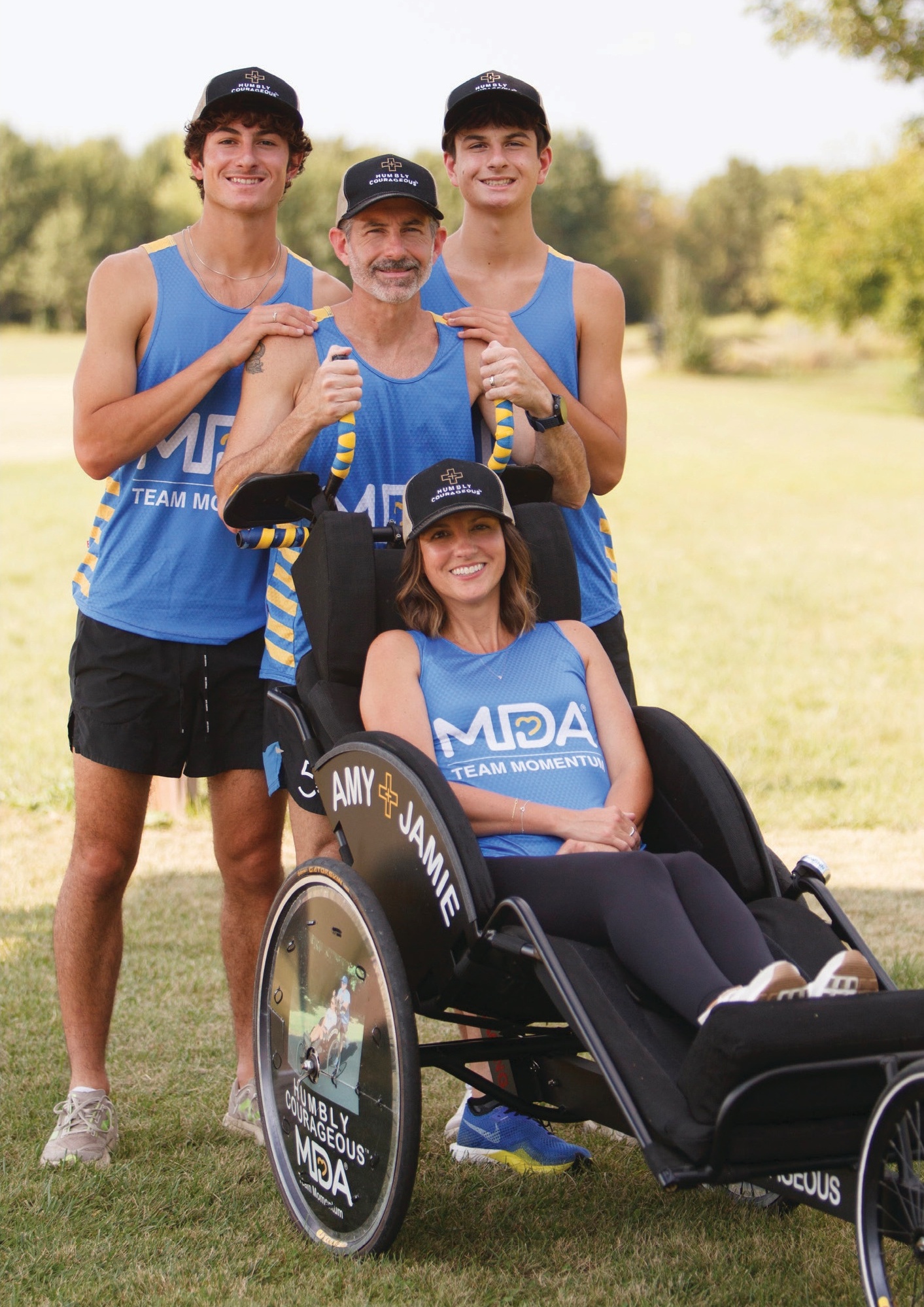
For Amy Shinneman, the finish line of a marathon is about much more than a medal. It represents possibility.
After being diagnosed with Bethlem myopathy, a rare form of muscular dystrophy, Shinneman spent 44 years searching for an explanation for the physical challenges she faced. She began to see her life — and herself — differently. That new perspective eventually led her to advocacy, writing, accessibility work and a quest to complete the world’s major marathons.
“When I was finally diagnosed with muscular dystrophy, I began to see myself in a different light,” Shinneman said. “I began to see my strengths, and not just how my muscle weakness affects me.”
Shinneman said she didn’t feel like she fully knew herself before her diagnosis because there was this huge missing piece that impacted everything she did.
“Living with uncertainty like that for so long is daunting and takes up a lot of mind space,” Shinneman said. “When I was able to put that to rest, I was able to live without that huge weight of not knowing what was coming next.”
According to Shinneman, living without that weight let her focus on helping those in a similar situation. In turn, she became involved with the Muscular Dystrophy Association (MDA).
“I felt like I had a new purpose and mission in life,” Shinneman said.
That mission soon found another outlet through writing. In 2019, Shinneman began sharing her experiences through her weekly blog, Humbly Courageous. What began as a personal way to process years of experiences eventually became a way to connect with readers living with disabilities and educate those who had never experienced life from that perspective. Her writing has since expanded to include a weekly column for the Hamilton County Reporter.
“After being diagnosed, I felt like I wanted to share my story,” Shinneman said. “Before diagnosis, I was more closed off about sharing my disability. The people closest to me knew bits and pieces, but there was a lot of internal struggle and angst that I did not share with anyone.”
As Shinneman began writing, she said she felt like she was reliving those moments again, but now through the lens of having answers.
“It has been really healing for me to write about my past experiences without the weight of so much uncertainty,” Shinneman said. “In the beginning, it was just for me; few people read my blog at first. When I started gaining more readers and started to hear from others how my story was helping them feel less alone, or even educating them, I felt encouraged to keep writing and sharing my story about living a life disabled.”
At the heart of Shinneman’s work is a desire to close the distance between people with disabilities and those without them. Today, Humbly Courageous has grown beyond the name of a blog. Shinneman has turned it into a nonprofit.
“Often, those of us with disabilities feel isolated and misunderstood,” Shinneman said. “I think that is largely due to a lack of understanding that at the end of the day, we are not that different. We all deserve equal treatment, and people with disabilities are just like everyone else at our core. It is just that we struggle with different physical or mental hardships.”
That same philosophy informs Shinneman’s accessibility advocacy. Through her work with Hamilton County Tourism, she has contributed to a “Know Before You Go” series, visiting local destinations and documenting their accessibility. For someone navigating the world with a disability, knowing what to expect before arriving can mean the difference between confidently enjoying an outing and worrying about whether basic needs will be met.
“It is so valuable to have information on the level of accessibility of a place before you go,” Shinneman said. “It helps with planning and can calm anxiety that may come from the anticipation of lack of accessibility. Knowing exactly what accessibility is in place makes for a much smoother experience. It allows a person with a disability to enjoy their time.”
For Shinneman, accessibility is not simply a matter of meeting a checklist of requirements. She describes the goal as creating spaces where people with disabilities can move independently and participate without having to call attention to themselves or ask others to make accommodations once they arrive.
“Accessibility, to me, means a seamless experience,” Shinneman said. “It means a place that, as a wheelchair user, I can get into an establishment with an accessible door button, use the restroom and have access to a table without causing a commotion. An accessible place promotes an environment where independence is possible and is a forethought, not an afterthought.”
Shinneman’s advocacy has also become a family endeavor. Shinneman previously served as a National Ambassador for the MDA, an experience she says changed not only her but her husband and sons. Along the way, she found a stronger voice and greater confidence in speaking publicly about disability.
“I have grown so much as a person since first becoming involved with the MDA,” Shinneman said. “I have become more confident in my advocacy efforts, and I have learned so much from other amazing advocates. I found my voice, and learned how to use it the best way that I can. Serving as their National Ambassador for two years was a life-changing experience.”
That voice traveled with Shinneman and her husband to Sydney, Australia, where the couple recently completed another World Marathon Major (WMM). They have made the races a shared pursuit. Sydney was their fifth World Marathon Major, but the significance of the trip extended far beyond the race itself.
“I was able to meet, for the first time, someone else with my same diagnosis,” Shinneman said. “I waited 52 years to meet someone ‘just like me.’ We met online six years ago, and she lives in Australia. We had always dreamed we could meet in person one day, and we finally did!”
Meeting another person with Bethlem myopathy gave the Sydney trip a deeply personal meaning. For someone living with a rare disease, finding another person who understands the experience without explanation can be extraordinary. The marathon became the backdrop for a meeting that Shinneman had imagined for years.
“It was an incredibly impactful experience for both of us, as well as my husband and her parents,” Shinneman said. “Living with a rare disease makes it difficult to connect with others who share almost identical struggles. There is just something about knowing there is someone who completely understands all the unspoken obstacles that I do.”
And then came the finish line. For Shinneman, reaching the end of a marathon was a reminder of both the physical challenges she lives with and the people who help her experience opportunities her disability might otherwise make inaccessible. In Sydney, that emotional moment also included the friend she had traveled across the world to meet.
“Each finish line we cross is an emotional experience,” Shinneman said.
“The fact that, though I have never run on my own, I have a person willing to push themselves to the limit so that I can have these opportunities is incredible. It is overwhelming in the best way. Also, seeing my friend and her family at the finish line was a really touching moment.”
For Shinneman, the work ahead is ultimately about changing perceptions — one story, one accessible space, one finish line and one conversation at a time.
“I appreciate the opportunity to share my story and to promote the importance of accessibility. Sharing stories like these goes a long way in bridging that gap,” Shinneman said.
To learn more, visit humblycourageous.com or reach out to Shinneman directly via email at amy@humblycourageous.org.