


The University of Notre Dame’s Rise From Wilderness to World-Renowned Legacy
 On a frigid, snowy November day in 1842, 183 years ago this month, eight Catholic priests arrived at a place whose name in English is translated “Lake of Our Lady,” marking the inauspicious beginnings of one of the most recognizable institutions in Northern Indiana.
In French, the St. Joseph County-based location was Notre Dame du Lac, and Father Edward Sorin had been accompanied on his long journey there from Vincennes, Indiana, by seven other French and Irish priests with plans to start a college there.
As Sorin wrote to his bishop at Vincennes, the lake-area land was given to the priests on the condition that they start the college “at the earliest opportunity. As there is no other school within more than a hundred miles, this college cannot fail to succeed…Before long, it will develop on a large scale (and) will be one of the most powerful means for good in this country.”
That school, which opened the following year in 1843, would of course become the University of Notre Dame, one of the best-known universities in the US, and certainly the best-known Catholic one, even if its reputation centers on the sport of football, for many people, as much as anything else.
In many ways, the story of the founding of Notre Dame begins with a perhaps even more remarkable story connecting a giant of US history with Indiana’s history.
Bishop Simon Bruté, born in France in 1779, had witnessed the horrors of the Reign of Terror in the wake of the French Revolution, and opted to be a priest despite receiving training to be a physician. Bruté became interested in missionary efforts to the US and in 1810 accompanied Bishop Benedict Joseph Flaget to Baltimore, where Bruté taught philosophy at St. Mary’s College, followed by various missionary efforts, teaching, and priestly roles along the east coast. He also returned to France in 1815 to retrieve his personal library, the largest of its kind in the entire US at the time. In fact, President John Quincy Adams called Bruté, who was also a prolific and eloquent writer, “the most learned man of his day in America.”
 By 1834, the splitting up of the Catholic diocese of Bardstown, Kentucky, into smaller sections, led to the creation of the Diocese of Vincennes, Indiana. That same year, Bruté accepted the position of Bishop of Vincennes and crossed the Appalachian Mountains to serve in a diocese that encompassed all of Indiana as well as eastern Illinois. He would later travel again back to France to secure additional priests for the vast area, as well as funds to erect churches and schools.
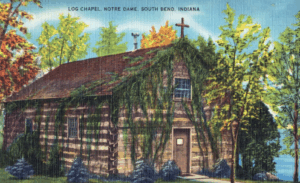
One of these trips, in 1836, saw the arrival from France of a young priest named Benjamin Petit, who later became a missionary to the Potawatomi at the oldest church in our own Lakes area Marshall County, a log cabin chapel between Culver and Plymouth. Petit would accompany over 800 Potawatomi on the Trail of Death in 1838, dying as a result, and he’s buried today under the replica log cabin chapel at Notre Dame (more on that shortly).
Bishop Bruté’s huge library, meanwhile, was sent by flatboat up the Ohio River to Vincennes where it formed the basis of the first library in the State of Indiana, today housed in what’s known as the Old Cathedral Brute Library, “one of the finest collections of rare books and artifacts in the United States today,” according to its website. The Old Cathedral itself refers to one of the oldest churches in the state, known today as the Basilica of St. Francis Xavier in Vincennes, built in 1826.
Meanwhile, Bishop Bruté’s efforts would converge with those of the first Catholic priest ordained in the US, Stephen Theodore Badin, whose life and missionary efforts, including to Lakes area Potawatomi Native Americans and those in the broader Kentucky and Indiana area, are a tale unto themselves.
For purposes of our story it’s enough to note that in 1832 Badin purchased 524 acres of land in the area of South Bend, constructing a log chapel there. In 1834, he sold the land to Bruté, on the condition that a school and orphanage would be built there, which of course, will bring us to Fr. Sorin’s 1842 journey to South Bend.
Incidentally, though Badin died in Cincinnati in 1853, his body was re-interred in 1906 under the same replica log chapel as the aforementioned Fr. Petit (the original chapel Badin had built had been destroyed by fire in 1856).
 Bruté died in 1839 and was succeeded by Bishop Célestin Guynemer, who had inherited the St. Joseph County land from his predecessor. Bishop Guynemer offered it to another young French priest (born 1814): Fr. Edward Sorin, a priest of the Congregation of the Holy Cross who had been sent to the US in 1841. After various other endeavors and discussions with his bishop that included Sorin expressing interest in starting a college, the agreement was made that he and six other priests would make the long journey from Vincennes to South Bend.
The group trekked the 250 miles north during one of the harshest winters Indiana had seen, splitting into two groups with Sorin’s group being the first to arrive in South Bend, on the afternoon of November 26, 1842. They were met by fur trader and explorer Alexis Coquillard, credited as the co-founder of South Bend, who took them the next day to the future Notre Dame site.
Sorin and the others moved into the log cabin chapel and set about the business of launching the school, including the eventual construction of a building known as Old College, which was completed in 1843, the oldest still-standing building on the campus.
With just two students enrolled initially, Notre Dame du Lac was at first only a primary and secondary school before receiving its college charter in January of 1844 by the Indiana General Assembly (the same year that a sister school to the all-male Notre Dame, a girls’ college named St. Mary’s, opened its doors).
The University of Notre Dame awarded its first academic degrees in 1849, even as the school continued to grow in both student population and buildings. By the university presidency of Fr. William Corby, from 1866-1872, the student body had grown to 500, adding its law school in 1869 and beginning construction of its Sacred Heart Church in 1870 (today that church is a basilica, meaning it was granted special status by the pope for its historic and architectural significance).
The school’s initial main building was replaced in 1865 with a second main building, the first to see a dome with a statue of the Virgin Mary atop it. Just 14 years later, that building — which housed much of the university at the time — was destroyed by fire, leading to massive fundraising and construction efforts that saw the completion of a 187-foot replacement building opened by the fall semester of 1879. The year 1882 saw the addition to that structure of the famous Golden Dome, adorned with a 19-foot statue of Mary and gilded with real gold (at Sorin’s insistence and following a lengthy debate over the matter with an opposing contingency). The dome became arguably the most recognizable and iconic feature of the university.
Of course the growth trend of the 19th century only continued into the 20th, with 2,500 students enrolled by 1925, even as descendants of Catholic immigrants from years prior, especially from Ireland, helped bolster its numbers and cultural status.
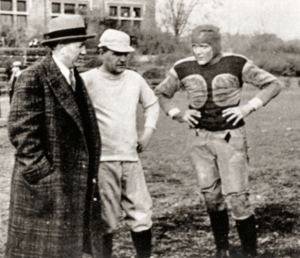
So, too, did the university’ s explosion onto the college football scene during that era, particularly under the leadership of legendary head coach Knute Rockne, who began in that role in 1918. Rockne not only led the “Fighting Irish” to five undefeated seasons, three national championships, and a Rose Bowl win (in 1925), but he and others helped craft the near-mythic status of the team by way of players like George Gipp, whose stature can be seen as the focus of the Ronald Reagan-led 1940 movie, “Knute Rockne – All American,” with its famous line urging Gipp’s team to “win one for the Gipper” — and the team’s 1924 players known as “the Four Horsemen,” so named for the opening line of sports writer Grantland Rice’s coverage of the Oct. 18 ND-Army game which read: “Outlined against a blue-gray October sky the Four Horseman rode again…”
The stature and scope globally of Notre Dame as a venerable institution only grew as the 20th century progressed, including under the 35-year leadership of Fr. Theodore Hesbergh (up to 1987), who was noted as a social activist, writer, and public servant who labored to increase the school’s academic reputation as one of the foremost Catholic institutions of scholarship in America.
And of course that football fanaticism continued, even as another classic sports movie, 1993’s “Rudy,” brought the program anew to international audiences.
Today, the University of Notre Dame graduate program includes more than 50 master, doctoral and professional degrees offered by its seven schools and colleges, an array of successful athletic programs, and an endowment valued at more than $20 billion.
It’s all a remarkable story of growth from the humble beginnings wrought by a small group of pioneer priests traversing the Indiana wilderness nearly 200 years ago, and perhaps one that fulfills Edward Sorin’s dream that his school would be “…one of the most powerful means of doing good in this country.”