
The Long Reach
On a calm morning just north of Shipshewana, the water tells the truth.
A pond’s surface might look still, even generous. Still, underneath the surface, the story is more complicated. Depth matters. Soil shifts. Banks erode slowly, then all at once. What holds today may not hold next season.
Bill Miller knows this because he has spent years listening to land most people only glance at. He doesn’t describe his work in lofty terms, and yet he doesn’t need to. When you spend your days shaping ponds, stabilizing shorelines, and working in water you can’t see through, precision becomes habit. Patience becomes instinct. Integrity becomes nonnegotiable.
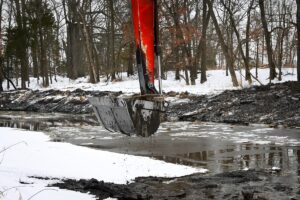
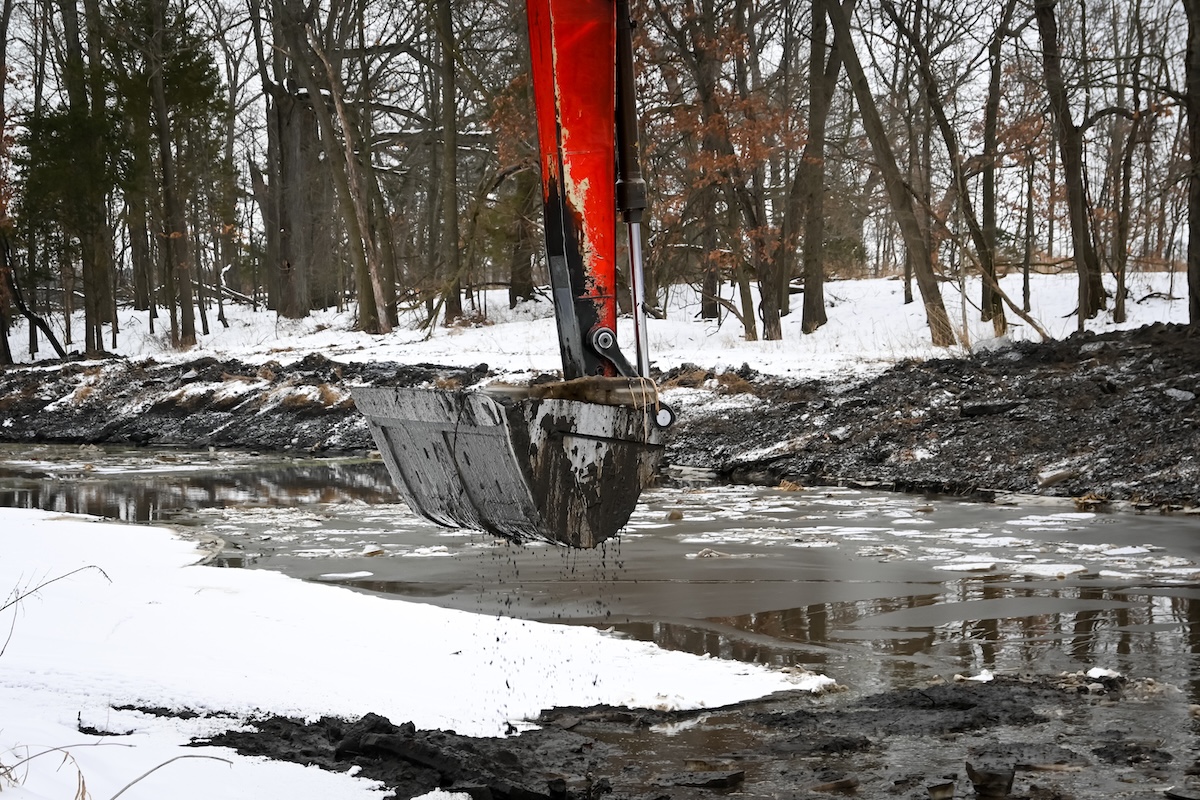
Bill is the owner and operator of Bill’s Long Reach Service, a Shipshewana-based excavation business specializing in pond and small-lake construction, maintenance, and repair. With a 60-foot long-reach excavator and years of hands-on experience, he takes on jobs that demand trust, because once the first scoop of earth is moved, there’s no undoing it.
A Neighbor, a Machine, and a Quiet Beginning
Bill grew up in Middlebury, Indiana, next door to an excavator. That proximity left an impression. As a teenager, he spent time helping, learning what machines could do while being guided by someone who respected them and the land beneath them.
Life took him elsewhere for a while. Like many in the region, Bill spent years working in the RV industry. Then came 2020, when the pandemic paused one world and another opened.
The fall before, Bill had purchased an excavator to work on his own pond. When shutdowns kept people home, neighbors started asking for help. One job turned into a handful of phone calls from people he hadn’t met yet. By the time work resumed elsewhere, Bill realized something important had happened.
“I probably wouldn’t have had the nerve otherwise,” he says. “But it all came at once.”
The timing wasn’t planned, but the fit for the new line of work was immediate.
Why Reach Matters More Than Speed
Pond work is deceptively complex. Yes, anyone can dig, but not everyone can dig correctly, especially in water.
Bill’s long-reach excavator allows him to shape bodies of water with steadiness and accuracy. A standard excavator can only reach so far before the operator runs out of room. That’s when depth becomes uneven, slopes become unstable, and future maintenance turns costly.
“With a short reach, you might get it deep in one spot,” Bill says. “But then you can’t reach far enough to keep it that way.”
Depth, width, soil type, and slope all work together. Get one wrong, and erosion or collapse follows. Bill has seen it happen when well-meaning property owners try to do the work themselves.
“I always tell them, you can work on it, just don’t make it too wide,” he says. “Otherwise, when I get there, I won’t be able to reach it.”
It’s not about taking over. It’s about finishing right.
When the Bottom Can’t Be Seen
Working in water introduces another challenge: You can’t see the bottom. You feel it.
Experience teaches the difference between reaching depth and holding it. A pond that looks right today can fill itself back in within months if the slopes aren’t designed to support the surrounding soil.
“That’s where people get disappointed,” Bill says. “They’ll say, ‘It’s not as deep as you said.’ But sometimes the only way to keep depth is to make it wider first.”
That kind of judgment can’t be rushed. It’s also why Bill is cautious about sending others into that environment. Some jobs require crane mats to stabilize soft ground. Others demand careful reading of soil that changes by the foot.
He once worked at a site where those mats likely saved both machine and operator.
“That was a rude awakening,” he says.
Holding the Line Against Erosion
Bank erosion is one of the most common and overlooked problems pond owners face. Over time, water eats away at the shoreline, vegetation takes over, and property lines quietly shrink.
Bill has steadily focused on rock installation to stabilize banks and reduce long-term maintenance. On public waterways, that work requires permits through the Indiana Department of Natural Resources, and it’s a slow process.
“You don’t just go,” he says. “You wait.”
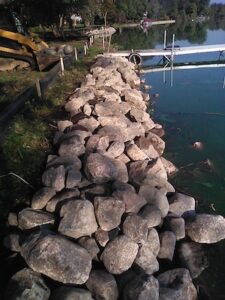
On Shipshewana Lake, Bill recently completed a project using glacier stone to protect a property that had nearly disappeared beneath overgrowth. The work called for careful cleanup, selective tree preservation, and compliance with DNR specifications.
The result wasn’t flashy, but it was solid, and it will last.
Trust Travels Faster Than Advertising
Bill doesn’t market aggressively, and he doesn’t need to. In five years, he hasn’t had a customer refuse to pay. Occasionally, someone may forget, but a reminder usually solves that.
He attributes that to something deeper than contracts.
“I was reading a devotion once about how fishermen tend to have integrity,” he says. “I think pond owners are that way, too.”
That belief guides how he works. He turns down jobs that don’t feel right. He won’t cut corners or skip permits. And he won’t promise something the land can’t support.
The result is word of mouth that carries weight.
A Business That Fits the Life Around It
Bill works mostly alone. Occasionally, his son or son-in-law helps with larger projects. Expansion and notoriety, however, aren’t his primary goals.
“I like having my own schedule,” he says. “I don’t toot my horn, and I want to keep doing the work I enjoy and maybe someday still take a vacation to Florida in the winter.”
There’s satisfaction in driving past a finished pond, knowing it will still be there years from now, quietly doing work that matters, then moving on to the next piece of land that needs listening.
For more information, contact Bill Miller of Bill’s Long Reach Service to discuss pond, lake, or shoreline projects at 260-336-0775.