

Palm Sunday Fury
It’s an incident in Northern Indiana history that one either remembers if one was alive for it, or is familiar with if paying much attention over the years: the terrible — and deadly — fury of the infamous “Palm Sunday” tornadoes of April 11, 1965, 61 years ago this month.
Six Midwestern states were hit that day with a total of 47 strong tornadoes.
In fact, the day marks the fourth-deadliest for tornadoes ever recorded, with as many as 271 people killed in the Midwest and 1,500 injured, 1,200 of them in Indiana. The Hoosier State saw 137 killed by 10 tornadoes during the late afternoon and evening (the deadliest recorded tornado outbreak was 747 killed in 1925, followed by 2011 — with 324 dead — and 1974, with 310).
Besides the storms sweeping through the Lakes area (which we’ll revisit in a moment), at least four tornadoes struck Central Indiana that evening between Indianapolis, Lafayette and Fort Wayne, with one storm destroying most of the towns of Russiaville and Alto and devastating part of Kokomo before moving into Marion.
That April 11 followed a previous month filled with cold and snow, so as warmer temperatures emerged that fateful Sunday for the first time in quite a while, many in the Lakes area were outside rather than near radios or televisions.
In fact, one of several changes wrought by the Palm Sunday outbreak pertains to dissemination of weather alerts. While radar stations were nowhere near as pervasive as they are today, weather services had actually recognized the imminent danger of the storms in time to issue adequate warnings. But many people didn’t receive them, and many didn’t recognize that a danger-related alert had been issued, since no real alert system existed outside of regular weather broadcasts.
This led, in 1966, to the introduction of the terms “tornado watch” (conditions are fertile for a tornado) and “tornado warning” (a tornado has been spotted), as well as many communities putting into place civil defense sirens to increase the reach of warnings when actual tornadoes were sighted. This was accompanied by a wider net of storm spotting through amateur radio and other forms.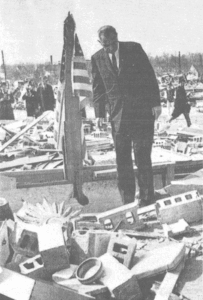
Earlier in the day on that Palm Sunday, storms had moved across Wisconsin and Illinois and tornado forecasts were issued for Northern Indiana, northwest Ohio and southeast Michigan.
As the band approached the Lakes area, damage having been done at Wanatah and Kingsford Heights, a thin funnel cloud touched down in Starke County near Hamlet, crossing U.S. 30 and moving across Koontz Lake, where some 100 cottages were damaged and one resident thrown some 600 feet to his death (one eyewitness reported seeing the funnel turn white as it picked up water from the lake as it crossed).
The tornado grew wider as it made its way toward Laville High School on U.S. 31 between Lapaz and Lakeville, where a new school building was under construction. As architects’ drawings and plans were blown across nearby fields, the tornado completely destroyed — among other things — the new gymnasium wall, which had been 28 feet high and 16 inches thick.
The County Line Brethren Church, just north of Lapaz, was completely destroyed at 6:08 p.m., just 22 minutes before members of the church choir and a Bible study group were scheduled to meet. Several nearby houses were leveled as well.
The one serious injury was to Lena Gillis, an elderly woman who was blown out of her home and thrown into the mud in the field behind it (nearby farmer Richard Mangus said Gillis was “rolled up like a mud ball” in the field; he also described seeing the bricks from the school flying in the sky “like birds” from the tornado).
Two miles west of Lapaz, 42-year-old Robert Halt saw the funnel cloud destroy the Findley Patterson farm just a mile away to the southwest (the storm killed the farm’s owner). Not trusting the safety of his own farmhouse’s tiny basement, Halt made the fateful decision to drive south on Pine Road toward U.S. 6 to escape the oncoming tornado. He watched the funnel from the car with his wife and three children as the storm jumped about erratically, eventually leveling a barn near the family’s still-moving car.
Halt told the South Bend Tribune that he “lacked 100 feet” of escaping harm, but instead timbers from the barn struck their car and destroyed its windshield. While his daughter was injured and sons unharmed, Halt’s wife, Madelyn, just 38 years old, died within minutes from her injuries. The ambulance taking them to Memorial Hospital in South Bend took some 90 minutes to make what should have been a less-than-30-minute trip, with traffic backed up badly.
In Marshall County alone, an estimated $1.5 million (1965 dollars) in damage to private property was added to the cost of damage to roads and cleanup to the tune of an additional $200,000.
One less tragic story from the Marshall County area was shared with this writer for an article in the Culver Citizen newspaper. Longtime Culver resident the late Pat Birk and her family lived in 1965 not far from State Road 6 near Lapaz. Birk said the basement of the house she and husband Art Birk and their family had was the only basement in the area, so 37 people were packed into their basement as the tornado hit.
And while Art and Pat Birk’s home had no significant damage, the old, large brick farmhouse of Art’s Aunt Laura Birk was hit while Laura and her sister were having a visit there.
“Afterwards they looked for the cattle,” recalled Pat. “The neighbors all looked, but they never did find any. Aunt Laura and Aunt Ida were buried in the mud up to their shoulders. The neighbors came over and dug those two ladies out.”
Laura Birk’s farm was destroyed except for one bizarre anomaly: a small piece of Aunt Laura’s bedroom left completely intact.
“Not far from where they were, out in the yard where Aunt Laura’s bedroom had been, her nightstand was standing exactly where it was if the house was still there,” Pat Birk recalled.
Strangest of all, still sitting on the nightstand was Laura’s Bible. When she asked what page it was on, Pat recalls, Laura said that was the exact page she had been reading.
“When somebody said something to Aunt Laura, she looked at them and said, ‘What’s so amazing about that? God knew I wasn’t done reading that yet!'”
DESTRUCTION IN THE EAST
In the meantime, the storms continued east, striking the small town of Wyatt, Indiana, north of Bremen, and hovering over Main Street, destroying some 20 homes.
The single tornado was then joined by a newly formed twister, and the path of destruction continued east to the areas of Wakarusa, Midway, Middlebury and the Dunlap/Elkhart-Goshen area, where its best-known and deadliest work was done.
Wakarusa was hit hard and a child there killed as the storm moved toward Goshen. There, it struck the Midway Trailer Court, killing 10 people and leveling some 80% of the trailer park before taking three more lives and leveling more properties in Middlebury.
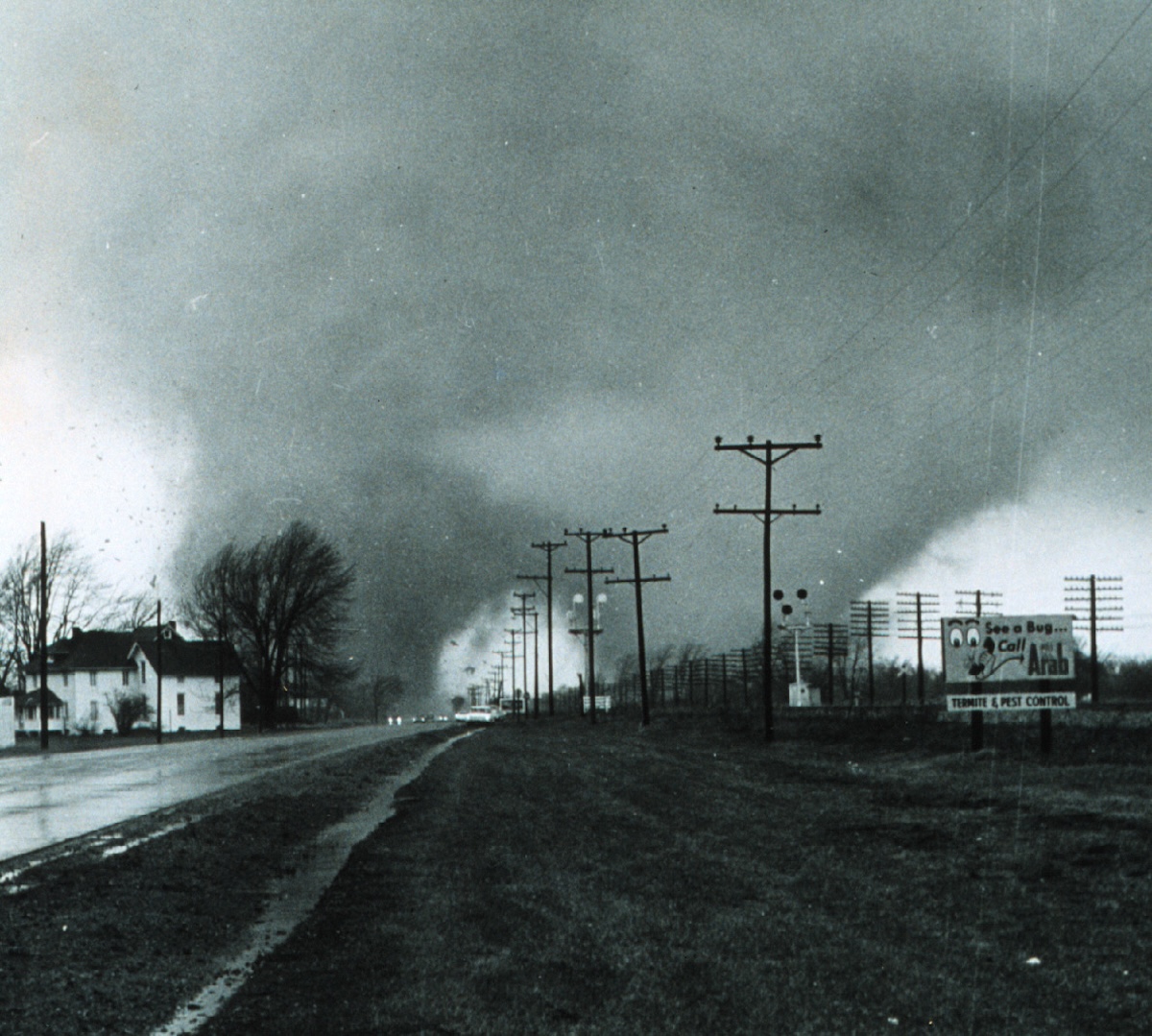
The most famous and impactful photo of that day’s tornadoes was taken by Paul Huffman, a reporter for the Elkhart Truth, who risked his own safety to photograph what had become twin funnel clouds on the way to Midway Trailer Court, as he and his wife, Betty, were awaiting the storm from about a mile south of the trailer park on U.S. 33.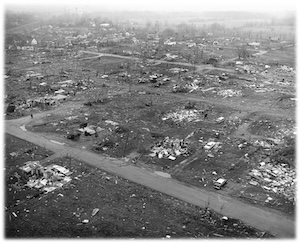
Another F4-rated tornado, around 45 minutes later, blew through just north of the trailer park, similarly splitting into two funnels and hitting Dunlap’s Sunnyside neighborhood. Since power lines and other communication tools were destroyed by the first tornado, residents of the subdivision had little warning of the approach of the extremely violent storm, and 27 lost their lives, in addition to six more killed in a truck stop and house at the intersection of U.S. 20 and State Road 15 (today, a memorial garden called “The Mighty Whirlwind” pays tribute to the lives lost, including that of 10-year-old Stevie Forsythe, whose family never rebuilt at the site).
As the storms moved toward the Shipshewana area, another F4 tornado (averaging between 207 and 260 mph) hit the Rainbow Lake area, killing 16 people, destroying the Shore Mennonite Church and allegedly sucking all the water briefly out of the lake, so immense was its power.
AFTER THE STORM
In the aftermath of the tornadoes, Indiana’s governor declared a state of emergency and news outlets across the nation reported on the situation.
Three days after the storms, on April 14, 1965, President Lyndon B. Johnson visited the area and toured the damage in Elkhart County, spending some 30 minutes at the Sunnyside subdivision site and remarking, “Horrible, just horrible.”
In all, the Palm Sunday tornado outbreak included 38 notable tornadoes, including 18 ranked at F4 or F5 on the Fujita scale of tornado intensity, and 22 of them deadly. Six states were affected. The outbreak set a record for a 24-hour timespan that stood until the first Super Outbreak in 1974. It also set a record in Indiana for tornado deaths in a 24-hour period.
The Palm Sunday outbreak was also important not only for the aforementioned changes it brought about in warning and communications systems, but also in the information gathered from it by tornado scientist Tetsuya Theodore Fujita (for whom the “F” ratings for tornadoes are named, after he developed them in 1971). Studying aerial surveys of the Palm Sunday tornado damage led him to realize that the reason some tornadoes may destroy one house but leave another undamaged nearby was not actually that the funnels “jump” off the ground, as previously assumed, but rather that the worst damage from tornadoes is caused by small mini-tornadoes within the larger funnel, which cause the most impact.
President Johnson, in a speech at the South Bend airport after his survey of the tornado damage on April 14, summed up the aftermath of the Palm Sunday tornadoes in words that were both prophetic and optimistic:
“We pray that our technology and science will some day enable us to exercise a greater measure of control and prevention (over natural disasters). Until that day comes, I know it is the will of the American people that whenever their neighbors or friends in any community, in any state, suffer such losses at the hands of nature, the government of this good and generous people should be ready and prepared to assist in every useful way.”




Comments 1
I remember that twin tornadoes in 65 I was 10 years old we went by after went all the disaster was over I’m in the storms I’m sorry and what a mess the railroad tracks around the right hand side we was headed east what a mess