


How the Interurban Railway Shaped Carmel
Writer / A. J. Wright, Carmel Clay History Museum
Have you seen the Indiana Historical Society’s exhibit on the interurban railway? The exhibit opened last winter and will run until August 1, 2026. It’s a fascinating look at a robust transportation system that has been almost completely erased from the landscape. The interurban was a network of electric streetcars that connected cities and towns across the state, and it had a large impact on the growth of Carmel.
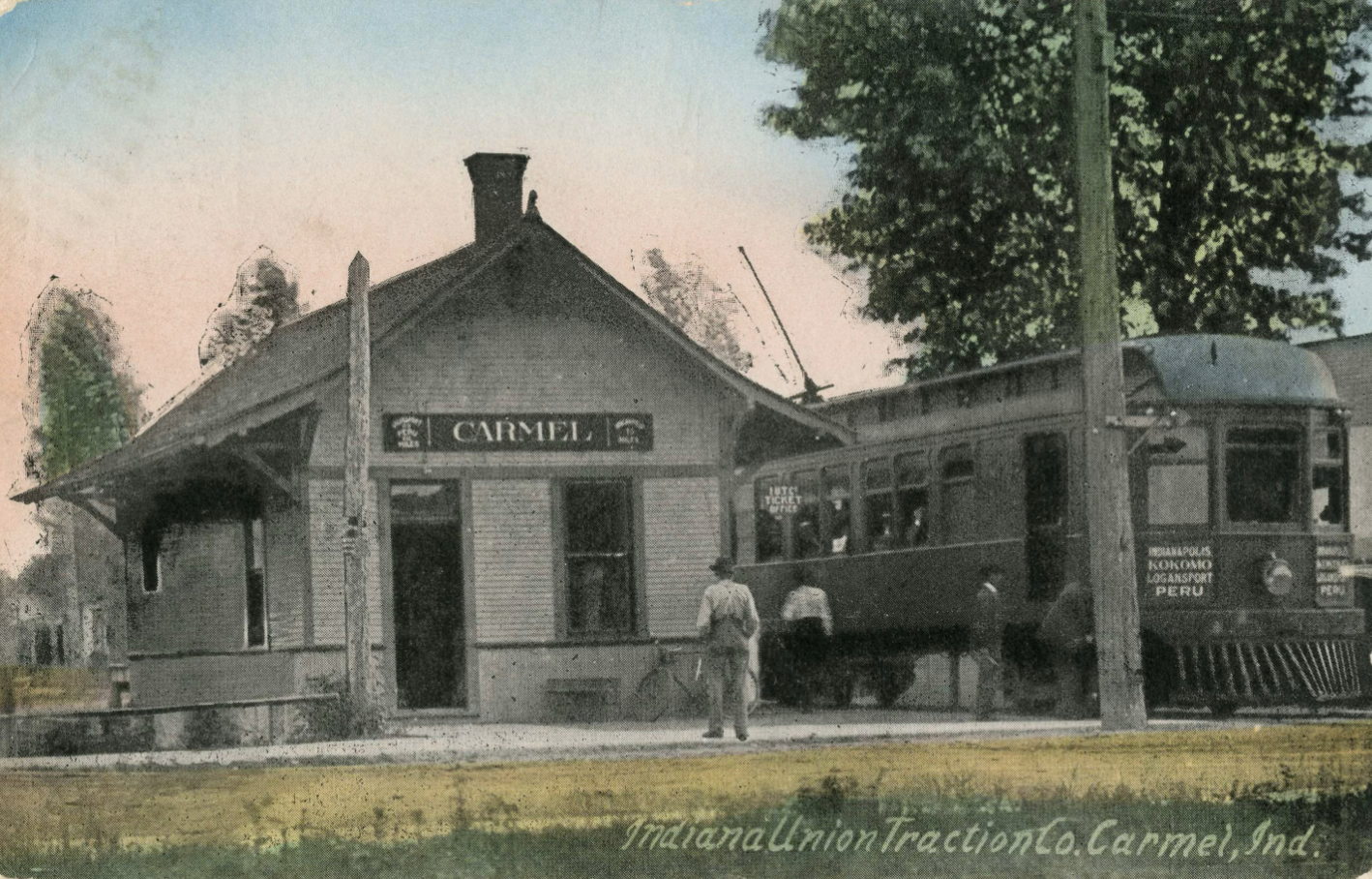
 In February 1902, Carmel’s town board granted the Union Traction Company a franchise to construct an interurban line through town. By April, Union Traction had secured the right-of-way from Indianapolis to Kokomo, and work on the line began in the summer.
Carmel resident William Kinzer wrote the following diary entry on September 7:
“A great many teams are coming to Carmel and work will commence on the electric railroad tomorrow. This will mark a great event in the history of this community. This work has been talked of a good deal, and now it looks like the work would be vigorously put through to completion.”
The interurban line entered Carmel along Willow Street, now Veterans Way/First Avenue NW. It then veered northeast at Smoky Row Road, passing through the community of Gray on the way to Noblesville. After a year of construction, the first Union Traction car rolled through town on October 30, 1903. A passenger and freight depot was built on the southeast corner of Main Street and Veterans Way in January 1906. Kate O’Donnell was the first station agent, and she held the job until 1913.
Residents appreciated the ease with which they could now travel to the capital and the county seat, as Union Traction ran 17 cars north and south each day. Louis Symons told the Hamilton County Ledger:
“I can hardly realize how convenient these interurbans are. I left home with a load at two o’clock this afternoon and drove to Carmel. I had no intention of coming to Noblesville, but it was so handy I just boarded the car and came up. I looked after some matters in less than an hour. It would have taken nearly a day to have made this trip the old way.”
The interurban spurred the growth of Carmel, as it allowed city workers to move to the small towns in the surrounding country and commute to their jobs each day. The town’s population increased by about 30% over five years after the line opened.
The interurban also gave rise to a new community. Orin Jessup envisioned a small village at the Pleasant Grove stop located at 106th Street and College Avenue. In 1914, he platted the 30-acre town of Home Place on the southeast quadrant of the intersection. Home Place was designed to be a neighborhood of modern bungalows with driveways, garages and yards big enough to keep chickens. Sidewalks lined every street, and electricity was supplied to every home by the Union Traction Company. It was a country town with the conveniences of the city nearby.
One aspect of the electric railways that does not get enough attention was their impact on the rise of sports during the early twentieth century. Soon after the interurban lines were constructed, baseball grew in popularity, as communities across the state fielded teams and expanded their schedules. There were even interurban leagues composed of clubs along the same rail line.
The interurban also enabled the rise of high school sports.
Football was the only sport offered at Carmel High School at the turn of the twentieth century, but the team only played a few games each season. However, the same year that the interurban went under construction in town, the Hamilton County High School Teachers’ Association, led by Carmel Principal John Teter, formed a committee to sanction athletic contests in anticipation of the growing demand for organized sports.
Basketball was added in 1903, and the rapid growth of high school athletic programs across the state led to the founding of the IHSAA that same year. Before long, thousands of student-athletes were traveling by streetcar to games in cities and towns across the state.
Unfortunately, interurban railroads suffered as the use of automobiles became more prevalent in the late 1920s. The assets of the Union Traction Company were purchased by the Midland United Company of Chicago at a receiver’s sale in the summer of 1930, and a new company, the Indiana Railroad Company, was organized to operate the line. However, the Indiana Railroad Company could not make the line profitable and went into receivership in June 1933.
The line through Carmel continued in operation until September 11, 1938, when the last streetcar passed through town. Imagine how convenient travel across the Midwest would be if the interurban still existed today. Sadly, it is just a distant memory.
A. J. Wright is a historian at the Carmel Clay History Museum. He has written several books on the history of Carmel that can be found on the museum’s website, carmelclayhistory.org/books.