

Making Waves
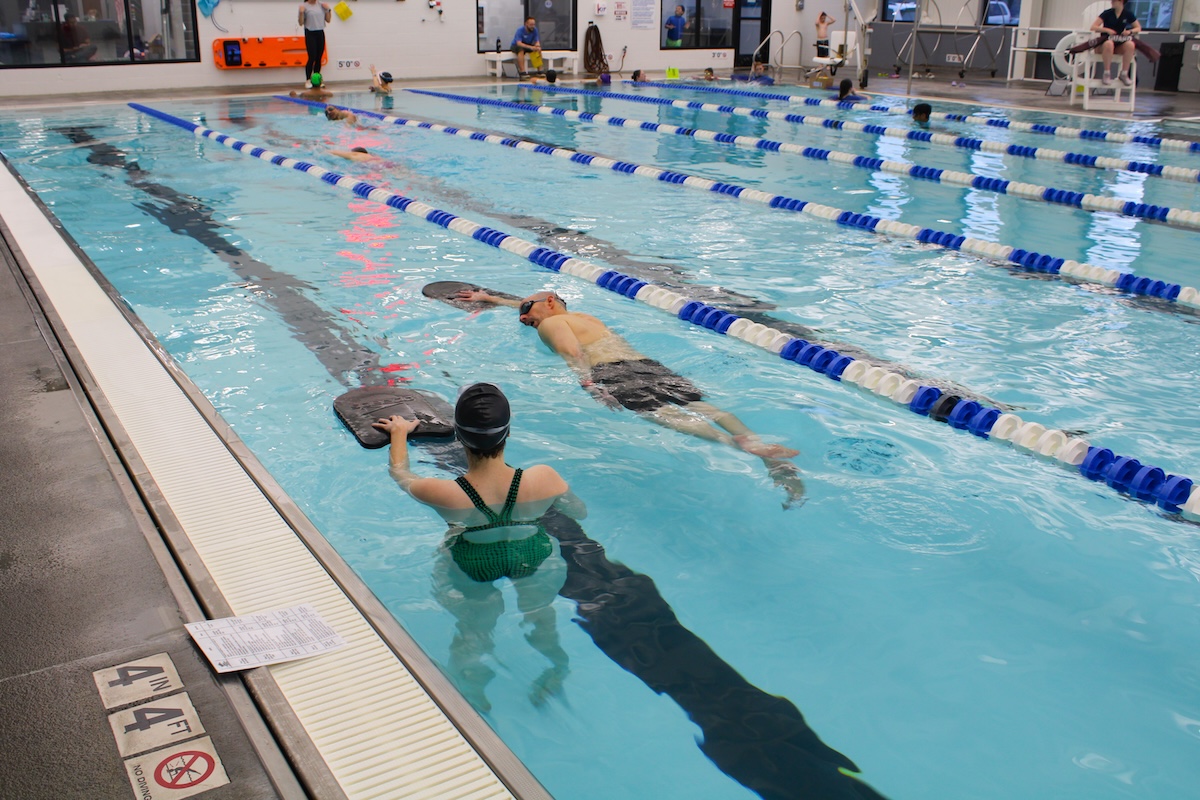
When most people imagine swimming classes, they probably think of small children wearing goggles and water wings. However, many students at Indy Aquatic Masters are parents and grandparents. Their swimming lessons for adults have gained momentum, and they will be expanding to new locations in the coming months.
“The CDC reports that 37% of the adult population in the U.S. can’t swim 25 yards. Generally, what happens is that if they don’t swim, then their children don’t swim, and it causes a lot of problems. There are 10 drownings every day. It’s the highest rate of preventable deaths in the United States,” says Mel Goldstein, founder and business development director of Indy Aquatic Masters.
“Indy Aquatic Masters is an adult aquatic fitness program, for adults who’ve chosen aquatics as a means of exercise for a healthier lifestyle. It’s generally made up of four components: fitness swimmers, competitive swimmers, triathletes and open-water swimmers. Adjunct to this master’s program, we try to teach adults how to swim,” he explains.
“We started Indy Aquatic Masters in 2011 and started the adult learn-to-swim program at the same time,” he adds. “We always wanted to expand. We’re not trying to get them into triathlons, we’re trying to save their lives. This may be a jumping-off point so that they can enjoy swimming more, or they could join other programs, but that’s entirely up to them.”
This adult learn-to-swim program is supported by the USA Swimming Foundation, United States Masters Swimming, the American Red Cross, the Indianapolis Fire Department, and recently, the Indiana Pacers Foundation.
“The reason we’re supported by them is that we teach the five competencies that they want people to know: you learn to jump in water over your head, tread water, turn around, swim 25 yards and climb out of the pool. In essence, we’re saving a life,” Goldstein says.
The classes are two days a week for four weeks. Each lesson is 45 minutes long. The classes are currently held in three locations: Carmel Swim Academy, Lawrence Central High School and the Jewish Community Center.
“The classes are relatively small, where we only have one instructor to maybe two students, but we prefer for it to be one-on-one. By the middle of April, we should have three additional locations. That way instead of 250 students, we can help 500, or even more,” he says.
“A lot of resources go into teaching kids to swim, and rightfully so, but we’re missing a lot of people in that 37% who don’t know how to swim or are afraid of water,” he adds.
Executive Director Michelle Harter says she’s been moved by some of the stories that have come out of the program, from grandparents who are finally able to join their grandkids in the pool, to students who’ve taken the course to surprise their family on vacation.
Goldstein remembers a former student of his who overcame his fear of water after taking lessons.
“I had a student several years ago who had served in Vietnam and almost drowned there. He said he turned the car around twice before he got there because he didn’t want to face that fear,” he recalls.
The staff at Indy Aquatic Masters understands that students come from many different backgrounds and have different personal histories when it comes to water. All of their students are age 18 or older, but many are around 40 or 50 years old or above.
“You stop and think about where we are in 2026; think about an African American grandmother, she’s now 65 or 70 years old, and wants to play with her grandkids in the water. Where was she going to swim in 1960 or 1970? Not only was she not worried about where to learn to swim back then, but where could she swim at all? So this is changing that. We do everything we can to adapt to teach them how to swim,” Goldstein says.
He has many years of experience with swimming and coaching. He was named Coach of the Year in 2001, and he was inducted into the International Swimming Masters Hall of Fame in 2012. Goldstein is passionate about teaching Hoosiers to swim and saving lives, and other coaches and staff members share that feeling.
“All of our instructors are certified by United States Masters Swimming, which is also partnered with the American Red Cross. Indy Aquatic Masters has been recognized three times by the national organization as the outstanding club of the year. We have several representatives who’ve been nationally recognized for their contributions to the aquatic world,” he says.
With small class sizes, the instructors are able to tailor their lessons to the students according to their ability and how comfortable they are around water.
“We have some people who are very afraid of water, and their first lesson might just be standing in it and moving water back and forth, learning how to blow bubbles, learning how to do all the mechanics that go into swimming. We teach them that the body floats, that it’s very hard for people to drown unless something is holding them down,” Goldstein says.

“We do everything we can to make it comfortable for that individual. Maybe the first lesson is just sitting on the side of the pool with their feet in the water. The second lesson, we say we’re going to try something new and we’re going to put your face in the water,” he continues.
Because of those small class sizes, however, there are only so many students who can participate in the program at a time, and that’s why they’ve been aiming to expand. Goldstein says he has a current wait list of about 80 people, and he wants to be able to help them as soon as possible.
There are between 10 and 20 instructors involved in the program at any given time, and he says many of them are in the master’s program.
“They’re giving back to the community with their time, as volunteers,” he says. “The value that we get from the program helps our core organization, because people start talking about it. I’m really proud of the fact that we’re sponsored by the Pacers Foundation. To the best of my knowledge, it’s the only professional sports team that has sponsored a swimming organization.”
Indy Aquatic Masters tries to keep the price of the adult learn-to-swim classes low so that more people are able to afford it and access life-saving training. Four-week sessions, with a total of eight lessons, are $120, with limited scholarships available.
“Learning to swim is not just life-changing for the students, but for the people who care about them,” Harter says.
For more information, visit indyaquaticmasters.com or call 317-537-7946. Potential students may email info@indyaquaticmasters.com to request being placed on their email notification list to receive alerts when registration first opens for any session.