

Everybody has a story. Most of those stories, however, will never be told, and certainly never be published. Through the Louisville Story Program, Darcy Thompson set out to not only share stories but also represent people from communities that have historically been underrepresented or misrepresented in the public discourse.
Prior to launching this documentary organization, Thompson worked for the nonprofit Teach for America. As a seasoned national staff member, he participated in a weeklong professional development retreat in New Orleans, Louisiana, doing a neighborhood, community-based story project.
“Writing and oral history mean a lot to me,” says Thompson. “I was energized to see the voices being published that you normally don’t get to hear from.”
When he got home to Louisville, he was inspired to introduce a similar model. In 2013 he began the Louisville Story Program as a one-man operation, for which he partnered with people in and around the city to develop books, exhibits and digital collections that document the richness and vibrancy of their respective communities.
“This intensive process of co-creation strengthens our community by making connections along the way by honoring legacies, building skills, educating audiences, and demonstrating the brilliance that abounds in every corner of our community,” says Thompson, Louisville Story Program’s executive director. “Often folks perceive the communities we serve as being rare exceptions of talent, when the truth is that there’s an abundance of creativity, resourcefulness, leadership and brilliance.”
Each book shares stories about different slices of Louisville life.
“My hope is that by celebrating these authors and their work that we can all learn, appreciate and hopefully spark some good civic dialogue to help us understand our city better and more fully.”
The first project by Louisville Story Program, called Our Shawnee, was written by eight high school students who were attending The Academy @ Shawnee (formerly Shawnee High School). At that time, the school had the lowest test scores in Kentucky.
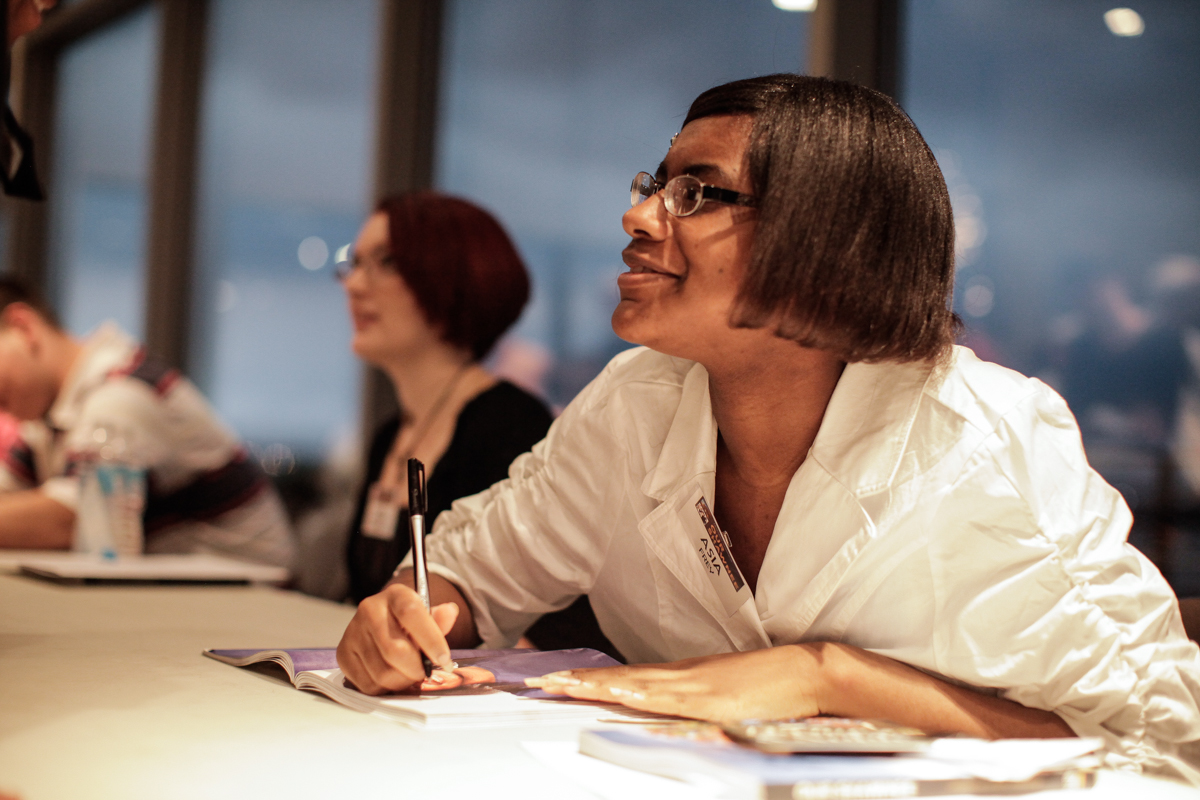
“Largely, test scores tell you about the economic demographics of a school more than anything else,” Thompson says. “We wanted to give these students the opportunity to talk about their lives using their own words.”
Our Shawnee, published in May 2014, became the bestselling book in Louisville that year. Articles touting it were published in the Courier Journal and USA Today.
Another book called I Said Bang!: The History of the Dirt Bowl includes 37 authors and details a decades-long, community-wide, grassroots basketball tournament. Published in 2016, the book won two national awards from the American Association for State and Local History. It also received a History in Progress award, which is only given to one or two projects a year in the country.
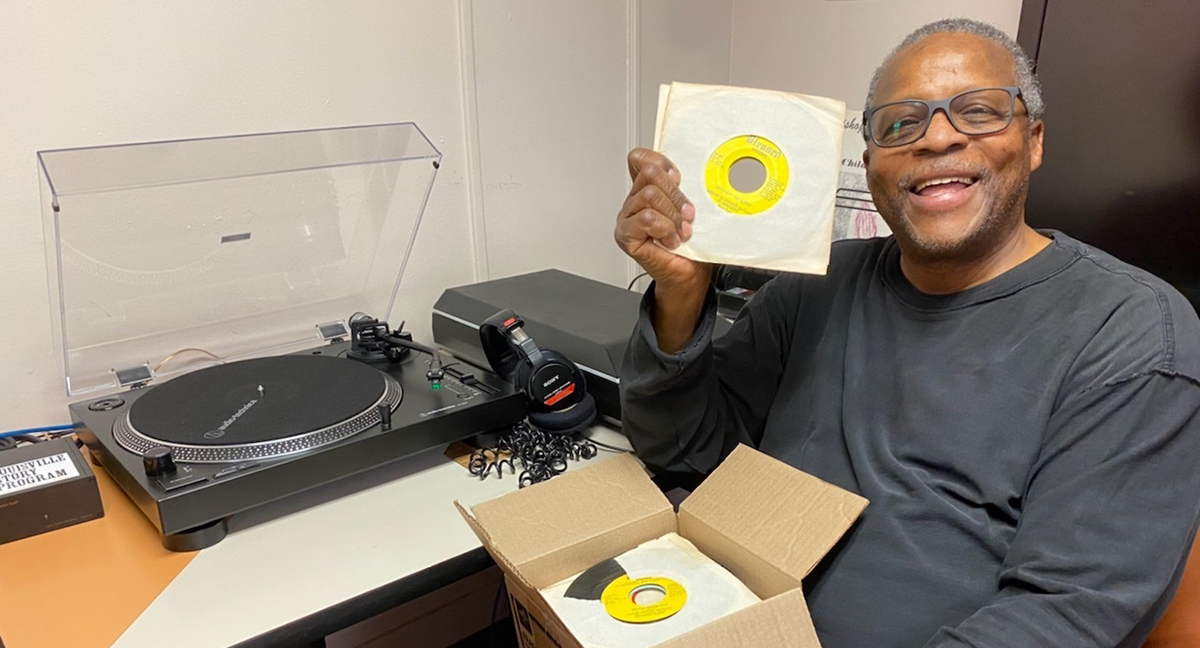
To date, the Louisville Story Program has produced 12 major publications, including the most recent from September 2024 called I’m Glad About It. It’s a book and boxed set about the legacy of gospel music in Louisville that features 83 restored recordings that were originally released on vinyl records between 1958 and 1981 by local gospel artists. Some of the projects have been photography based. For instance, Available Light, a coffee-table book, documents and preserves the legacy of Louisville’s black photographers. It honors the legacy of Bud Dorsey, West Louisville’s most iconic photographer who snapped more photos of life in black Louisville from 1970 on than anyone else in the city.
The Louisville Story Program also completed a youth project on the Kentucky School for the Blind.
“It’s the only book that’s ever been written by blind and visually impaired teenagers talking about their experiences in the world,” says Thompson, noting that they made three editions of the book, including a braille, large print, and standard print.
Better Lucky Than Good documents the backside of Churchill Downs, home of the Kentucky Derby. Written by 32 people who work in the barns performing various jobs such as stable hands, hot walkers, grooms, outriders, jockeys and gate workers, the book provides various perspectives and shows the collective effort it takes to put on the iconic race.
While the Louisville Story Program initially began with Thompson seeking out people to share their stories, as word spread, more people began knocking on their door to ask about a collaboration.
“We love it when people come to us with an idea,” says Thompson, who makes sure that during this collaboration between author and editor, he gets it right.
“We are accountable to them,” Thompson says. “It’s important because people are trusting us with their most precious stories.”
Right now the Louisville Story Program is working on a book called The Peacekeepers Project that will launch in the fall in conjunction with a national conference that will be held in Louisville.
“We were approached by a national organization called Cities United,” Thompson says. “They work with folks in 130 cities to help build safer and healthier communities by reducing community violence.”
After each project is complete, the Louisville Story Program holds book launching events where they invite the community to participate. On average, around 400 people come out to each book launch. While some people are friends and family of the authors, many are community members who are there to celebrate the project. Clearly, the community wants to hear these stories.
“There are experiences people have been affected by, in which they feel a connection through honesty and candor,” Thompson says. “Seeing their experience represented can be really powerful.”
In the case of Our Shawnee, for instance, many students go into school facing challenges with limited access to resources. Thompson explains that a student’s trauma may manifest in anger or frustration. What often follows is blame to the student and/or their family, which isn’t fair. This book shows the amazing writing students are capable of when they are supported and championed.
“That was really powerful for them because the world is always telling them and their families that they are nothing,” Thompson says. “To pour iron into their spine is really amazing.”
And then there is simply the human element that mustn’t be forgotten.
“As humans, we are wired for connection,” Thompson says. “That’s why sharing our stories is so important.”
The Louisville Story Program is located at 859 Library Lane in Louisville. For more information, call 502-583-3326, email hello@louisvillestoryprogram.org, or visit louisvillestoryprogram.org.