
The American Printing House (APH) in Louisville is the world’s largest nonprofit organization creating accessible learning experiences since 1858. Their mission is to provide braille products, materials, support services and specialized technology for people who are blind or low vision.
Opening Oct. 30, The Dot Experience is a new chapter in the APH story, designed to be the most inclusive interactive museum in the world.
Darrick Wood, director of The Dot Experience, has more than two decades of leadership in museums, attractions and educational environments serving K-12 and adult learners. He used to take his students on tours at APH.
“I would tell my students that this is a laboratory. For nearly 170 years, people at APH have been asking what is the current technology and how can we use it to make people’s lives better. For a long time, APH has been singularly focused on people with blind and low vision,” Wood said. “Our goal at The Dot Experience is to offer a world-class museum celebrating what APH does and for visitors to explore the possibilities. We want the world to look different when you re-enter it.”
Wood hesitates to call it a museum, simply because our idea of a museum is different from the one they offer at The Dot Experience.
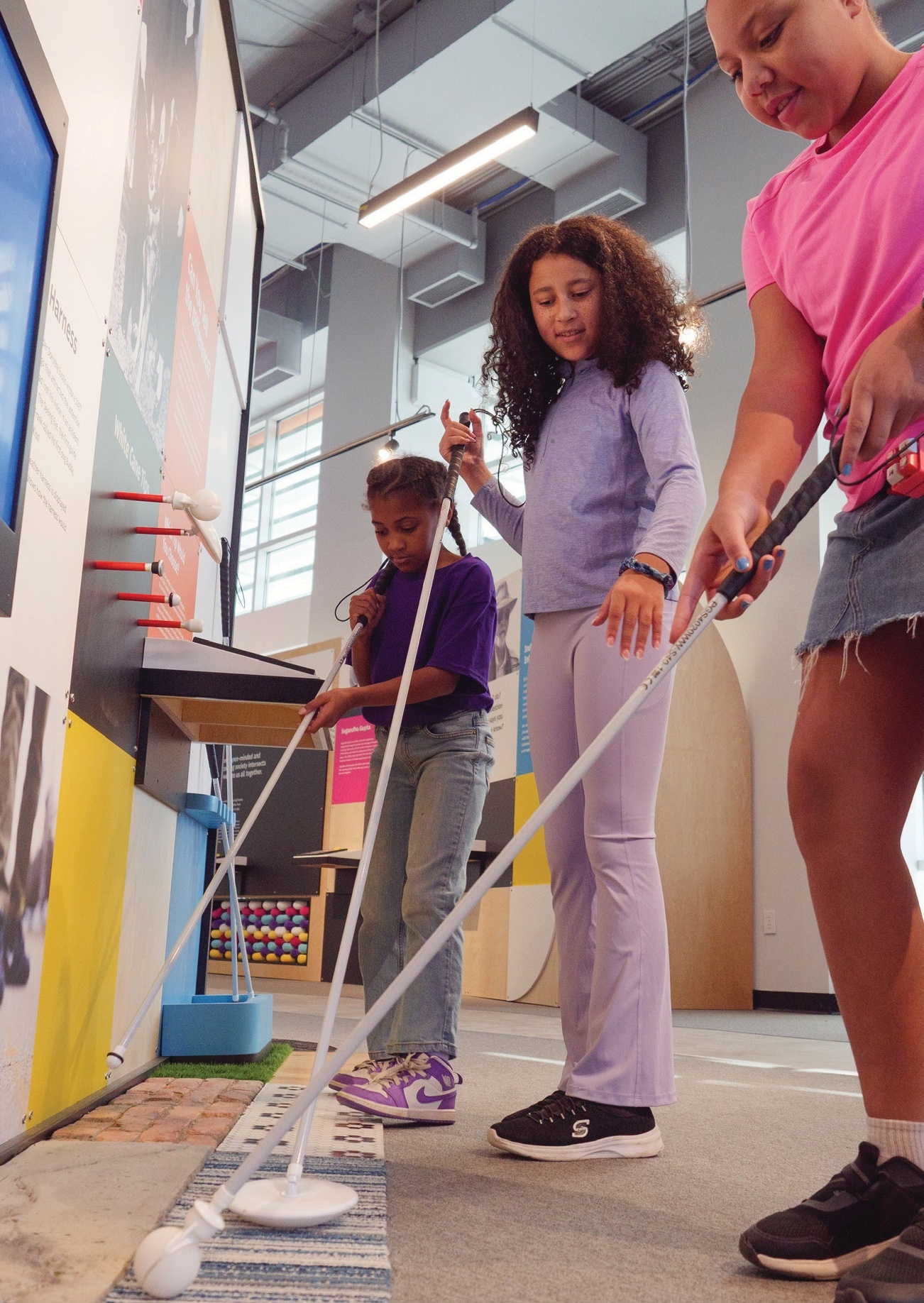
Most museums are quiet, no-touch and slow-moving. The Dot Experience is the opposite of that.
“We’ve landed on this heart-opening idea to make a commitment to inclusive design. For example, we have Stevie Wonder’s piano from his high school in Michigan. If vision isn’t your preferred way to having that moment, we decided we need to make sure people can touch it. This is an incredibly high-touch museum. There’s an option for how you interact with everything here,” Wood said.
The experience is now home to the entire Helen Keller Foundation archives also.
Visitors can feel the rush of the water and the chill of the cast-iron pump that sparked Keller’s first breakthrough with language, try a braillewriter replica and experience two different typewriters used by Keller.
Keller archivist Justin Gardner came with the collection.
“He loves the story and really works against the idea of reducing someone to a single idea. We know about the water pump, we know she was a great person, but he makes sure we know she was human,” Wood said. “I’ve heard him say, ‘Helen Keller loved Bourbon.’ He wants us to find her inspirational but not unattainable. She lived a life like everyone else.”
In addition, don’t miss the Who We Are exhibit, featuring immersive storytelling and multimedia, look at braille through the eyes of its inventor, Louie Braille, in the Change the World exhibit and find history as it comes alive in the Archival Collection.
Real People, Real Impact shares the stories of innovators, educators, artists and advocates over the years and how they have changed the future of accessibility.
The exhibits and experiences were created after a wide range of feedback.
Designers underwent play testing for all of the activities at the museum. First, asking prototype developers with an array of disabilities, from blindness and fine motor skills to others, to share their opinions.
The goal was to make sure the museum was inclusive to everyone.
“They were incredibly opinionated and that was really energizing to be a part of this. We would say, when we get it completely wrong, that’s when we’re doing the most learning,” Wood said. “Their voices mattered.”
Since then, there have been a few soft opening days, inviting neighborhood residents, staff and other groups to come in for the experience and share feedback.
The 28,000-square-foot space should take approximately an hour or two to visit, but while there, don’t miss the additional factory tour.
The APH building is connected to The Dot Experience. They’ve created a walking path throughout the factory, and each day, tours are offered.
“People have been really impressed with the factory tour too. You’re able to be right there with the staff buzzing around you. Based on the day, they might be working on a project for the Library of Congress, printing educational materials for third graders or fine-tuning microscopes for those who are blind or low vision,” Wood said.
The museum is equipped with ASL interpretation and other languages. While staff at The Dot Experience are constantly asking who doesn’t feel welcome here yet and what can we do to change that, there’s a bit of education and advocacy for those without disabilities, too.
“There are two things that can happen when confronted by a community that has been historically marginalized. You can back away because it’s scary, new or unknown, or you can have an experience that’s so welcoming and engaging that it opens people’s hearts,” Wood said. “We want people to say, ‘I didn’t know this,’ ‘My world has gotten bigger.’”
Yes, it’s a museum and an interactive one at that. It’s full of artifacts, education and unique stories to tell. However, The Dot Experience staff hope it becomes more than that.
“I think in addition to the intentional design and the big choices here, the piece that takes longer to consciously notice is to see these examples and then ask yourself how you fit into all this,” Wood said. “How can I get involved; how do I become more aware of new communities? What has been that subtle change in you after visiting?”
Visit thedotexperience.org for more information.