
For generations, the name Goodwill has been synonymous with secondhand stores, clothing donations and the familiar feeling of knowing that something no longer needed can find a new home. But behind the racks and donation centers is an organization whose reach extends far beyond retail.
Today, Goodwill Legacy Group is helping individuals and families overcome barriers to economic independence through education, employment, health and housing. At the center of that work is the Goodwill Foundation, the organization’s philanthropic arm, which for more than 50 years has connected community members, businesses and foundations with opportunities to help advance Goodwill’s mission.
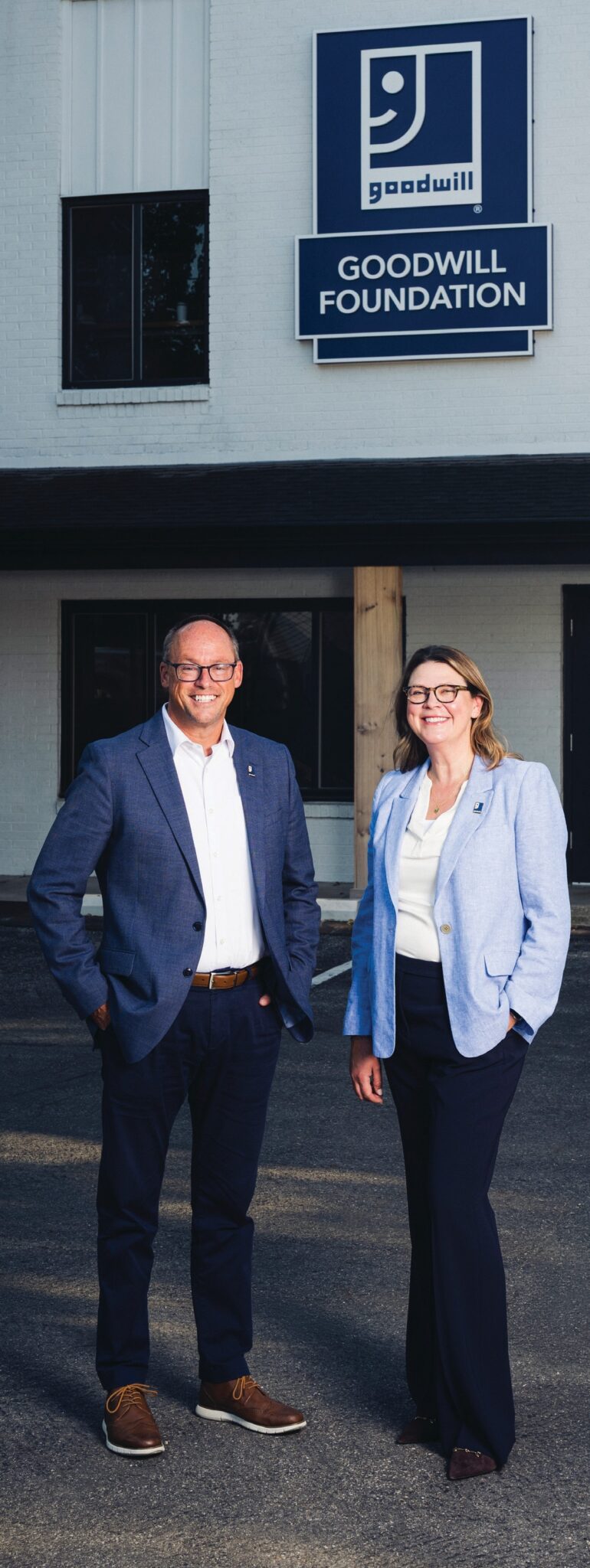
“The Goodwill Foundation helps connect people, businesses and foundations that want to make a difference with Goodwill’s broader mission of helping individuals and families build greater independence and reach their potential,” says Rachel Cline Eble, Senior Vice President and Chief Philanthropy Officer.
Philanthropic support enables Goodwill to strengthen existing programs, expand successful initiatives and respond to emerging needs. It also provides an opportunity to test new ideas and bring promising solutions to more people.
Ultimately, Cline Eble says, the Foundation brings together people who share a fundamental belief: everyone deserves the opportunity to build a fulfilling and independent life.
While Goodwill’s retail operations remain an important part of its model, creating jobs and generating resources to support its mission, the organization’s work encompasses a much broader range of services.
Goodwill operates The Excel Center, a network of tuition-free high schools that help adults earn a high school diploma. It also operates Indianapolis Metropolitan High School, which provides a different educational environment for traditional-aged students who may benefit from an alternative approach.
Through Goodwill Nurse-Family Partnership, registered nurses work with first-time parents beginning during pregnancy and continuing through their child’s second birthday. Goodwill also provides employment and workforce services for individuals who face barriers to work, including people with disabilities, limited education or involvement with the justice system.
More recently, housing has become a fourth pillar of Goodwill’s mission. “We believe that serving people holistically through education, employment, health, and housing is the best chance for people to thrive,” Cline Eble says.
That holistic approach reflects an understanding that the challenges facing individuals and families rarely exist in isolation. Goodwill Legacy Group, the organization’s multiregional organization, now serves more than 15,000 individuals each day. Yet even as its reach has grown, the needs remain significant.
“The challenge isn’t usually one isolated barrier,” Kent Kramer, President and Chief Executive Officer. “It’s several things happening at the same time. That is why Goodwill focuses on a holistic model, because economic mobility is rarely created by solving just one problem.”
For nearly a century, Goodwill has focused on helping people obtain meaningful employment and achieve greater independence. But the organization has continually adapted its programs as community needs change.
Employment remains at the heart of the mission, but Goodwill recognized that education can be a critical first step toward a better job. In Indiana, nearly 500,000 working-age adults lack a high school diploma, helping drive the creation and expansion of The Excel Center.
Likewise, health and housing programs address barriers that can make long-term employment difficult to sustain. Goodwill Nurse-Family Partnership supports first-time mothers and their children, while Goodwill Horizon House helps neighbors experiencing homelessness find greater stability.
The evolution reflects a central Goodwill philosophy: economic mobility requires looking at the whole person.
“We want to build solutions that can work at scale, adapt to different communities and improve economic mobility not just for an individual, but for the next generation as well,” Kramer says.
The people Goodwill serves are equally diverse. They may include an adult returning to school years after leaving high school, a first-time mother seeking the healthiest possible start for her child, an individual with a disability who wants to work, someone experiencing homelessness or a person rebuilding a career after involvement with the justice system.
What they share is a desire to move forward. “Every individual has value, and every person deserves a chance to reach their potential,” Cline Eble says.
That philosophy of connection is now taking physical form in Broad Ripple, where the Goodwill Foundation has established a new office. The team chose the location in part because the neighborhood has a strong sense of community and offers a mix of residents, entrepreneurs, small businesses, nonprofits and longtime institutions.
“We wanted the Foundation to have a home that reflects what we want philanthropy and community engagement at Goodwill to be: welcoming, collaborative and connected,” Kramer says.
The Broad Ripple office will primarily serve as a home for the Foundation and a place to bring people together. Donors, volunteers, businesses and community organizations can meet with the Goodwill team, learn more about its work and explore opportunities for collaboration.
For Cline Eble, the location is about more than having a new office. It is about creating a point of connection between Goodwill and people who may know the organization primarily through its stores.
“I see Broad Ripple as a place where someone can come in knowing Goodwill as a place they donate items and leave understanding the much larger impact they could be a part of,” she says.
The Foundation’s role is to build the relationships and resources that allow Goodwill’s programs to grow. That makes connectivity one of the most important opportunities connected with the new location.
Community members interested in getting involved can support Goodwill’s mission in many ways. Financial contributions through the Goodwill Foundation help fund programs and services. Volunteers can contribute their time and skills, while businesses can partner with Goodwill through philanthropy, sponsorships, employee volunteer opportunities and donation drives.
Volunteerism, Cline Eble says, can also be an educational experience, an opportunity for people to better understand the barriers many Hoosiers encounter on their path toward economic independence.
Goodwill can match volunteers with opportunities based on their interests and availability. That might mean serving alongside retail associates, working with students at The Excel Center as they prepare to enter the workforce, or supporting Goodwill Horizon House by organizing donations and packing meals or snack packs.
Businesses, meanwhile, can work directly with Goodwill to connect their philanthropic priorities with the organization’s mission. “We spend a lot of time speaking with companies about what their philanthropic goals are and finding ways to connect those goals to our mission,” Cline Eble says.
The goal is to create partnerships that are meaningful for both the organization and the community. Goodwill Indy’s greatest opportunity is helping people understand how much the organization does. Goodwill has strong name recognition, but Kramer says a gap remains between knowing the name and understanding the mission.
The new Broad Ripple office is one way Goodwill hopes to close that gap. The organization’s goal for the coming year is to build relationships with residents and businesses, strengthen connections with existing supporters and create more opportunities for philanthropy, volunteerism and corporate engagement.
For Goodwill, those relationships are essential. They provide the resources and partnerships needed to innovate, expand successful programs and respond when new needs emerge. And for the community, understanding the mission offers an opportunity to see a familiar organization through a new lens.
Goodwill is not simply a place to donate gently used items. It is a network of programs that provide education, training, coaching and support to people working toward a better future.
“When you engage with Goodwill, you are investing in the future of our community,” Cline Eble says.
Everyone ultimately shares the vision: meaningful work, a safe place to live, access to education, a healthy family, and the opportunity to build a good life.
Goodwill’s role is to help remove the barriers that stand between individuals and those goals. Its Foundation provides the resources that make that work possible. And its new Broad Ripple home offers another place for the community to join the effort.
Because when more people join the mission, the impact reaches farther, not just helping individuals today, but strengthening families and communities for generations to come. For more information, visit goodwillindy.org/foundation.