

Writer / Amy Beaucham
For anyone who regularly loads and hauls motorcycles, lawn equipment, appliances, or other heavy items, traditional trailer ramps can create unnecessary frustration. Drivers must allow ample space behind the trailer, position the ramps, and carefully guide the load up an incline that may be steep, awkward, or difficult to navigate.
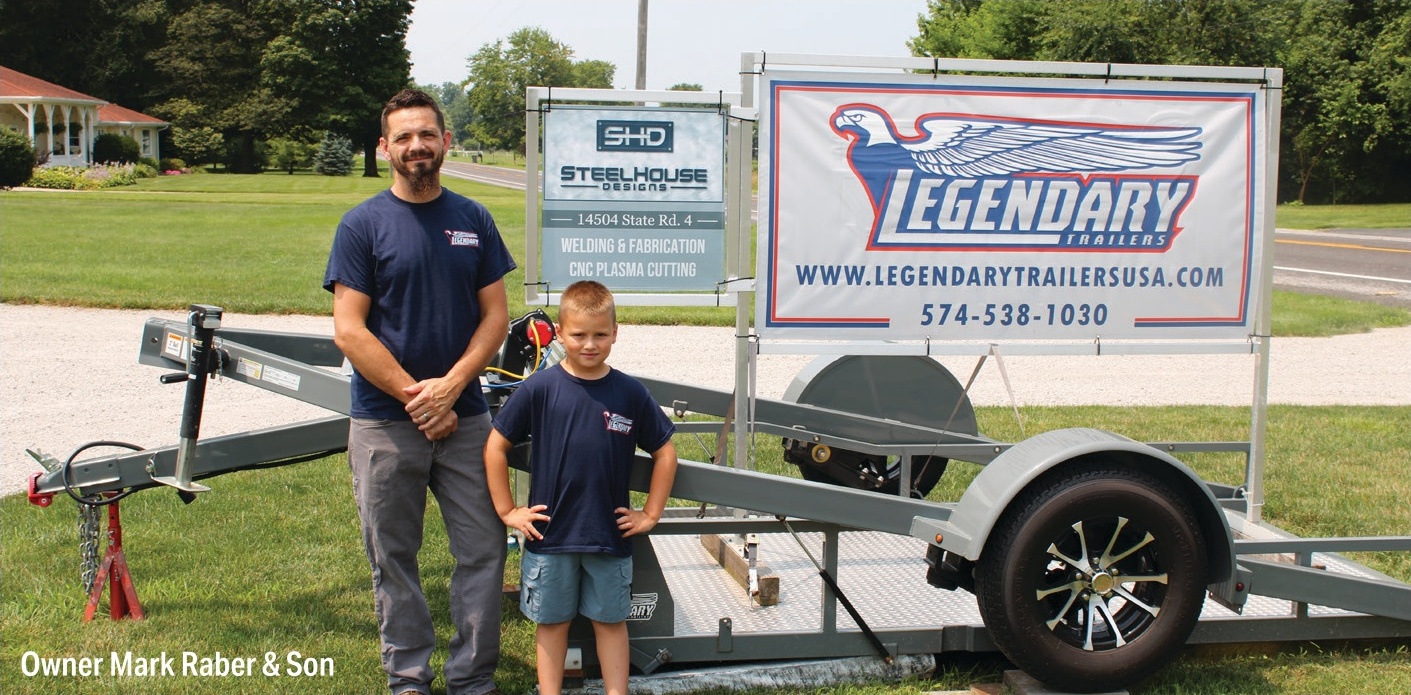
Mark Raber believes there is a better way. At Legendary Trailers in Goshen, Raber builds specialty drop-deck trailers that lower completely to the ground. Instead of pushing or driving equipment up traditional ramps, customers can load it directly onto a level deck. With the push of a button, the deck rises into position and locks securely for travel.
“Let’s be honest, ramps are a hassle,” Raber says. “They’re either heavy and awkward, or light enough to bend and break.”
His trailers are designed to eliminate that hassle, helping customers load motorcycles, lawn equipment, furniture, appliances, tools, and other valuable items more easily and safely.
Raber’s interest in metalworking began long before Legendary Trailers received its Indiana manufacturing license in December 2024. As a child, Raber spent as much time as possible in his grandfather Andrew’s blacksmith shop.
He remembers the ringing of metal and the distinctive sights, sounds, and smells of the shop. He also remembers how welcome his grandfather made each grandchild feel as they watched him work.
“I’m sure we were probably annoying at times, but I never got that from him,” Raber says. “I always felt like he loved having us in there.”
His grandfather became well-known and respected throughout the community. He treated each visitor as an individual and modeled the kind of personal service Raber would later bring to his own work.
Although Raber grew up fascinated by the sights, sounds, and smells of his grandfather’s blacksmith shop, he did not begin working with metal himself until after he was married. He started by experimenting with welding, then gained additional experience through production welding. He later established Steelhouse Designs, his welding and fabrication shop on his family’s Goshen property.
The skills, tools, and experience he developed through that work eventually allowed him to pursue an idea that captured his attention.
Raber first saw a drop-deck trailer at a local shop in Shipshewana. The concept impressed him immediately, but he also recognized components of the design that could be improved.
“I wanted to make the best drop-deck, ground-level utility trailer that anybody could buy,” he says.
Raber studied the existing trailers, designed his own version, and built a prototype in his fabrication shop. His friend and neighbor Brad, a retired automotive engineer, spent many hours helping him brainstorm during the development process. Brad offered Raber ideas, technical insight, and encouragement as the design took shape.
The result was a trailer Raber believes offers greater versatility and convenience than many traditional models on the market.
Many drop-deck trailers require you to disconnect from your tow vehicle before lowering the deck. Others require you to walk around the trailer to manually remove and reinstall locking pins on both sides.
A Legendary Trailer eliminates those extra steps. The trailer remains connected to your tow vehicle throughout the loading process, while Raber’s innovative single-lever deck-locking system lets you release and secure both locking pins from the driver’s side. Lower the deck, load your cargo, raise it back up, and lock it—all without stepping over the tongue or walking around the trailer.
It’s a smarter design that saves time, reduces effort, and makes every load easier.
The trailer uses an electric winch and an onboard 12-volt battery rather than a traditional hydraulic system. Raber explains that the winch helps keep the trailer affordable, simplifies operation, and eliminates concerns about leaking hydraulic fluid or ruptured hoses.
Replacement parts are also easier to find. Should a winch eventually require replacement, a suitable model can be obtained from many tool retailers or online suppliers. Customers do not have to locate a hydraulic repair shop or have special hoses manufactured.
Raber also points out that the winch serves another purpose. Its strap can be disconnected from the deck and used to pull an item onto the trailer. This can be especially helpful when loading a disabled mower, a broken-down utility vehicle, a heavy tool chest, or equipment that cannot move under its own power. Although broken-down motorcycles can often be pushed onto the lowered deck, the winch provides another convenient loading option when needed.
Raber shared the recent experience of a customer who had purchased a Legendary Trailer and needed to transport several large mechanic’s tool chests. The customer expected to have to use the winch to load them. However, once the trailer was lowered to ground level, he found he could simply roll them directly onto the deck. Being able to adjust the trailer to an ideal loading position made the task significantly easier.
Those moments are among the most rewarding parts of Mark’s work.
“I just love seeing people’s faces light up when they first see the trailer operate and realize how much easier it can make the loading process,” he says.
One of Raber’s friends borrowed the trailer to pick up a small tractor. When the seller saw the deck begin to lower, he stopped to retrieve his phone and record it in action. His wife soon joined him and playfully remarked that she wished her husband had never seen the trailer because she already knew he would want one of his own.
The ramp-free loading design can also be especially beneficial for motorcycle owners. Raber knows from experience how challenging it can be to guide a heavy motorcycle up a ramp. As the motorcycle reaches the top, the rider’s feet may no longer reach the ground, creating a brief but unsettling moment before the bike reaches the trailer deck.
Raber’s own Harley-Davidson once broke down and could not be repaired. Instead of attempting to push the disabled motorcycle up a ramp, he lowered his trailer and moved the bike directly onto the deck with minimal effort.
The design can also accommodate customers with limited mobility or strength. Raber’s father-in-law, Tom, lost the use of his left arm after having polio as a child. For him, managing a heavy ramp while also releasing pins is extremely difficult. Operating the trailer with the push of a button offers a far more practical and accessible solution.
Raber believes the trailers can help older adults, women who want to load equipment independently, and anyone who would rather avoid lifting and positioning a cumbersome ramp.
Three standard sizes are available from Legendary Trailers. The 4-by-8-foot model works well with smaller sport utility vehicles and for everyday hauling needs. Its usable deck is slightly larger than 4 feet by 8 feet, which allows it to accommodate a standard sheet of plywood. A 6-by-10-foot model is available for utility use or for transporting a single motorcycle, while the popular 6-by-12-foot model offers greater versatility and can accommodate two motorcycles.
Every trailer produced by Raber comes standard with aluminum wheels, an aluminum tread-brite floor, LED lighting, an onboard battery, an electric winch, square-tube railing, a powder-coated steel frame, and a welded-in rock guard. The aluminum battery and storage box also provide room for straps and other accessories.
Raber added the welded rock guard after seeing trailers with pieces of plywood attached to their fronts in an attempt to protect cargo from road debris. He wanted the protection built into the trailer to provide additional strength while also maintaining an attractive appearance.
Motorcycle owners frequently add the optional 16-inch aluminum rock guard for even greater protection. Other options include auxiliary deck-loading lights, self-locking motorcycle wheel chocks, wood or steel flooring, and custom powder-coat colors.
The auxiliary lights brightly illuminate the deck when a customer is loading after dark. Instead of trying to hold a flashlight or adjust a headlamp, the operator can flip a switch located inside the battery box.
At the heart of every Legendary Trailer is a frame Raber constructs for durability. He uses tubular steel rather than lighter angle iron, which may bend or warp over time. He also uses thicker-wall steel tubing than many competing manufacturers.
“I never want to settle for something that’s simply good enough,” Raber says. “I want to build something that’s truly durable.”
Each Legendary Trailer is built to order, with an estimated completion time of four to six weeks. Raber is involved in every stage, including ordering components, positioning each piece, welding, assembly, and final inspection. Customers may pick up their trailers in Goshen, and delivery or shipping arrangements may also be available, depending on location.
Raber offers a three-year structural warranty and a one-year component warranty. He considers those warranties an extension of the responsibility he feels toward every customer who trusts his craftsmanship.
“I take it very seriously that people put their trust in me to haul their valuable equipment down the highway,” he says.
That responsibility is reflected in the three words at the heart of Legendary Trailers: honesty, quality, and integrity. Those three principles guide Raber’s workmanship, his customer relationships, and every decision he makes while building a trailer.
“Without honesty, there won’t be any trust,” Raber says. “Without trust, there are no sales. Without quality, customers may feel disappointed and undervalued. Without integrity, one might be tempted to cut corners or compromise when things get tough.”
Because Raber has spent much of his life around the RV manufacturing industry in Elkhart County, he has seen how easily production can become centered on quotas and numbers rather than the person purchasing the finished product. He wants Legendary Trailers to remain different.
“There are still companies that genuinely have the customer’s best interests in mind,” he says. “You can still uphold that standard and build a high-quality product.”
Legendary Trailers is also a family-oriented business. Raber’s wife, Sharon, handles the bookkeeping, office responsibilities, and other administrative needs. Their daughter, 10-year-old Makenzie, and son, 7-year-old Mason, contribute in age-appropriate ways by sweeping the shop, holding the camera while Raber records social media videos, and proudly identifying situations where someone could benefit from a drop-deck trailer.
Whenever they see someone struggling to load a traditional trailer, the children are quick to offer their assessment.
“Hey, Dad, I know what kind of trailer they need,” they say. “They need a Legendary Trailer.”
After years of balancing Legendary Trailers and Steelhouse Designs with a full-time career in RV manufacturing, Raber now devotes himself fully to the businesses. Building trailers has become far more than a side project. It is the work he believes he was equipped and called to do.
“These trailers have been my dream and my passion,” he says. “I really want more people to know about them and experience using them.”
His long-term goal is to establish a dealer network and create a Legendary Trailers presence in every state. He plans to connect with established trailer dealers, attend industry events, strengthen the company’s social media presence, and continue introducing customers to the benefits of the ramp-free loading design.
Growth is important, but Raber does not want it to come at the expense of the qualities that inspired the business. He hopes to combine innovation with what he describes as old-world values. His thoughts often return to his grandfather’s blacksmith shop, where people knew one another, respected the craftsman behind the work, and received service they could trust.
Mark’s grandfather never had the opportunity to see his grandson become a professional metalworker or to see him establish Legendary Trailers. Andrew’s influence, however, can be found in every carefully placed weld, every customer relationship, and every decision Mark makes to prioritize quality over shortcuts.
“At Legendary Trailers, we believe quality over quantity isn’t just a slogan — it’s a commitment,” Raber says. “We still believe in honest workmanship, treating people right, and building products we’re proud to stand behind. Those old-world values still exist, and they’re built into every trailer that leaves our shop.”
Through Legendary Trailers, Raber is honoring the past while building something innovative for the future. By combining old-world craftsmanship with practical innovation, he has created a better way to haul. More importantly, he has built a company grounded in the same honesty, quality, and integrity that first inspired him in his grandfather Andrew’s blacksmith shop.
Some things are meant to be lowered. Standards are not one of them. Guided by the values he first witnessed in his grandfather’s blacksmith shop, Raber has designed an innovative trailer that lowers its deck with ease while upholding the deeply rooted standards at the heart of his work.
Legendary Trailers is located at 14542 State Road 4, Goshen, IN 46528. For more information visit legendarytrailersusa.com, call 574-538-1030 or email office@legendarytrailersusa.com.