

American businesswoman Elizabeth Holmes headed the now defunct company Theranos, manufacturer of a device said to have the ability to perform hundreds of blood tests from a sample so small as a finger prick. Theranos stock had such a high valuation in the early 2010s that Holmes became the youngest female billionaire in the U.S. Unfortunately, the device didn’t work. And in 2018, a federal grand jury convicted CEO Holmes (and COO Sunny Balwani) of defrauding investors. She paid a fine, and in 2023 began serving an 11+ year sentence in a federal prison in Texas.
Always reluctant to face the media, Holmes gave virtually unlimited access to herself, her partner Billy Evans, and their two young children to documentarian, comedian, and performance artist Nathan Fielder. Just over a month prior to the onset of her prison stint, Fielder began recording nearly every aspect of Holmes’ life in San Diego, as well as interviewing her, her businessman father, and Evans. Regarding darn near everything. The resulting motion picture, “You Can See Everything” is this year’s most mystifying film. Is it a documentary? Is it performance art? Or both?
I’ve always had a little bit of an issue with Michael Moore’s insistence on putting himself in all his films. Is that necessary? To wit, who made “Woodstock?” The answer is Michael Wadleigh, but you’d never know. Wadleigh didn’t appear in the film, nor did we even hear him asking questions. He simply recorded his subjects as talking heads – interspersed of course with music and crowd scenes. Not the case with Moore. Definitely not the case with Fielder. Not only does he appear in every scene, but he eventually moves in with Holmes and Evans!
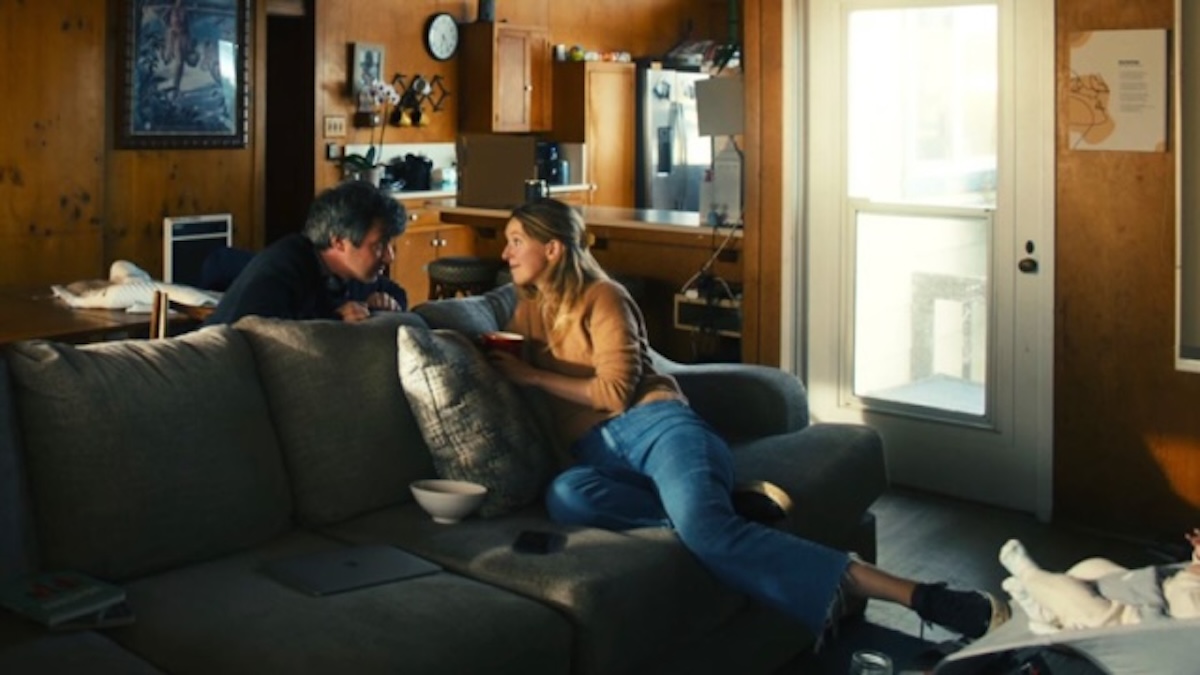
And he films “You Can See Everything” in extreme close-up. When the camera backs out enough to frame both Fielder and Holmes, we see that he sits uncomfortably close to her. Is there more going on here than simply an interviewer asking probing questions? Don’t know. But as they used to say back in the day, “It’s a helluva way to run a railroad.”
So, what do we learn about Holmes? We learn she does not believe she is guilty of anything. Save for the little white lies of childhood, she believes she has never told a lie. She believes she did not defraud any investors, and that the Theranos blood tester had the capability of performing hundreds of blood tests. But that’s where Fielder takes issue with Holmes’ verbiage. When she claims the Theranos machine “can run hundreds of tests,” she means it “has the capacity” to run hundreds of tests. The machine was never tested.
So, is she merely guilty of poor word choice? It’s not so simple. As you might imagine, Holmes is brilliant, but in strictly a right brain manner. She understands the science behind her inventions – and cares far more about that science – than she does the intricacies of running a business. In fact, just days prior to the beginning of her prison term, we see her on the phone soliciting potential investors for a new invention which she plans to work on inside the prison walls via communication with Evans and others on the outside.
So, right brain? Works great! But left brain? Oh my! Fielder shows her a video of Abbott & Costello’s classic “Who’s on First?” bit – a comedy routine with which Holmes claims she is unfamiliar. And guess what? She doesn’t get it! She doesn’t understand that “Who” is the name of the team’s first baseman, “What” is the name of the second baseman, and “I Don’t Know” is the name of the man on third. This of course is the genius behind the routine. Could Holmes be the only person in the world who doesn’t understand?
Later, Fielder shows her another video. This is of the 2022 Hulu miniseries “The Dropout,” starring Amanda Seyfried as Holmes in a biography of Holmes, including the downfall of Theranos. Seeing this depiction for the first time brings Holmes to tears. She has no problem grasping what she believes is a one-sided depiction of her life, and she gets to the point where she must ask Fielder to stop the video; she simply cannot watch anymore.
Once Holmes reports to the federal prison, Fielder makes a directorial choice which shifts “You Can See Everything” from documentary to performance art. He brings Seyfried herself into the film! He begins by sharing the footage he shot of Holmes, Evans, and himself during her final days of freedom. Why? Because he later uses Seyfried to “play” Holmes during scenes which were not (or could not be) filmed.
Seyfried plays Holmes (and actor Christopher Abbott plays Evans) in a scene depicting Fielder and co-director Lance Oppenheim sitting at Holmes’ dining room table pitching the idea to her. Obviously, no cameras were present at this meeting because Fielder’s crew hadn’t started filming yet. Same with the film’s final sequence in which Fielder is allowed a short visit with Holmes in the visiting area of the prison. Again, no cameras or film crew allowed here. So, Fielder recalls their conversation as best he can, and then has Seyfried play Holmes for “You Can See Everything.” Interesting? Certainly. But would a true documentarian include Seyfried in this work at all?
So, what do we learn from spending nearly three hours with Holmes as filtered through the mind of Nathan Fielder? Ironically, very little. Unlike a Michael Moore film, in which the good guys and bad guys are determined very early on, Fielder doesn’t take a stand one way or the other. He simply lets Holmes and Evans spill their guts on the proverbial floor, and leaves us to piece the puzzle together.
On the one hand, Holmes may be oblivious to some of the finer workings of the business world. On the other, COO Balwani likely took advantage of Holmes’ naivete during the heyday of Theranos. Evans may be doing so now. He claims the two fell in love within the first half hour after they met – before Evans even knew who she was. Once Holmes is in prison, Evans posts to Holmes’ Facebook page – as Holmes! He claims they know each other so well, he knows exactly how she’d respond to each post.
Is Holmes’ simply the victim of poor business (and life) choices? Perhaps, although we see Evans is a wonderful father to their two young children. If he’s the “bad guy” of this picture, he’s certainly not painted as pure evil, a la your typical Michael Moore bad guy.
Maybe Holmes is the sharpest tool in the shed. Maybe she’s pulling the wool over Fielder’s eyes, and by extension, ours. Maybe she really does understand “Who’s on First?” but refuses to admit it, lest she provide Fielder with the bait he feeds her in attempt to trap her in an unwitting lie regarding her word choice to Theranos investors.
It’s hard to say “You Are Everything” is entertaining. In parts, it’s downright uncomfortable. But it is one of the most thought-provoking films of recent years. You’ll be thinking about this one, and playing it over in your mind, for days after viewing it. And even though it’s not “entertaining” in the purest sense of the word, it left me begging for more.
Upon the conclusion of Richard Linklater’s 2014 classic “Boyhood,” I found myself longing for more story. I wrote that I hoped Linklater would continue to film his four protagonists during the ensuing years and eventually release a sequel, so we would know what happened to the characters. I felt the same way at the end of “You Can See Everything.” I want Fielder to be present in 2034 when Holmes leaves prison. I want extensive interview footage of Holmes’ thoughts and dreams at that time in her life. I feel like there’s more to this story. And since this is real life, it hasn’t been written yet.
But if Fielder does eventually make a sequel / follow-up, I don’t feel like I need to see Amanda Seyfried anymore.