

Film Review – The Bride
Maggie Gyllenhaal’s second directorial effort, “The Bride!”, almost works as a companion piece to Guillermo del Toro’s 2025 film “Frankenstein.” Although the two films were shot simultaneously – and both based on Mary Shelley’s classic “Frankenstein” novel – they were released by different studios, adapted by different writers and directors, and feature completely different casts. It just so happens the two films have been released within months of one another.
The curiosity to me is that del Toro’s film was released last fall – in anticipation of the forthcoming Oscar season. Whereas Gyllenhaal’s project has just now been released in March – typically the time of year when studios release material they know stands no chance of garnering any nominations for next year’s awards season. Why is this a curiosity? Because I actually prefer “The Bride!” (I also prefer the old 1935 “Bride of Frankenstein” to the 1931 “Frankenstein,” but that’s another story for another day.)
I typically like (or at least admire) del Toro’s work, but I found “Frankenstein” too gory, gothic, and over-the-top for my taste. The explosion and fire the monster creates when he destroys Dr. Frankenstein’s castle is so volatile as to be inadvertently humorous. The blood and guts of the doctor sawing body parts off cadavers made me turn my head away from the screen. Del Toro proved that bigger and bolder does not always equate to better. I’d prefer to watch the dated 1931 Universal version than del Toro’s.
I was expecting more of the same from “The Bride!” After all, today’s technology has lent itself to accentuating carnage at the expense of story. I had also read that Gyllenhaal’s adapted screenplay featured a mishmash of styles – sort of a “throw in everything including the kitchen sink and hope some of it sticks” approach. And while it is true that “The Bride!” could have used another trip or two through the old editing mill, I found myself pleasantly surprised at the depth of Gyllenhaal’s characters, and the strength of the narrative.
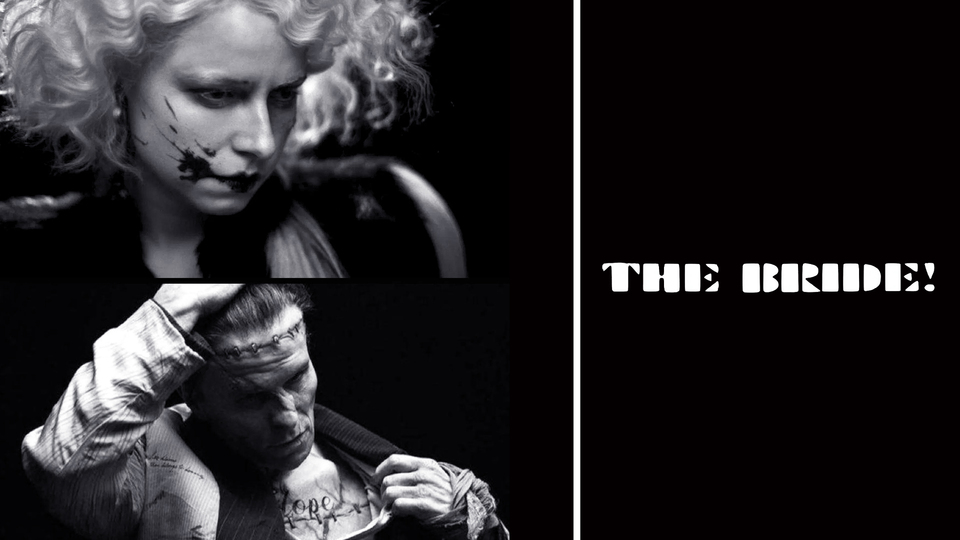
And it certainly doesn’t hurt that Jessie Buckley – who is likely just about to win the Best Actress statuette for her recent work in “Hamnet” – is assigned the task of pulling off the very difficult role of the Frankenstein monster’s reanimated bride. The role is a challenge because deceased author Mary Shelley (also Buckley) speaks to the Bride – whose real name is Ida – from the afterlife, controlling her thoughts, actions, and words. And, oh those words! This Bride is wont to speak in the literary parlance of some of our greatest authors, including Herman Melville. Her long, overwrought monologues are intriguing, if not perplexing. In this sense, “The Bride!” is reminiscent of Yorgos Lanthimos’ 2023 film “Poor Things,” in which Willem Dafoe’s mad scientist character reanimated the deceased Emma Stone, then “controlled” her by teaching her how to think and act around others.
And Frank (the monster’s name in this adaptation) is played by the chameleonic Christian Bale. Jacob Elordi has been nominated for Best Supporting Actor at next week’s Oscars, but if anything, Bale’s monster character is the more captivating of the two. Elordi makes us aware that the Frankenstein monster has real feelings. But his interpretation remains aloof and detached from the viewer. Bale’s monster is far more communicative and feels more like a real person. We instantly relate to this monster – so much so much so that we often forget he is a monster at all.
Frank visits a so-called “mad scientist” in 1936 Chicago to provide him with a reanimated female partner. The scientist (played by Annette Bening) digs up the recently buried Bride/Ida. Coincidence? Yes. But “The Bride!” wouldn’t succeed without a certain level of coincidence. Frank and Ida take an instant liking to one another. He to her literary charms – and remember, she is being “controlled” by Mary Shelley – and she to his somewhat grotesque and uninhibited masculinity.
Unlike del Toro’s “Frankenstein,” here our heroes break out of the mad scientist’s eerie laboratory to experience the “real world.” And this is where “The Bride!” most succeeds. Where del Toro’s monster could only be seen, touched, and experienced by those in the castle (Dr. Frankenstein and any visitors), these two protagonists actively seek out a society more accepting of them than one would think, given the 1936 setting. Taking them out of the laboratory open up a whole new world for them. And our imaginations are therefore sparked from the get-go.
Frank has a desire to see all the movies of his favorite actor and dancer Ronnie Reed, played by Jake Gyllenhaal, Maggie’s brother. He’s sort of a Fred Astaire type, and Frank longs to be able to dance just like Ronnie. But wherever Frank and Ida go to watch Ronnie’s movies, havoc seems to ensue. First, Frank doesn’t know his own strength (which is character trait of the monster in Shelley’s novel and all subsequent film versions), and Ida screams uncontrollably at the most inopportune times. Their crime spree takes them from Chicago to New York and back again – sort of a “Bonnie and Clyde” or “Natural Born Killers” rampage. And where they do find a sense of belonging is in an underground Chicago nightclub which seems more like a 1990s rave than anything from the 1930s. Here, I was unpleasantly reminded of Damien Chazelle’s 2022 film “Babylon.” Fortunately, the rave doesn’t take up much screen time.
Trailing the duo Jake and Myrna, a pair of police detectives, played by Peter Sarsgaard and Penelope Cruz. Their inclusion is somewhat unnecessary to the Frank and Ida story, but I found myself drawn to them because they are so “normal” they ground the otherwise outrageousness in a sense of real-world commonality. We’ve seen these characters in so many films over the years that they draw us into the narrative in a way their exclusion would not. In other words, we experience Frank and Ida through them. There’s also a feminist slant to their incorporation in the story because Myrna wants to advance to the level of full detective – not just an assistant. Jake knows she’s smart enough, but he’s apparently the only cop who doesn’t dismiss her due to her gender.
There’s also a side story about a big-time mob boss named Lupino that Ida used to work for prior to her death. Played by Croatian actor Zlatko Buric, he’s sort of a 1930s James Cagney type gangster, but with a touch of a more ruthless Martin Scorsese crook thrown in to make him more frightening.
So, what do we have here? A mashup of Mary Shelley’s 1818 novel, “Poor Things,” “Bonnie and Clyde,” “Babylon,” and Martin Scorsese. Boy, that’s a lot of genres to juggle! And this is where Gyllenhaal has faced criticism. Unlike her 2021 directorial debut, the tight and thought-provoking psychological drama “The Lost Daughter” (which also starred Jessie Buckley), “The Bride!” fails to find a groove within just one genre. On the other hand, the material here is so wild and eccentric, it almost invites a plethora of styles. In other words, Gyllenhaal gives us the freedom to experience her film without pigeonholing it into one specific approach. It’s a risk, but I find it refreshing. Unlike del Toro’s “Frankenstein,” I didn’t look at my watch once.
Will “The Bride!” be remembered next Oscar season? Most likely not. But if del Toro’s “Frankenstein” can receive a nomination for Best Picture, this one certainly deserves it too. I don’t want to call “The Bride!” a must-see, but if you’re in the mood for something off the wall, you couldn’t do much better.