

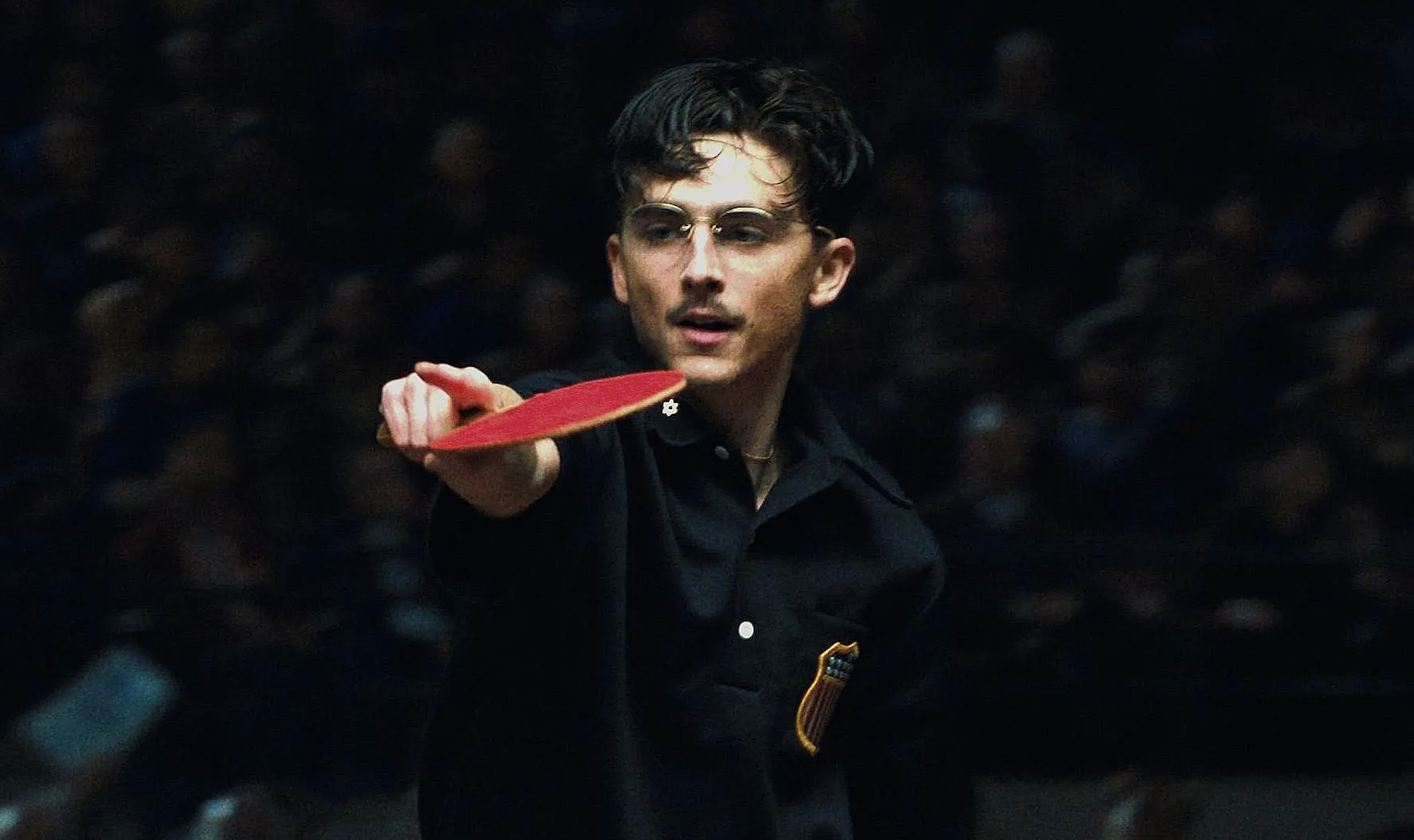
Marty Mauser is the kind of guy everybody hates. Cocky and brash, but also smart and determined, Marty is the type who will screw over his own grandmother just to get ahead in life – then he’ll come back and somehow make it up to her. He’s the one who will come over in the middle of the night and ask to crash at your apartment for a couple days. Although you emphatically refuse, he somehow talks his way into staying. And he’ll pay you later for your trouble.
In John Safdie’s new film “Marty Supreme,” Marty works as a shoe salesman in 1952 New York – a low-end job, to be sure, but he is obviously the best salesman in the store. Marty also happens to be a whiz at ping pong, then known as table tennis – a sport which is just about to catch on in the United States. Marty’s goal is to compete in the British Open, but he has to steal $700 to afford the trip abroad. Marty has a girlfriend Rachel, but she is married to a man who abuses her. As you might expect, that doesn’t deter Marty from pursuing her.
Marty is played by perhaps our greatest young actor, Timothee Chalamet, whose first “adult” role was as Bob Dylan in last year’s “A Complete Unknown.” Here, he treads far different water from the docile, introverted songwriter. In fact, if you didn’t know, you wouldn’t even know the two roles are played by the same person. That’s how good an actor Chalamet has become.
In London, Marty spots retired Hollywood actress Kay Stone, played by Gwyneth Paltrow. He seduces her – again, against her constant objections – which leads him to meet Kay’s husband Milton (Kevin O’Leary), a highly successful businessman. Now, why would Marty “need” to know either Kay or Milton? We don’t know. And at first, he’s not even sure himself. But he knows these connections could pay off in the future.
And they do. After the tournament, Milton offers Marty a huge sum of money to play a tournament in Tokyo in which he is to intentionally throw the match in favor of the Japanese player – which will boost the sport of table tennis in Japan. Marty refuses, as his competitive spirit simply won’t allow him to lose any match – even for enough money to pay off all his debts. Yet (and this is a big “yet”) after the British Open, Marty takes a job playing table tennis as the halftime show for Harlem Globetrotters games – a “sideshow” gig if there ever was one!
Upon his return from England, Marty is arrested for stealing the money to afford his trip. And that’s where Safdie’s original screenplay (co-written by Ronald Bronstein, who also wrote “Uncut Gems” with Safdie) really takes off. Marty breaks the arm of a mysterious rich man when his bathtub falls through the floor of a rat-infested motel (don’t ask), and he is tasked with caring for the man’s prized dog while the man is in the hospital. Marty and his girlfriend Rachel (who is very pregnant with Marty’s child) manage to lose the dog, then spend time and energy to retrieve it – all while trying to come up with $1500 to pay a fine imposed by the World Table Tennis Association for his behavior during the British Open. If he doesn’t pay the fine, he’s banned from the upcoming World Championship.
And so goes Marty’s existence – covering his rear end here, while creating another mess there. It’s aggravating to watch but completely alluring. We haven’t rooted for a guy this bad since Little Alex in “A Clockwork Orange.”
And when I say “Marty Supreme” really “takes off,” I liken the second half of this film to the second half of this year’s “One Battle After Another” or last year’s Oscar winner “Anora.” Once we realize the bulk of the narrative will take place over a short period of time – with a ton of plot crammed into that time – we simply sit back and enjoy the ride. This is one of those screenplays that must have taken a lot of time and energy to construct – yet it’s so wonderfully enjoyable for the audience that we simply enjoy it. We don’t have to “work too hard” to reap the benefits of this truly enrapturing story. Wherever it goes, we’re happy to be along for the ride.
Eventually, Marty and Rachel locate the man who has stolen the dog, Marty attends a theatrical performance of Kay’s big comeback play, he travels to the Tokyo “tournament” aboard Milton’s private jet, and Rachel enters labor at the local hospital. All this action occurs at lightning speed, in a long, but never boring, narrative. And the irony is that “Marty Supreme” doesn’t necessarily seemed overstuffed. This level of plot development would appear to be the norm in Marty’s life.
So, what are we to take from the Marty character? On the one hand, he’s so cocksure of his own ability that he wills himself into situations he has no business being a part of. On the other, his life always seems to thread a fine line between enormous success and abject poverty. If ever there were a fictional character with the inherent ability to talk his way ahead in life, it is Marty. Chalamet’s over-the-top performance is similar to that of Leonardo DiCaprio in “Wolf of Wall Street.” Smart? Yes. Power eight. Persistent? Even more so. Power ten! DiCaprio has never been better. Neither has Chalamet.
And thanks in large part to Chalamet’s Oscar-worthy achievement, “Marty Supreme” has emerged late in the year as one of the top contenders for the Oscars and other 2025 awards. Again, this one is similar in tone to Paul Thomas Anderson’s “One Battle After Another,” but if anything, “Marty Supreme” is the superior film. Although supremely entertaining, “One Battle” has that been-there done-that feel to it. Whereas “Marty Supreme” is completely and totally original. I can say the two films (and “Anora”) are similar, but you’ve never seen anything quite like “Marty Supreme.”
And I should take a moment to mention the music. Although the setting is 1952, the clothes and hairstyles seem like they could have come from any time period of the last 70 years. And the music is straight out of the 1980s – including Tears for Fears, as well as the Korgis’ buried treasure “Everybody’s Got to Learn Sometime.” Is that by design? Perhaps. The 1952 setting is only useful in planting the explosion of ping pong in its proper time period. But the rest of the screenplay – including Marty’s attitude and persistence – feels more modern. It’s as though Safdie and Bronstein don’t want to be confined by the rigidity of time and setting. The result is a more “universal” film. And one of this year’s very best.