

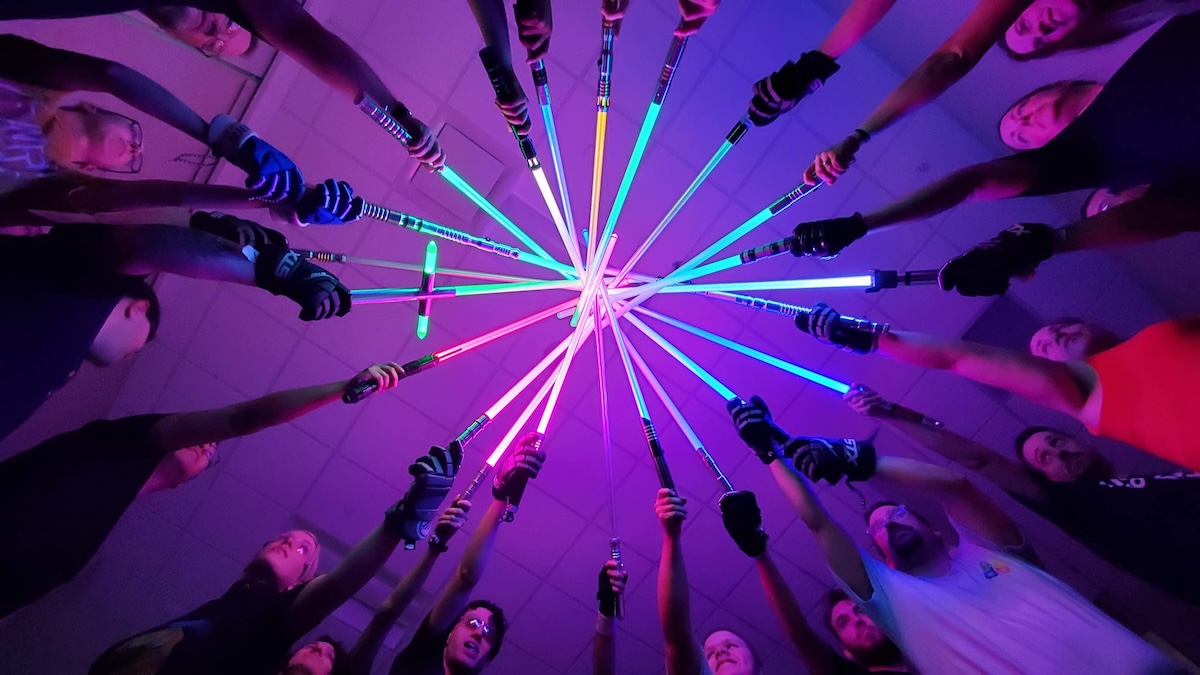
Saber Skills
More than a decade ago, Michael Tucker was working as a stage combat instructor and planning choreography for plays throughout the Midwest.
He’d always been interested in Historical European Martial Arts (HEMA), a practice dating back to the Late Middle Ages, Renaissance and early modern period that uses classic fighting methods ranging from gladiator combat to fencing.
So when his future wife found a job listing for a sword fighter or someone with combat experience, Tucker quickly reached out.
“I met with Doug Trefun and he brought a lightsaber with him. He said he’d promised the library in Fishers that he would present a family-friendly performance on May 4 and was up a creek with no experience in martial arts,” Tucker says.
Of course, Tucker was up for the challenge and a kid-friendly class was created.
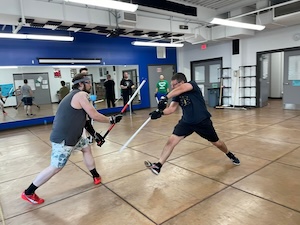
The presentation they put together had visitors fascinated and parents asking for more information. It was so successful that Tucker and Trefun came up with the idea of creating the Indy Lightsaber Academy.
“It was actually Doug’s idea and I thought it was crazy but went with it anyway. I spent the next several months developing different systems and lightsaber forms — the same ones we use today — and a few months later we opened our first school in a small space in Irvington,” Tucker says.
They shed the padded sabers used with the children in exchange for the real version.
Tucker designed his own lightsaber with polycarbonate tubing and reflective foil with a mirror at the top, attached to a multicolored flashlight. Participants treat it just like a sword or any other weapon used in martial arts.
Believe it or not, there are a set number of rules to lightsaber fighting, established even before Tucker came on board.
There are two types of fighting: one that requires a helmet and one that does not. The objective is to strike your opponent in the torso — or head if playing with helmets — for points within the allotted time frame. The person with the most points wins.
At Indy Lightsaber Academy, there are seven levels built similarly to the martial arts belt structure. Everyone starts at Level 1 and works their way through each level.
During a class, participants do a warmup and then split off with instructors as they work on Levels 1, 2 or 3. Higher-level students work with Tucker or help teach other students.
They’ve also added a sparring class to continue those skills at a competitive level.
As the classes grew and interest deepened, the Indy Lightsaber Academy moved from venue to venue and town to town, most recently hosting classes at the Richard A. Carlucci Recreation and Aquatic Center in Plainfield.
Instead of opening a brick-and-mortar location, it’s always been important to him to keep costs low and affordable. So far, he’s worked with parks departments and gymnasiums available to rent for classes.
The lightsaber fighting sport has boomed. After all, who doesn’t want to channel Luke Skywalker and learn the moves so many have watched on the big screen for decades?
Over the years, as the Star Wars films were released and popularity grew, others began asking to partner with Tucker — Trefun had moved on to other endeavors — or have help getting their own group started both in the U.S. and internationally.
Competitions and opportunities grew along with the interest.
“As new groups were formed, we were traveling to 10 regional and national tournaments a year and saw hundreds of students all over the Indy area. We even traveled to Paris once per year for a competition and began hosting our own international competition at the Irsay Family YMCA,” Tucker says.
He says the popularity of the sport has risen and fallen — and risen again — in the U.S., mainly with changes and iterations in the martial arts world.
For example, some began using body armor or protection, while Tucker and most international organizations use little to limited body protection.
“Internationally, they focus on no armor so their popularity continues to grow. I think at one point, myself and one other organization in the U.S. were the only two doing no armor. It’s just a cultural difference and personally, I align with the international rules,” Tucker says.
For some, it’s a dream turned reality. For others, it’s a great way to meet friends and get a fun workout in. Regardless of the reason, Tucker says there are many positives to getting involved.
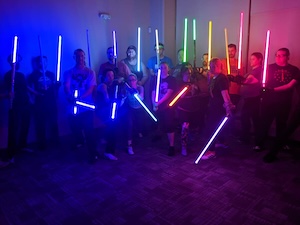
Lightsaber fighting is open to anyone 15 years and older, but Tucker says the demographic typically ranges between mid-20s and mid-50s.
“We’ve always targeted nontraditional gym members. Martial arts are a very empowering feeling and I think it helps people feel in control of their body and themselves. There’s a fitness and wellness component to the class because I care about their longevity and I want everyone to have fun,” Tucker says.
There’s a social aspect too.
“We have dinner together. We’ve traveled the world together. I’ve seen couples who met through the academy who are now married. Over the years, we’ve created lifelong friendships,” Tucker says.
Looking forward, the Indy Lightsaber Academy is undergoing some transitions at the moment. They’re in the market for a new location in Indianapolis and surrounding areas.
They are also in the process of rebuilding the website and soon Tucker will pass the baton to current instructors, all previous students at Indy Lightsaber Academy.
“It’s really cool to see the second generation of the academy become up-and-coming leaders,” Tucker says. “I’ve trained them and they’re ready to take on the next generation.”
For more information, visit Indy Lightsaber Academy on Facebook or email indylightsaberacademy@gmail.com.