

When you twist an ankle, tweak a shoulder, or take an ill-timed tumble down the stairs, the last thing you want is to sit in an emergency waiting room surrounded by people who are coughing, sneezing, and clutching their stomachs. You want fast, specialized help without the financial sting of an emergency department bill. Riverview Health heard that call loud and clear, which is why they opened three new orthopedic walk-in clinics designed to deliver immediate, expert care for sudden injuries while offering a convenient option for patients seeking more specialized care.
The clinics, which just opened on September 28, operate Monday through Friday from 8 a.m. to 4 p.m. across three strategically chosen locations—Westfield, Noblesville, and Carmel—effectively covering the corners of Hamilton County.
“We’re trying to improve access with more affordable options rather than urgent care and ER expenses,” says Stacie Vance, Orthopedics Service Line Executive.
The placement of the clinics wasn’t random. It was intentional, data-driven, and rooted in community need. One clinic sits near Riverview Hospital on Westfield Road, another at Hazel Dell and 146th Street in Carmel, and the third off State Road 32 and Spring Mill Road in Westfield. Together, they form a triangle of orthopedic access.
“The goal is simple,” Vance says. “We want to make it easier for people to get specialized orthopedic care right when they need it, without navigating referrals or waiting for an appointment.”
Walk-in clinics are great because they allow you to “skip the line” so-to-speak, giving you direct access to specialty orthopedic care without first having to visit an ER or Urgent Care.
Riverview Health Orthopedic surgeon, Dr. Stephen Jacobsen, MD, says the clinics are designed for people experiencing acute injuries—sprains, strains, fractures, sudden shoulder pain, or chronic issues that have suddenly worsened. These are the kinds of problems that don’t require an ER but absolutely require expertise.
“The ER is good for treating people with heart attacks and strokes,” Jacobsen says. “But if you go to an emergency room with a sprained ankle, you may wait longer since other, more acute patients will always take priority.”
At the walk-in clinics, patients skip the waiting room roulette. Plus, they’re seen by orthopedic specialists who have diagnostic equipment at their fingertips. That means X-rays, durable medical equipment, ultrasound, bracing, casting, and even injections are available on-site.
“You don’t need an appointment,” Jacobsen adds. “You will see an orthopedic specialist without having to wait for hours and hours on end in an ER.”
And there’s another perk: you’re not sitting shoulder-to-shoulder with people who could be battling any number of contagious ailments.
“When it’s wintertime and everyone has got the flu, you won’t necessarily have to sit in the same room as fifteen people who are sick,” Jacobsen says.
Injury doesn’t just hurt physically—it rattles your sense of control. Jacobsen says that’s where orthopedic expertise makes the biggest difference.
“When you see someone who has suffered an injury and they are able to get to somebody who knows everything there is to know about this injury and how to treat it, that eases their mind,” he says. “They will walk in in disarray and walk out hopefully feeling a lot better.”
Vance agrees. “We can reassure patients, we can decrease their anxiety, and then they can leave with answers and a plan.”
The clinics are prepared to treat a wide range of injuries and conditions, including sprains and strains; sudden onset pain; fractures of fingers, toes, and ankles; sports injuries; falls, trips, and stumbles; and chronic orthopedic issues that suddenly worsen.
“Maybe you slept on your shoulder wrong and now you can’t move it,” Jacobsen says. “We can manage those types of complaints, too.”
The cherry on top is that these clinics are housed within existing orthopedic offices, which means patients can be matched with the right specialist immediately.
“For instance, if you’ve fallen and caught yourself with your hands, we’ll make sure you get with our hand team,” Vance says.
The staffing model includes surgeons, non-operative sports physicians, physician assistants, and nurse practitioners—essentially, the full orthopedic spectrum.
“We basically cover the entire gamut,” Jacobsen says.
“Our goal is to minimize wait times,” Vance says. “I anticipate dramatically lower wait times compared to urgent care and ERs.”
And sometimes, the speed of care is nothing short of life-changing.
Vance recalls a recent walk-in patient who arrived with a visibly fractured arm.
“They were in the OR within two hours of showing up at one of our offices where they didn’t even have an appointment,” she says. “The need is there. The access is there. And we have the ability to directly take care of each patient during that visit and beyond.”
That continuity of care is one of the biggest advantages of the walk-in model because what happens after the visit is important. Patients are immediately plugged into Riverview’s orthopedic system, giving them access to specialists, rehab, and even broader medical support if needed.
“They are now a patient in our system,” Jacobsen says. “We have all of the advantages of all our different providers, skillsets, and specialties.”
If a walk-in patient reveals underlying issues—diabetes, pulmonary concerns, or other conditions—Riverview can connect them with the right providers.
“You have a whole team behind you,” Vance says. “We can align them with appropriate providers that might be important to their recovery.”
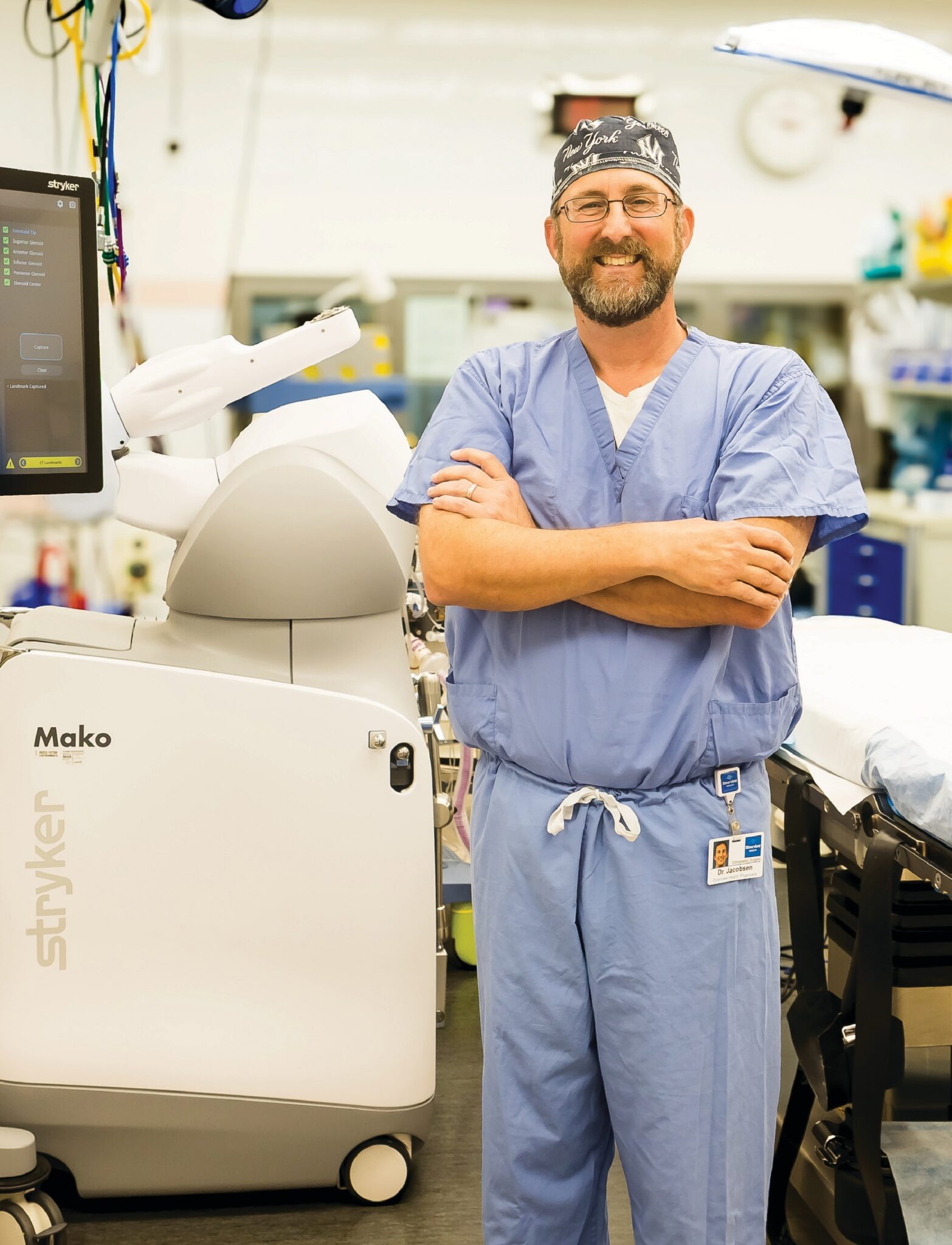
Beyond walk-in convenience, Riverview Health is also investing in cutting-edge surgical technology. The hospital now has the Mako robot from Stryker—the first in the nine-county central Indiana area on the market with the shoulder platform. In addition, Riverview hospital will also have the platform for hip and knee replacement.
The Mako system uses CT-based 3D modeling to guide bone preparation with millimeter-level accuracy. It also includes “hard stops” that prevent surgeons from cutting beyond the planned area.
“‘Plan more, cut less,’ is the motto,” Jacobsen says. “This can preserve the bone, which is critical to being able to fit the implants properly.”
The result means faster recovery, less damage to surrounding tissue, and longer-lasting implants.
“The robot brings variability down to one percent,” Jacobsen explains. “Improving the longevity of replaced joints.”
With three new walk-in clinics and same-day appointment availability, Riverview Health is redefining what orthopedic care looks like—faster access, lower costs, specialized expertise, and seamless continuity. It’s a model built for real life: the sprained ankles, the weekend sports injuries, the sudden shoulder pain that makes you wince every time you reach for the coffee pot.
Most importantly, it’s built for people who want to feel better—quickly, safely, and confidently.
For more information, visit riverview.org/walk-in or call 317-770-3777.